
Write in Third Person opens a world of storytelling possibilities. This comprehensive guide delves into the nuances of third-person narrative, exploring its various forms and applications across different genres. From understanding the grammatical nuances to crafting compelling plots, we’ll cover everything you need to master this powerful storytelling technique.
We’ll analyze the differences between limited and omniscient third-person perspectives, examining how each impacts character development and narrative voice. Discover how descriptive language, skillful dialogue, and effective plot structures elevate third-person narratives to new heights. Whether you’re a seasoned writer or just starting out, this guide will equip you with the tools to write captivating stories using third-person narration.
Defining Third-Person Narrative

Third-person narration is a powerful storytelling technique where the narrator recounts the events and characters’ actions and thoughts from a perspective outside the story. This detached viewpoint allows for a broader scope of coverage, providing insight into multiple characters and situations. It’s a common choice in various genres, from gripping fiction to insightful non-fiction, allowing authors to manipulate the reader’s perception of the story’s events.This method of storytelling offers a unique window into the narrative, enabling a deeper understanding of the characters and the world they inhabit.
The narrative voice is distinct from the characters themselves, fostering a sense of objectivity and allowing for a wider range of perspectives to be explored.
Third-Person Point of View: A Comprehensive Overview
Third-person narratives offer a flexible approach to storytelling, allowing authors to present the story from a detached, yet nuanced perspective. This objectivity enables a deeper exploration of characters and events, often revealing hidden motivations and complexities.
Types of Third-Person Narration
Different types of third-person narration allow authors to control the level of insight into characters’ minds and motivations. Understanding these variations is crucial for analyzing and appreciating the nuances of storytelling.
- Third-Person Omniscient: This perspective grants the narrator complete knowledge of all characters’ thoughts, feelings, and motivations. The narrator can delve into the inner workings of multiple characters, revealing their deepest secrets and intentions. This allows for a comprehensive understanding of the characters’ motivations and the intricate web of relationships within the narrative.
- Third-Person Limited: In this approach, the narrator focuses on the thoughts and feelings of a single character. The reader gains insights into the specific character’s perspective, creating an intimate connection and a more personal understanding of the narrative’s events.
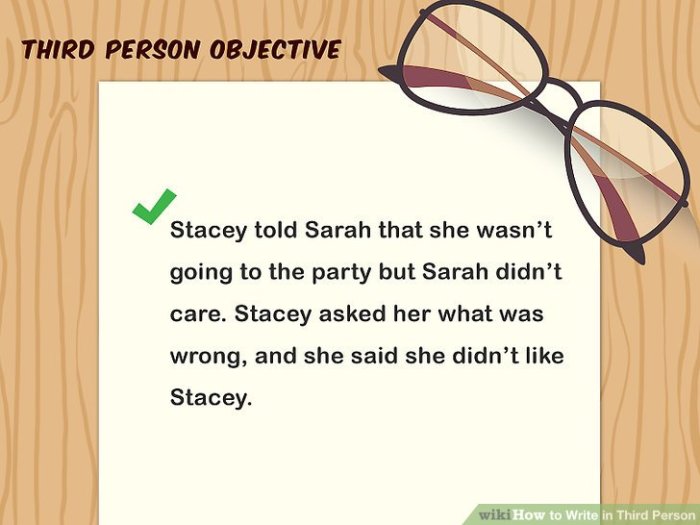
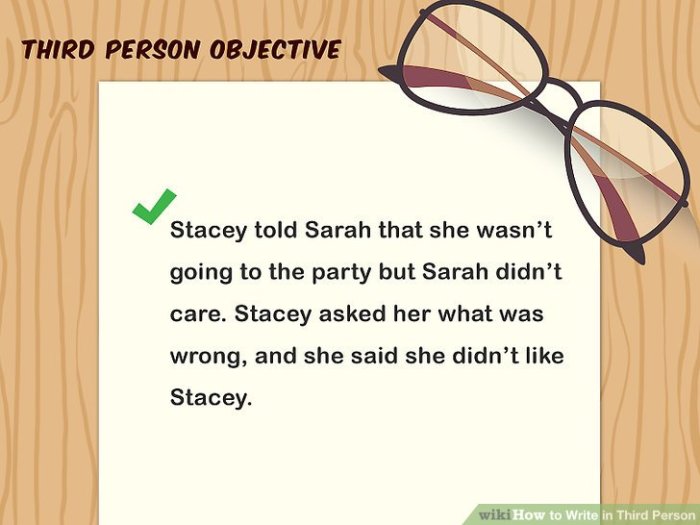
- Third-Person Objective: This style presents the story as if the narrator were an observer. No insight into any character’s thoughts or feelings is offered. The reader only experiences the events as they unfold, creating a detached and impartial narrative.
Grammatical Characteristics of Third-Person Writing
The grammatical structure of third-person narration is characterized by the use of third-person pronouns (he, she, it, they) and third-person verb conjugations. These grammatical choices contribute significantly to the narrative’s tone and style.
- Pronoun Usage: Consistent use of pronouns like “he,” “she,” “it,” and “they” distinguishes third-person narration from other perspectives.
- Verb Conjugation: The verbs used in third-person narration reflect the actions of the characters and their motivations, and are conjugated in the appropriate tense to convey the timeline of the narrative.
- Adjective Usage: The choice and use of adjectives in third-person writing plays a crucial role in describing the characters, setting, and atmosphere of the story.
Examples of Third-Person Narration in Different Genres
Third-person narration is widely used in various genres, each employing it to suit its specific narrative needs.
- Fiction: In novels, such as Jane Austen’s “Pride and Prejudice,” the third-person limited perspective allows the reader to understand the protagonist Elizabeth Bennet’s internal struggles and motivations, while the omniscient perspective in works like “The Great Gatsby” provides insights into the motivations and relationships of all the characters.
- Non-fiction: Biographies and historical accounts, such as “The Diary of a Young Girl” by Anne Frank, frequently use the third-person limited perspective to relay the protagonist’s experiences and thoughts. Journalistic pieces might use the third-person objective style, focusing on the events without revealing the thoughts of the involved individuals.
Comparing First, Second, and Third-Person Narratives
Understanding the differences between first, second, and third-person narratives is crucial for appreciating the diverse ways stories can be told.
| Narrative Perspective | Point of View | Focus | Example |
|---|---|---|---|
| First Person | From the narrator’s own perspective | The narrator’s experiences and thoughts | “I woke up feeling strangely anxious.” |
| Second Person | Directly addressing the reader | The reader’s actions and choices | “You open the door and step into the hallway.” |
| Third Person | From a detached, outside perspective | Characters’ actions, thoughts, and motivations | “He looked at her, a flicker of doubt in his eyes.” |
Crafting Third-Person Narratives
Crafting compelling third-person narratives requires more than just recounting events. It’s about weaving a tapestry of voice, tone, and descriptive language that draws the reader into the story. This involves understanding how to create a distinct narrator, utilize evocative language, and expertly employ the “show, don’t tell” technique to bring characters and settings to life. A well-crafted third-person narrative can transport readers to another world and leave a lasting impression.Beyond simply relating facts, the narrative voice acts as a crucial filter, shaping the reader’s understanding and emotional response to the story.
A strong third-person voice establishes the author’s style and creates a consistent, believable perspective from which the story unfolds.
Voice and Tone
The voice and tone of a third-person narrative significantly impact the reader’s experience. A detached, objective voice might be appropriate for factual accounts, while a more subjective tone could convey emotions and perspectives. This choice directly influences the narrative’s overall impact. The author must carefully consider how the voice and tone contribute to the story’s theme and purpose.
Creating a Unique Third-Person Voice
Crafting a unique voice in third-person narration involves more than just using descriptive language. It necessitates understanding the character’s motivations, background, and relationship to the events unfolding. A consistent voice is key. This includes:
- Employing specific vocabulary: Choosing words that align with the character’s social standing, profession, or personal experiences helps establish a unique voice. For instance, a scientist might use technical jargon, while a farmer might employ more colloquial language.
- Varying sentence structure: Using a mix of short, punchy sentences and longer, more descriptive ones keeps the narrative dynamic and engaging. A character experiencing intense fear might use short, staccato sentences, whereas a character reflecting on a past event might employ more complex sentence structures.
- Developing distinct perspectives: The narrator’s viewpoint shapes the narrative’s angle. A narrative focused on a single character’s perspective will differ significantly from one that considers multiple perspectives. This allows for nuanced portrayals of complex situations and characters.
Descriptive Language
Descriptive language is essential in third-person narratives. It brings the characters, setting, and events to life, making the story more vivid and engaging for the reader. Vivid descriptions create a sense of presence and immersion. Sensory details, particularly sight, sound, smell, touch, and taste, help paint a clear picture in the reader’s mind.
Show, Don’t Tell, Write in Third Person
The “show, don’t tell” principle is crucial in third-person narration. Instead of explicitly stating a character’s emotions or thoughts, the author should reveal them through actions, dialogue, and descriptions. This technique fosters a more immersive and engaging reading experience. For example, instead of stating “He was angry,” the author might describe his clenched fists, furrowed brow, and sharp tone of voice.
Narrative Perspectives in Third-Person
Different narrative perspectives offer varying levels of insight into the story. The choice of perspective influences the reader’s understanding of the events and characters.
| Perspective | Description | Example |
|---|---|---|
| Omniscient | The narrator knows the thoughts and feelings of all characters. | “She felt a surge of fear, while he remained calm, aware of the trap he had set.” |
| Limited Omniscient | The narrator knows the thoughts and feelings of only one or a few characters. | “She felt a surge of fear, her heart pounding in her chest. He remained calm, his mind racing to anticipate her next move.” |
| Objective | The narrator only describes actions and events without revealing inner thoughts or feelings. | “She stumbled backward, her eyes wide. He stood motionless, his gaze unwavering.” |
Structuring Third-Person Narratives
Crafting compelling narratives in third-person requires a strong understanding of organization and plot structure. A well-structured narrative guides the reader through the story, creating anticipation and engaging them with the characters and their journeys. This section dives into the intricacies of structuring third-person narratives, exploring methods for developing compelling plots and utilizing dialogue effectively.A well-organized third-person narrative provides a clear path for the reader, moving them through the story’s events in a logical and engaging manner.
This structure should not only present the plot but also reveal character development and thematic elements. Effective plot structuring is crucial for creating a satisfying and memorable reading experience.
Organizing a Story with Third-Person Perspective
Understanding how to organize a story in third-person is essential for creating a compelling narrative. A clear structure ensures that events unfold logically, and characters’ motivations become evident. The narrative should progress through a sequence of events, leading to a climax and resolution.
Writing in third person can be tricky, especially when you’re trying to maintain a neutral tone. Take a look at Sacha Baron Cohen’s hilarious antics, where he gets politicians to cite pop culture references like Cardi B and Blink 182 as justifications for arming kids here. It’s a prime example of how a skilled writer can use the third-person perspective to create a compelling narrative, even when the subject matter is absurd.
It really highlights the power of using this perspective to dissect and expose societal issues, making for an engaging read. Ultimately, mastering the art of third-person writing takes practice, but it’s a valuable tool in any writer’s arsenal.
- Establishing the Setting and Initial Situation: The narrative begins by introducing the characters and their initial circumstances, the setting, and the central conflict. This foundational element provides context for the reader, setting the stage for the unfolding events.
- Developing the Rising Action: The narrative builds upon the initial conflict, introducing obstacles and challenges that the characters must overcome. This stage involves complications and escalating tension, increasing the stakes for the characters and the reader.
- Reaching the Climax: The climax represents the turning point of the story, where the central conflict reaches its peak intensity. This moment is crucial for determining the characters’ fate and the direction of the plot.
- Resolving the Conflict: The resolution follows the climax, providing closure to the story. It reveals the outcome of the conflict and the characters’ adjustments, offering a sense of finality and satisfying conclusion.
Creating Compelling Plot Structures
Different plot structures can affect the narrative’s impact. Understanding various structures allows writers to select the most appropriate approach for their story.
- Linear Plot Structure: This structure presents events chronologically, following a straightforward path from beginning to end. This method is effective for simple stories with a clear progression of events.
- Nonlinear Plot Structure: This approach disrupts the chronological order, using flashbacks or other techniques to reveal crucial information or enhance character development. This structure can add depth and intrigue to the narrative.
- Circular Plot Structure: This structure begins and ends in the same place, highlighting the cyclical nature of life and the characters’ journeys. This structure is often used to explore themes of growth, repetition, and transformation.
Using Dialogue to Advance the Narrative
Dialogue is a vital tool in third-person narratives, revealing character traits and advancing the plot.
- Dialogue Reveals Character: Dialogue reveals characters’ personalities, motivations, and relationships. The way a character speaks often reflects their inner thoughts and emotions.
- Dialogue Advances the Plot: Dialogue can propel the plot forward by revealing information, creating conflict, or driving characters’ actions. Dialogue acts as a catalyst for the unfolding events.
- Dialogue Establishes Setting and Atmosphere: Dialogue can also create a sense of place and mood. The language used in dialogue can paint a vivid picture of the environment and the prevailing atmosphere.
Sample Plot Structure in Third-Person Narration
Amelia, a young astrophysicist, discovers a peculiar signal emanating from a distant star. Intrigued, she embarks on a quest to decode the message. The signal leads her to a hidden observatory, where she uncovers a conspiracy involving powerful corporations and the manipulation of interstellar communication. In a tense climax, Amelia must confront the conspirators, using her knowledge of astrophysics to expose their plot.
The resolution reveals the true intentions behind the signal, and Amelia’s discovery sparks a global debate about the ethics of interstellar communication.
Comparing Plot Structures
| Plot Structure | Impact on Third-Person Narratives |
|---|---|
| Linear | Creates a clear, straightforward narrative; easy to follow; effective for simpler stories |
| Nonlinear | Adds depth and complexity; enhances character development; can create suspense and intrigue |
| Circular | Highlights cyclical themes; explores character growth and transformation; often emphasizes the importance of the past |
Employing Third-Person for Specific Effects
Unlocking the power of third-person narrative allows writers to delve into the intricate world of character motivations, build palpable suspense, and craft immersive atmospheres. By shifting perspective from the author’s voice to that of a detached narrator, writers can create a powerful connection with readers, while simultaneously wielding greater control over the narrative’s effect. This deeper exploration enables the crafting of vivid and compelling stories.Third-person narration offers a versatile toolset for conveying specific effects.
By manipulating the level of access the narrator has to characters’ thoughts and feelings, authors can precisely shape the reader’s understanding and emotional response to the narrative. This nuanced control allows for the subtle yet profound revelation of character motivations, the careful build-up of suspense, and the evocative creation of atmosphere and mood.
Revealing Character Motivations
Third-person narration, particularly when used with careful precision, allows writers to unveil the complex inner workings of characters without explicitly stating their motivations. By focusing on a character’s actions, choices, and reactions, the reader can infer their desires and anxieties, thereby building a richer understanding of their personality. The narrator can subtly hint at underlying conflicts and desires through carefully selected details, thereby leading the reader to draw their own conclusions.
For example, a character’s consistent avoidance of a particular place might suggest a painful memory associated with it.
Building Suspense and Tension
The third-person perspective allows for a masterful manipulation of information. By withholding crucial details or presenting them in a fragmented or ambiguous manner, authors can effectively build suspense and tension. The narrator can carefully control the pace of the narrative, revealing only necessary pieces of information at opportune moments, thereby escalating the anticipation and anxiety felt by the reader.
This meticulous control of pacing and detail creates a heightened sense of unease and curiosity.
Creating Atmosphere and Mood
Third-person narration is a powerful tool for shaping the emotional landscape of a story. By focusing on sensory details, descriptive language, and the emotional responses of characters, the narrator can evoke a specific atmosphere or mood. For example, a description of a character’s trembling hands, coupled with a dark, stormy sky, could create a sense of foreboding and anxiety.
The careful selection of imagery, tone, and setting can profoundly affect the reader’s emotional connection to the narrative.
Examples of Specific Effects in Literature
Many literary masters have effectively employed third-person narration to create powerful effects. In Charles Dickens’ “A Tale of Two Cities,” the detailed descriptions of the social and political climate of 18th-century France effectively set the scene and build a palpable sense of impending revolution. The narrator’s focus on the characters’ reactions and anxieties further amplifies the tension and suspense.
Third-Person Limited vs. Omniscient in Character Development
| Aspect | Third-Person Limited | Third-Person Omniscient |
|---|---|---|
| Character Understanding | Limited to the perspective of a single character. Reader gains insights based on the character’s experiences and perceptions. | Offers insight into multiple characters’ thoughts and feelings, allowing a more comprehensive view of motivations and conflicts. |
| Depth of Characterization | Focuses on a single character’s internal experience. May be more intimate but less comprehensive. | Provides a broader understanding of characters’ complexities, potentially showcasing contradictions and hidden motivations. |
| Narrative Scope | Narrower focus on one character’s journey. | Wider scope, enabling a deeper understanding of the overall story’s context. |
| Example | A story told from the viewpoint of a detective, revealing their thoughts and feelings as they solve a mystery. | A story showcasing the inner turmoil of multiple characters involved in a political conspiracy, revealing their conflicting desires and motivations. |
Third-Person in Different Genres: Write In Third Person
Third-person narration, a powerful storytelling tool, adapts to various genres, subtly altering its approach to match the specific atmosphere and message. Understanding these adaptations allows writers to effectively convey themes and engage readers within each genre’s unique conventions. This exploration delves into how third-person narration molds itself to fit diverse narratives, from the suspense of mystery to the passion of romance and the wonder of science fiction.The application of third-person narration is not uniform across genres.
While the fundamental structure remains the same—telling the story from an external perspective—the style, focus, and tone adapt to the genre’s specific demands. This flexibility allows writers to immerse readers in the unique atmosphere of each genre.
Writing in the third person can be tricky, especially when you need to be factual and objective. For example, if you’re reporting a dangerous dog, you need to clearly state the facts without judgment. This is where a detailed report comes into play, like reporting a dangerous dog to the authorities; you should accurately describe the incident, using the third person to maintain neutrality and professionalism.
Report a Dangerous Dog is a crucial step in ensuring safety. Mastering this perspective will help you convey information effectively in any situation that calls for a neutral account.
Mystery
Third-person narration in mystery often adopts a detached, investigative style. The narrator acts as an impartial observer, meticulously piecing together clues and following the protagonist’s path. This allows for suspenseful reveals and keeps the reader guessing until the climax. The focus is typically on the details of the crime, the investigation, and the characters’ motivations. A key element is withholding information to maintain tension and create anticipation.
Examples include the classic works of Agatha Christie, where the narrator presents a puzzle for the reader to solve alongside the protagonist.
Romance
In romance, third-person narration often emphasizes the emotional connection between characters. The narrator can use vivid descriptions of feelings, internal thoughts, and the atmosphere to highlight the blossoming love story. The focus is on the characters’ emotional journeys and their evolving relationship. The narration can be subjective, reflecting the perspective of one or both characters, but it also needs to provide objectivity in order to not disrupt the reader’s emotional investment.
For instance, in works like “Pride and Prejudice,” Jane Austen masterfully weaves a narrative that explores the complexities of love through the lens of a detached third-person narrator.
Science Fiction
Science fiction narratives often utilize third-person narration to explore themes of technology, societal change, and the human condition. The narrator may present a detached, objective account of the scientific advancements or the impact of futuristic societies. Alternatively, the narration can delve into the characters’ inner thoughts and motivations, particularly if they are grappling with the implications of the extraordinary circumstances.
Examples include works like “The Martian,” where the narration follows the protagonist’s struggles with scientific challenges, but also offers a detailed perspective of the Martian environment and the human response to it.
Strengths and Weaknesses of Third-Person in Various Genres
| Genre | Strengths | Weaknesses |
|---|---|---|
| Mystery | Maintaining suspense, facilitating investigation, allowing reader participation | Potentially losing emotional depth, relying heavily on plot, possible lack of character development |
| Romance | Highlighting emotional connection, creating intimacy, showcasing character growth | Risk of being overly sentimental, potentially overlooking other plot elements, challenge in balancing objectivity and subjectivity |
| Science Fiction | Exploring futuristic settings and ideas, conveying complex scientific concepts, showcasing societal impact | Difficulty in creating believable futures, potential for technical inaccuracies, challenge in maintaining reader interest |
Third-Person and Visual Storytelling
Third-person narrative, a powerful tool in writing, offers a distinct perspective on characters and events. This perspective, when translated into visual media, becomes crucial for engaging audiences and conveying complex narratives effectively. Understanding how to translate the nuances of third-person narration into visual language is essential for creating compelling films, comics, and other visual stories.Visual storytelling is a dynamic process that relies on a multitude of elements to bring a narrative to life.
Third-person narration, when translated, must maintain its core characteristics, while also embracing the unique opportunities offered by visual mediums.
Visualizing Third-Person Narrative
Third-person narration in written form provides a lens through which readers experience the story. This lens is adapted in visual media by leveraging a variety of techniques. Camera angles, character design, and setting details all contribute to bringing the narrative to life. The use of visual cues is essential to conveying information and emotion, mirroring the subtle and overt cues a reader would infer from a well-crafted third-person narrative.
Visual Elements Supporting Third-Person Narrative
The effectiveness of a third-person narrative in visual media relies heavily on how visual elements reflect the narrative’s perspective. Visuals must reinforce the narrative, allowing the audience to understand the character’s internal states and external actions.
- Setting Design: Environment is paramount. A cluttered, dimly lit room can convey a character’s anxiety, while an expansive, sun-drenched meadow could suggest happiness. Carefully designed settings visually embody the narrative’s atmosphere. A detailed depiction of a character’s cluttered desk, filled with half-finished projects and crumpled papers, can powerfully convey a character’s internal struggles in a visual way.
- Character Design: Physical characteristics and clothing choices are crucial. A character’s posture, facial expressions, and body language all communicate their emotions and internal states. A character dressed in worn, faded clothing, with a hunched posture, can immediately suggest hardship and resilience. A sharply tailored suit, with a confident posture, can suggest ambition and power.
- Camera Angles: A high-angle shot can depict vulnerability, while a low-angle shot can emphasize power. The camera angle can be used to establish the narrative’s point of view and create specific emotional reactions in the audience. A low-angle shot of a character confronting a menacing figure can visually emphasize the character’s courage.
- Lighting: Light and shadow can be powerful tools for evoking emotion and mood. Harsh shadows can suggest danger, while soft, warm light can evoke feelings of comfort and safety. A character bathed in a harsh, flickering light might be associated with fear and uncertainty. A soft, golden light can suggest a character’s inner peace and serenity.
Writing in the third person can feel a bit stiff sometimes, but it can also be surprisingly effective, especially when you’re trying to create a detached narrative. For example, check out this news about Jack White being named to the Nashville Council on Gender Equity jack white named to nashville council on gender equity. It’s a great illustration of how the third person perspective can bring objectivity and clarity to a story, even when covering a significant news event.
Hopefully, this example helps solidify your understanding of the third-person point of view.
Adapting Third-Person for Visual Media
The successful translation of third-person narrative into visual media requires careful consideration of the medium’s limitations and strengths. Visual storytelling is more direct; it conveys information through images and actions, while written narratives rely on words to describe the same.
- Film: Film relies on the use of camera angles, cinematography, and editing to convey information, while dialog, character actions, and close-ups are crucial for visual storytelling. A close-up on a character’s face, displaying a mixture of fear and determination, can convey more than pages of descriptive text.
- Comics: Panel layouts and visual effects, like expressions and body language, are key elements in comics. A large panel with a character looking down and a smaller panel depicting a character running away can convey a character’s sense of loss and urgency in a concise visual narrative.
Examples of Third-Person Adaptation
Numerous films and comics effectively adapt third-person narratives. The “Lord of the Rings” film series and “The Walking Dead” comic book series are excellent examples. The visual adaptation captures the narrative’s nuances and creates a unique visual experience for the audience.
Visual Elements for Third-Person Narrative
This table Artikels visual elements commonly used to enhance third-person narratives in visual mediums.
| Visual Element | Description | Example |
|---|---|---|
| Setting Design | Environment reflects character’s internal state. | A cluttered study for a stressed character. |
| Character Design | Physical traits and clothing convey emotions. | Torn clothes for a character facing hardship. |
| Camera Angles | Convey emotional and power dynamics. | High-angle shot to depict a character’s vulnerability. |
| Lighting | Creates mood and evokes emotion. | Harsh light for a character facing danger. |
Avoiding Common Pitfalls in Third-Person Writing
Mastering third-person narrative involves more than just using “he,” “she,” or “they.” It demands precision in voice, consistent perspective, and a deep understanding of character development. This section delves into common pitfalls and offers strategies to overcome them, ensuring your third-person narratives are compelling and engaging.Effective third-person writing hinges on avoiding inconsistencies that can disrupt the reader’s immersion.
Understanding these common errors allows writers to craft narratives that maintain a consistent voice and a believable perspective.
Inconsistent Point of View
Maintaining a consistent point of view is crucial for reader engagement. Readers need to trust the narrator’s perspective. A shift in perspective can disorient the reader and damage the narrative’s credibility. For example, if a story begins by focusing on a character’s internal thoughts and feelings, then suddenly jumps to describing their physical actions without that same introspective depth, the reader will feel confused and the narrative will lack cohesion.
Implausible Character Actions
Characters should act in a way that aligns with their established traits and motivations. A sudden, unexplained change in behavior can make the character seem inconsistent or unrealistic. For instance, a character known for their calm demeanor should not suddenly become reckless without a clear explanation for the change. This lack of internal consistency weakens the narrative.
Passive Voice Overuse
While passive voice can be useful in specific situations, excessive use can weaken the narrative. It can make the writing seem vague or unfocused, removing agency from the characters. For example, instead of “The book was read by the boy,” use “The boy read the book.” This active voice demonstrates a stronger connection between the action and the actor.
Lack of Show, Not Tell
Third-person writing should emphasize sensory details and actions to immerse the reader in the narrative. Avoid stating information directly; instead, showcase it through descriptions and actions. For example, instead of “The character was sad,” use “Tears welled in the character’s eyes as they stared at the broken vase.” This sensory detail creates a stronger emotional connection.
Maintaining Consistency in Third-Person Narratives
To maintain consistency, writers should create a detailed character profile and stick to it throughout the narrative. Consider a character’s history, motivations, and values when writing. A consistent characterization enhances the believability of the story.
Table of Common Third-Person Errors and Solutions
| Error | Solution |
|---|---|
| Inconsistent Point of View | Maintain a single perspective throughout the narrative, whether internal thoughts or external actions. |
| Implausible Character Actions | Ensure character actions align with their established traits and motivations. |
| Passive Voice Overuse | Use active voice whenever possible to enhance clarity and agency. |
| Lack of Show, Not Tell | Focus on sensory details and actions to create a vivid narrative. |
Final Conclusion
In conclusion, mastering the art of third-person narration empowers writers to create rich and engaging narratives. We’ve explored the intricacies of different perspectives, the significance of voice and tone, and the strategic use of narrative techniques. By understanding the nuances of third-person storytelling, writers can craft compelling narratives across various genres, from fiction to non-fiction, and even translate their work into visual mediums.
Remember to practice and experiment with these techniques to discover your unique voice.