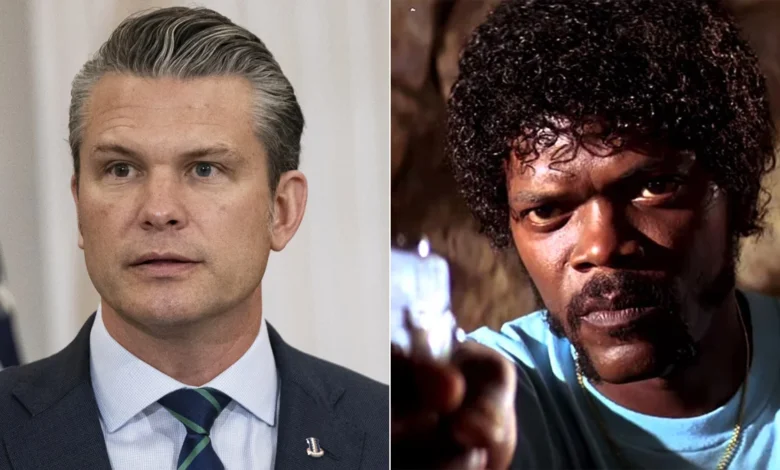
During a solemn worship service held at the Pentagon, Defense Secretary Pete Hegseth delivered a prayer that, to the surprise of many and the amusement of others, bore an uncanny resemblance not to scripture but to a memorable monologue from Quentin Tarantino’s iconic 1994 film, Pulp Fiction. The incident, which quickly garnered widespread attention across traditional and social media platforms, highlighted the often-unforeseen intersections of pop culture, religious observance, and high-level government proceedings. The prayer, shared by Hegseth as a tribute to a recent military operation, inadvertently included a near-verbatim excerpt from the famous speech delivered by Samuel L. Jackson’s character, Jules Winnfield, a speech itself a heavily re-written adaptation of a passage from the biblical book of Ezekiel.
The Incident Unfolds at the Pentagon
The event in question transpired on April 16, 2026, during a scheduled worship service within the hallowed halls of the Pentagon, a regular occurrence designed to offer spiritual reflection and solace to military personnel and civilian staff. Defense Secretary Pete Hegseth, a prominent figure with a background as a U.S. Army National Guard officer and a well-known media personality, was a featured speaker. His address was intended to honor the valor and dedication of military service members, particularly those involved in recent critical operations.
Prior to reciting the prayer, Hegseth provided context, explaining that the text had been shared with him by the lead planner of a Combat Search and Rescue (CSAR) operation. This mission had recently achieved a significant success, rescuing two Air Force crew members during an ongoing operation in Iran, a region of heightened geopolitical tension. Hegseth stated that the prayer was known as "CSAR 25:17," a designation he believed was intended to reference Ezekiel 25:17 from the Bible. His preamble suggested a sincere belief that he was invoking a traditional biblical passage, lending gravity to the service and paying homage to the rescue team’s actions through spiritual means.
The "CSAR 25:17" Prayer: A Closer Look
Hegseth then proceeded to recite the prayer, which resonated with a striking familiarity for many who heard it, albeit not from their religious texts. The prayer he delivered was:
“The path of the downed aviator is beset on all sides by the iniquities of the selfish and the tyranny of evil men. Blessed is he who, in the name of camaraderie and duty, shepherd the lost through the valley of darkness, for he is truly his brother’s keeper and the finder of lost children. And I will strike down upon thee with great vengeance and furious anger those who attempt to capture and destroy my brother. And you will know my call sign is Sandy One when I lay my vengeance upon thee, and amen.”
The immediate reaction among those aware of Pulp Fiction was one of bewilderment. While the sentiment of protection and vengeance might align with certain interpretations of divine justice, the specific phrasing and dramatic cadence were undeniably reminiscent of cinematic dialogue rather than canonical scripture. The alteration of "righteous man" to "downed aviator," "charity and goodwill" to "camaraderie and duty," and the personalized "call sign is Sandy One" replacing "my name is the Lord" were clever, yet ultimately revealing, adaptations.
The Pulp Fiction Monologue: A Cultural Touchstone
To fully appreciate the scope of the misattribution, it is crucial to revisit the source material from Pulp Fiction. The film’s enduring legacy is partly built on its sharp, unconventional dialogue, and few lines are more iconic than Jules Winnfield’s pre-execution speech. Samuel L. Jackson’s portrayal of the philosophical hitman elevated the monologue to legendary status, making it one of the most quoted film lines of the late 20th century. The full Pulp Fiction quote, as delivered by Jackson, is:
“The path of the righteous man is beset on all sides by the inequities of the selfish and the tyranny of evil men. Blessed is he who, in the name of charity and goodwill, shepherds the weak through the valley of darkness, for he is truly his brother’s keeper and the finder of lost children. And I will strike down upon thee with great vengeance and furious anger those who attempt to poison and destroy my brothers. And you will know my name is the Lord, when I lay my vengeance upon thee.”
The brilliance of Tarantino’s writing lies in its ability to take a kernel of an idea and imbue it with new life and context. In this instance, the "Ezekiel 25:17" recited by Jules Winnfield is a pastiche, not a direct quote. Tarantino himself has acknowledged that the bulk of the monologue was an original creation, loosely inspired by elements of the actual biblical verse and, more directly, by a passage from the 1973 Japanese martial arts movie Bodyguard Kiba, starring Sonny Chiba. This layered origin further complicates the notion of simple attribution, demonstrating how cultural references can evolve and intertwine over time. Pulp Fiction itself was a critical and commercial success, grossing over $213 million worldwide on an $8 million budget and earning numerous accolades, including the Palme d’Or at Cannes and an Academy Award for Best Original Screenplay, cementing its place as a cornerstone of modern cinema.
The Actual Ezekiel 25:17: A Divine Pronouncement
In stark contrast to its cinematic and adapted versions, the actual biblical text of Ezekiel 25:17 from the King James Version reads:
“And I will execute great vengeance upon them with furious rebukes; and they shall know that I am the Lord, when I shall lay my vengeance upon them.”
This original verse is notably shorter, more direct, and forms part of a larger prophecy delivered by the prophet Ezekiel against the Ammonites, a nation hostile to Israel. In its biblical context, it is a declaration of divine judgment and retribution, a powerful statement of God’s sovereignty and justice. It lacks the descriptive narrative and moralizing tone found in the Pulp Fiction adaptation, which adds elements of "the path of the righteous man," "shepherds the weak," and "brother’s keeper" – themes largely absent from the original short verse. The vast difference between the actual scripture and the prayer recited by Hegseth underscores the extent of the misattribution.
Chronology of Discovery and Public Reaction
The realization of the prayer’s true origin was swift. Immediately following the service, snippets of Hegseth’s speech began circulating online. Social media, particularly platforms like Twitter (now X), became the primary conduit for the rapid dissemination of the gaffe. A clip, juxtaposing Hegseth’s delivery with Samuel L. Jackson’s iconic scene from Pulp Fiction, quickly went viral, generating millions of views and sparking a torrent of comments, memes, and analyses. The timestamp on one prominent tweet, dated April 16, 2026, served as an immediate record of the incident’s public exposure.
The reactions were diverse. Many found humor in the situation, marveling at the audacity or the sheer unawareness of quoting a cult film in such a formal, sacred setting. Others were critical, suggesting it demonstrated a lack of diligence or respect for both religious texts and military decorum. Some defended Hegseth, attributing it to an honest mistake, a consequence of receiving information from others in a high-pressure environment. The fact that the original "CSAR 25:17" was likely crafted by a member of the rescue team, possibly with full knowledge of its Pulp Fiction roots, added another layer of intrigue. This suggests a potential disconnect: the prayer’s original authors may have intended it as an inside joke or a morale booster, but its transmission up the chain of command, devoid of context, led to its unwitting presentation as scripture.
Pete Hegseth: Background and Public Persona
Pete Hegseth’s public profile is multifaceted, combining military service with a prominent career in conservative media. A graduate of Princeton University, Hegseth served in the U.S. Army National Guard, including deployments to Afghanistan and Iraq, earning a Bronze Star and a Combat Infantryman Badge. This background often positions him as a credible voice on military affairs and national security.
Following his active service, Hegseth transitioned into media and political commentary, becoming a co-host of Fox & Friends Weekend and a regular contributor to Fox News. His public persona is often characterized by a staunch patriotism, a strong advocacy for conservative values, and a vocal commitment to his Christian faith. This devout public image made the Pulp Fiction misquote particularly jarring for many, as it seemed to contradict his carefully cultivated brand of traditionalism and spiritual sincerity. The incident, therefore, not only created a moment of levity but also sparked discussions about authenticity and the sources of inspiration public figures draw upon.
The Context of Pentagon Worship Services
Worship services at the Pentagon are not uncommon; they are part of a long-standing tradition within the U.S. military to provide spiritual support and promote morale among service members and staff. These services often feature guest speakers, including civilian leaders, who offer prayers, reflections, or motivational addresses. The aim is to foster a sense of community, reinforce ethical principles, and offer moments of quiet contemplation amidst the demanding environment of defense operations.
The solemnity of such an occasion is typically paramount. Participants expect reverence, thoughtful discourse, and, when scripture is cited, accuracy. The accidental recitation of a pop culture reference, no matter how well-intentioned its immediate source, can inadvertently undermine the gravitas of the event and raise questions about the vetting process for speeches and prayers delivered in official capacities.
Broader Implications and Cultural Commentary
The "Pulp Fiction Prayer" incident, while seemingly minor, carries several broader implications. Firstly, it underscores the pervasive nature of popular culture. Pulp Fiction is not merely a film; it is a cultural phenomenon whose dialogue has permeated the collective consciousness to such an extent that it can be mistaken for ancient scripture. This highlights the blurring lines between entertainment and more traditional forms of wisdom or authority.
Secondly, it serves as a cautionary tale about misattribution and the ease with which information, or misinformation, can propagate, especially in the digital age. In a world saturated with content, the origin of quotes and ideas can become distorted, leading to embarrassing gaffes in even the most formal settings. For public figures, the incident emphasizes the critical need for rigorous fact-checking, even for seemingly innocuous contributions from subordinates.
Thirdly, the episode touches upon the intersection of faith, military service, and secular culture. While faith plays a significant role in the lives of many service members, the manner in which it is expressed in official contexts is often subject to scrutiny. The prayer, in its adapted form, blended a desire to honor military heroism with a theatrical interpretation of divine vengeance, creating a unique, if unintended, commentary on the language used to articulate purpose and sacrifice in modern warfare.
Finally, the incident sparked a wider debate about the role of humor and seriousness in public life. While some saw the gaffe as harmless, others viewed it as disrespectful to both religious traditions and the solemnity of military service. The swift, global reaction, amplified by social media, demonstrates the public’s keen eye for incongruity and its readiness to engage with and dissect such moments. The "Praying Pete Hegseth Accidentally Quotes Pulp Fiction Instead of Bible" event will likely endure as a memorable example of how quickly and unexpectedly pop culture can infiltrate and redefine traditional narratives in the digital age.