Yellowstone National Park Officials Condemn Dangerous Wildlife Confrontation Following Viral Incident Involving Tourist Harassing Grizzly Bear

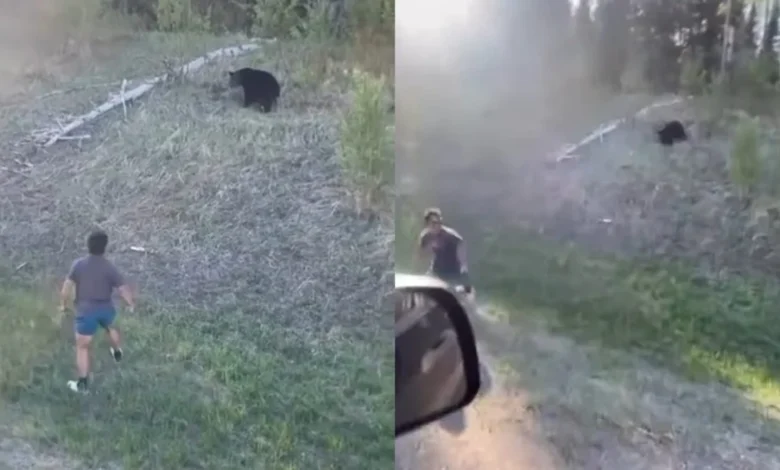
The National Park Service (NPS) is once again facing a surge in reckless visitor behavior following the emergence of a viral video depicting a tourist actively provoking a bear within the boundaries of Yellowstone National Park. The footage, which has circulated widely across various social media platforms, shows an adult male exiting his vehicle to confront a grizzly bear stationed along a park roadway. The individual is observed charging toward the apex predator, flexing his muscles, and emitting growling sounds in an apparent attempt to intimidate the animal. This incident represents a severe violation of federal regulations and highlights a growing trend of "wildlife harassment" that park officials warn could lead to fatal outcomes for both humans and animals.
Detailed Chronology of the Confrontation
The incident occurred during daylight hours along one of the primary transit corridors within Yellowstone National Park, a region known for high wildlife density and frequent "bear jams"—traffic congestion caused by visitors stopping to view animals near the road. According to the visual evidence, the grizzly bear was foraging peacefully on the shoulder of the road when a silver vehicle came to a stop.
Ignoring established safety protocols, one of the occupants exited the passenger side of the car. Rather than maintaining a safe distance or utilizing a telephoto lens for photography, the man moved aggressively toward the bear. Witnesses and video evidence confirm that the individual closed the distance to well within 20 yards, significantly violating the mandatory 100-yard buffer zone required for bears and wolves.
As the man approached, he adopted an aggressive physical stance, flexing his arms and shouting at the animal. The bear, initially appearing confused or indifferent, eventually reacted to the provocation. As the tourist turned his back to return to the vehicle—a movement wildlife experts identify as a primary trigger for a predatory chase instinct—the bear initiated a bluff charge. The animal lunged forward with explosive speed, stopping only when the man reached the safety of his vehicle door. While no physical contact was made, the proximity of the encounter placed the individual seconds away from a potentially lethal mauling.
The Regulatory Framework: NPS Safety Guidelines
The National Park Service maintains strict, non-negotiable distances for wildlife viewing to ensure public safety and the preservation of natural animal behaviors. These regulations are codified under federal law and are prominently displayed on park signage, literature, and digital maps provided to every visitor upon entry.
For "non-violent" or less aggressive species, such as bison, elk, bighorn sheep, and deer, the NPS mandates a minimum distance of 25 yards (23 meters). Despite their herbivorous nature, these animals are responsible for more injuries in Yellowstone than bears; bison, in particular, are known for their speed and unpredictability during the rutting season.
For apex predators, specifically bears and wolves, the mandatory distance increases to 100 yards (91 meters), equivalent to the length of a professional football field. This buffer is designed to prevent habituation—a process where animals lose their natural fear of humans—and to provide the animal with enough space to forage or travel without feeling threatened. When a human enters this "flight or fight" zone, the animal’s stress levels spike, often leading to defensive aggression.
Legal Implications and Federal Penalties
Harassing wildlife in a national park is not merely a violation of park policy; it is a federal misdemeanor. The National Park Service Investigative Services Branch (ISB) frequently utilizes social media footage to identify and prosecute individuals who flout these laws.
Under 36 CFR § 2.2(a)(2), the "feeding, touching, teasing, frightening or intentional disturbing of wildlife nesting, breeding or other activities" is strictly prohibited. Individuals found guilty of these actions face significant legal repercussions, including:
- Fines: Violators can be fined up to $5,000 per incident.
- Incarceration: Federal judges have the authority to sentence offenders to up to six months in a federal prison.
- Restitution and Bans: Convicted individuals are often required to pay restitution to the park and may receive a multi-year or lifetime ban from all National Park Service properties.
In recent years, the NPS has taken a "zero tolerance" approach to these incidents. In 2021, a woman from Illinois was sentenced to four days in jail and ordered to pay over $2,000 in fines and fees after she approached a grizzly bear and her cubs at Roaring Mountain in Yellowstone. Park officials emphasize that legal action serves as a necessary deterrent against a culture of "clout-seeking" behavior on social media.
The Ecological Toll: "A Fed Bear is a Dead Bear"
The impact of human interference extends far beyond the immediate risk to the tourist. Wildlife biologists warn that when animals become accustomed to human presence or are repeatedly provoked, they undergo behavioral changes that often lead to their destruction.
When a bear loses its natural wariness of humans due to repeated close-range encounters, it is classified as "habituated." If that bear subsequently associates humans with food or begins to display "bold" behavior in developed areas, it becomes a "nuisance animal." In many cases, if a bear charges or injures a human—even if the human was the clear provocateur—the animal is euthanized to prevent future incidents.
"The tragedy of these viral videos is that the human usually walks away, but the animal pays the ultimate price," says a former park ranger. "By charging that bear, the tourist was not just risking his life; he was potentially signing a death warrant for a grizzly that was simply existing in its natural habitat."
The "Touron" Phenomenon and Social Media Influence
Sociologists and park analysts have noted a sharp increase in what the public colloquially terms "tourons"—a portmanteau of "tourist" and "morons." This phenomenon is largely attributed to the rise of short-form video platforms like TikTok, Instagram, and YouTube. The incentive for "viral" content often outweighs the perceived risk of physical harm or legal prosecution.
The psychological disconnect between the digital world and the natural world appears to be widening. Visitors often view national parks as curated outdoor museums or petting zoos rather than raw, unmanaged wilderness. This "Disneyfication" of nature leads to a false sense of security, where tourists believe that if an animal were truly dangerous, it wouldn’t be allowed near the road.
Furthermore, the "echo chamber" of social media encourages escalatory behavior. When one video of a close encounter receives millions of views, subsequent visitors may feel compelled to get even closer or perform even more outrageous stunts to garner similar attention. The incident of the man growling and flexing at a grizzly is a prime example of this performative recklessness.
Statistical Context of Human-Wildlife Conflicts
Yellowstone National Park encompasses over 2.2 million acres and receives approximately 4 million visitors annually. Despite the high volume of human-wildlife overlap, actual attacks remain statistically rare, which often contributes to visitor complacency.
According to NPS data, since the park’s inception in 1872, only eight people have been killed by bears within the park. To put this in perspective, more people die in Yellowstone from drowning or thermal burns (falling into hot springs) than from bear attacks. However, the frequency of "near-misses" and harassment incidents has spiked in the last decade.
Bison remain the most frequent cause of animal-related injuries. Between 1980 and 1999, more than 50 people were injured by bison in Yellowstone. These incidents almost exclusively involve visitors who approached the animal within the 25-yard limit to take a "selfie" or touch the animal’s fur.
Conclusion and Future Outlook
The National Park Service continues to urge the public to act as stewards of the land rather than consumers of it. The man featured in the recent video remains a subject of public scrutiny, and while the NPS has not officially confirmed an active manhunt, they typically investigate all documented reports of wildlife harassment.
To mitigate these incidents, some conservation groups have proposed stricter "buffer zone" enforcement, including higher fines and the deployment of more wildlife marshals during peak season. Educational campaigns, such as the "Yellowstone Pledge," encourage visitors to promise they will stay on boardwalks and maintain safe distances from animals.
The survival of the American wilderness depends on the mutual respect between humans and the wildlife that inhabits these protected spaces. As the viral video of the charging tourist demonstrates, the line between a memorable vacation and a national tragedy is often just a few yards—and a significant amount of common sense. Visitors are reminded that they are guests in a wild ecosystem where the inhabitants are powerful, unpredictable, and deserving of the space required to remain wild.
Related posts: