The contentious question of whether power cables truly impact audio quality, and the closely related concept of "snake oil," have ignited passionate debate among audiophiles for decades. A recent poll conducted by John Darko, a prominent figure in the audio enthusiast community, on his YouTube channel, aimed to clarify the prevailing definitions of "snake oil" within this niche yet vocal demographic. The results reveal a significant schism, highlighting fundamental disagreements about value, deception, and the very nature of perceived improvement in high-fidelity audio systems.
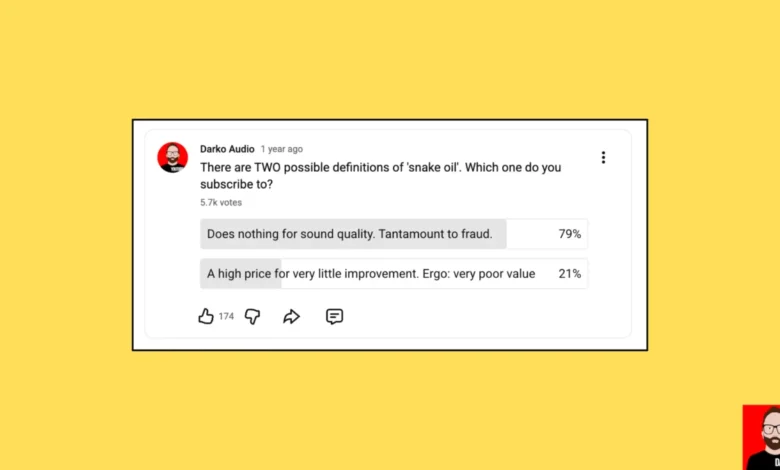
The poll, which garnered nearly 6,000 votes, presented two distinct definitions of "snake oil." The first, a more stringent interpretation, defined it as a product that offers no discernible benefit to sound quality and is therefore tantamount to fraud. The second, a broader definition, characterized snake oil as a product whose exorbitant price is justified by only negligible improvements, rendering it exceptionally poor value for money. The outcome was a stark division: 79% of respondents subscribed to the stricter definition, while 21% opted for the looser interpretation. This 79/21 split underscores a critical divergence in how consumers perceive and label products that push the boundaries of sonic performance and pricing.

The Strict Camp: A Demarcation of Fraud and Value
Proponents of the strict definition of snake oil draw a clear line between outright deception and merely overpriced components. For this group, a product is only "snake oil" if it demonstrably achieves nothing whatsoever. For instance, a loudspeaker cable priced at £5,000 that offers a marginal, albeit measurable, improvement over a £50 alternative might be considered a terrible value proposition, but it’s not inherently fraudulent because it does something. In contrast, a sticker applied to a mains fuse box with the purported function of "harmonizing the electrical field" would unequivocally fall under the strict definition of snake oil, as it lacks any scientifically verifiable mechanism of action and offers no measurable or audible effect.
Under this narrow definition, many of the more extravagant offerings within the audio industry are afforded a significant degree of benefit of the doubt. A power conditioner costing £3,000 might be perceived as wildly overpriced, and a fuse within a power strip might be deemed audibly inconsequential. However, unless a product can be definitively proven to exhibit zero measurable and zero audible effects, the strict-definition adherents will refrain from labeling it "snake oil." Instead, they would categorize it as "bad value." This linguistic precision is crucial for this demographic, as terms like "fraud" carry substantial legal and ethical weight, along with potential defamation risks, which are absent from the less severe accusation of being "overpriced." This perspective emphasizes the importance of objective proof and the distinction between genuine deception and subjective value judgments.
The Loose Camp: When Price Becomes Deception
The "loose camp" finds the strict camp’s demarcation to be overly pedantic. For this group, if a manufacturer charges a premium many times the standard market rate for a product whose sonic benefits are nearly imperceptible to the vast majority of listeners with competent hi-fi systems, the marketing surrounding such a product can itself be seen as a form of deception. This perspective encompasses premium cables, costly accessories, and exotic audiophile tweaks. If the resulting improvement is so minuscule that it remains indistinguishable from no change for approximately 99% of listeners, the 21% of respondents consider such products fraudulent in spirit, irrespective of whether their underlying physics are technically operational. Unlike the strict adherents, this group is less concerned with precise measurements or audition results; their core objection is rooted in the product’s prohibitive price point relative to its perceived benefit.

This stance suggests that the perception of value is intrinsically linked to the concept of ethical marketing. When the price-to-benefit ratio becomes astronomically skewed, the act of selling the product, regardless of its functional efficacy, can be viewed as exploitative. This viewpoint acknowledges the subjective nature of audio perception but posits that extreme price discrepancies can erode the ethical foundation of the transaction, even if the product performs a function, however minor.
Examining the Boundaries: Where Definitions Falter
Both definitions, while coherent within their own frameworks, encounter limitations when applied to the nuanced reality of the high-end audio market. The strict definition grapples with establishing a definitive threshold for what constitutes "nothing." The question arises: at what point does a measurable, yet inaudible, difference become functionally equivalent to no difference at all? Furthermore, how should differences that some listeners report experiencing, but which do not manifest in laboratory testing, be categorized?
Consider a £5,000 loudspeaker cable that a listener subjectively claims sounds "more open and airy" than a £50 cable, yet no objective measurement can isolate the cause of this perceived difference. Does this cable "do something"? If, technically, the £5,000 cable exhibits ever-so-slightly lower capacitance than its £50 counterpart, it has indeed "done something." However, whether this technical distinction translates into an audible improvement is a matter of debate, blurring the lines between objective reality and subjective perception. This highlights the inherent challenge in reconciling objective measurement with subjective listening experience.

Beneath these definitional quandaries lies a more fundamental philosophical disagreement: the enduring debate between those who assert that all audible phenomena are measurable and all measurable phenomena are audible, and those who dissent from this view. The "snake oil" debate often serves as a proxy battleground for this older, unresolved argument.
The loose definition, conversely, faces the opposite problem: it risks diluting the term’s impact. Once "overpriced relative to benefit" becomes sufficient grounds to label something "snake oil," the accusation loses its potency. Virtually every premium product across all market segments faces this charge from some segment of consumers. For instance, are Focal’s Utopia headphones "snake oil" when compared to their more affordable Azurys model? Is a £10,000 amplifier inherently "snake oil" when a £1,000 amplifier delivers 90% of its performance? If applied consistently, the loose definition would encompass a vast majority of high-end audio products, rendering the term almost meaningless. Neither definition, therefore, escapes scrutiny without encountering its own set of logical inconsistencies.
Author’s Perspective: Intent as the Defining Factor
John Darko, in his analysis, leans towards the strict definition but introduces a crucial caveat: intent. He posits that labeling a product "snake oil" is a serious accusation, implying fraud. For him, the defining characteristic of snake oil is not merely uselessness but knowingness – the manufacturer’s deliberate intent to sell a product they understand to be ineffectual. This aligns with the historical analogy of original traveling medicine-show pitchmen who, it is presumed, were aware of the fraudulent nature of their wares.

Tying "snake oil" accusations to manufacturer fraud, Darko argues, sharpens the focus on technical proof, both through listening and measurement. It also provides a degree of leniency for manufacturers who may have inadvertently arrived at false positives during product development, distinguishing honest mistakes from deliberate deception.
However, proving intent is significantly more challenging than conducting listening tests or running measurements. While analyzing a product with an Audio Precision analyzer or conducting a blind listening test is relatively straightforward (assuming proper experimental design, execution, and interpretation, and accounting for placebo effects), demonstrating that a manufacturer knowingly sold a useless product is a far greater hurdle. Without concrete evidence, such as internal documentation or whistleblower testimony, the accusation of fraud struggles to gain traction.
The 21% of respondents, operating under the loose definition, do not require such proof of intent. Their objection is fundamentally a complaint about price. A £5,000 cable, when £50 alternatives exist, is perceived as an act of exploitation, regardless of what any technical test might reveal.

Darko suggests that most audio manufacturers genuinely believe in the products they sell. While this belief doesn’t necessarily equate to good value or even universally audible benefits, it often means that the "fraud" framing doesn’t neatly apply.
Navigating the Ambiguity: The Practical Implications
The divergence in definitions, with 79% and 21% of respondents adhering to distinct interpretations, points to a significant practical problem. When the term "snake oil" is casually deployed in online forums or social media discussions, there is often a lack of clarity regarding which definition is being invoked. Is the accusation directed at a manufacturer for knowingly perpetuating a fraud, or is it a simple expression of dissatisfaction with a product’s price point? These are fundamentally different claims with vastly different implications, yet the same two words are used, leading to unproductive arguments and a lack of clarity. This ambiguity is not merely academic; it derails potentially constructive conversations that could lead to more informed decision-making for consumers.
When "snake oil" is loosely applied to anything deemed overpriced, the term loses its power and significance. The constant cries of "snake oil" for products that are merely expensive, rather than demonstrably fraudulent, can lead to listener fatigue and a diminished capacity to identify genuine deception.

Darko advocates for reserving the term "snake oil" for products that the manufacturer unequivocally knows to be useless. All other instances, where the concern is primarily about price versus perceived benefit, should be classified as value complaints – a valid critique, but distinct from an accusation of fraud. This refined approach aims to foster more precise and productive discourse within the audiophile community, enabling a clearer distinction between genuine exploitation and subjective value judgments. The historical context of "snake oil" sales, dating back to the 19th century, involved deliberate deception by traveling salesmen peddling tonics and elixirs with no medicinal value. Applying this historical precedent to modern audio products requires a similar understanding of intent to deceive. The debate over power cables and associated accessories, while often heated, ultimately circles back to this fundamental question of intent and the consumer’s right to accurate representation in the marketplace.
Related posts: