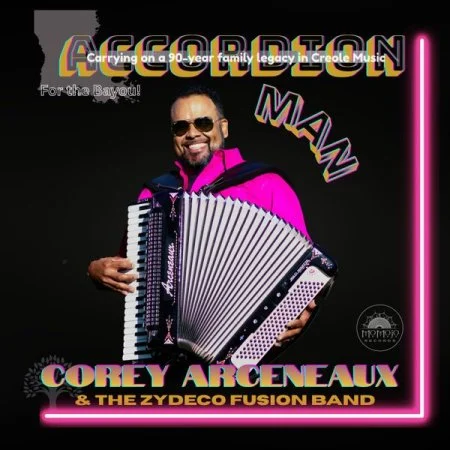
Corey Arceneaux & The Zydeco Fusion Band – Accordion Man marks a significant milestone in the career of one of the most enduring figures in the contemporary Zydeco scene. Released in 2026 under the MoMojo Records label, this 10-track collection, spanning 38 minutes, represents a culmination of decades of musical evolution. Arceneaux, an accordionist whose professional recording history stretches back to a debut cassette release in 1991, has utilized this project to bridge the gap between traditional Louisiana Creole sounds and modern rhythm and blues influences. The album is not merely a solo effort but a multi-generational family endeavor, featuring his three sons in prominent roles both in front of the microphone and behind the production console. Recorded across two distinct geographical hubs—the historic Dockside Studio in Maurice, Louisiana, and a secondary tracking facility in Fairfax, Virginia—the album serves as a sonic map of Arceneaux’s journey from the bayous of the South to the metropolitan corridors of the East Coast.
The Evolution of Corey Arceneaux: From 1991 to 2026
To understand the weight of Accordion Man, one must look at the timeline of Corey Arceneaux’s career. Emerging in the early 1990s, Arceneaux entered the Zydeco scene during a period of transition. The legends of the genre, such as Clifton Chenier and Boozoo Chavis, had already established the blueprint, while younger artists like Beau Jocque were beginning to experiment with heavier, funkier grooves. Arceneaux’s 1991 debut introduced a player who respected the traditional "double-clutching" beat of the rural dance halls but possessed a technical proficiency that hinted at broader aspirations.
Over the ensuing thirty-five years, Arceneaux refined his craft, navigating the shifting tides of the music industry. His move toward the East Coast—evidenced by his current tour schedule spanning Maryland, New York, and West Virginia—reflects a broader trend of Zydeco’s diaspora. While the heart of the music remains in the 22-parish region of Acadiana in South Louisiana, artists like Arceneaux have successfully exported the "fais do-do" atmosphere to the Mid-Atlantic and Northeast, finding a dedicated audience in urban centers far from the Gulf of Mexico.
A Family Legacy: The Personnel of the Zydeco Fusion Band
The defining characteristic of Accordion Man is its status as a "family affair." In Zydeco culture, musical knowledge is often passed down through lineage, a tradition exemplified by families like the Ardoins and the Cheniers. Arceneaux continues this legacy by integrating his children into the core of the Zydeco Fusion Band.
His eldest son, Desmond Joseph, provides the foundational low end on bass guitar, while his youngest son, Tyler Arceneaux, serves as the rhythmic engine, handling drums, percussion, and the quintessential Zydeco instrument: the frottoir (scrubboard). The middle son, Corey Jr., took on the role of co-producer, working alongside his father and brothers to ensure the album maintained a contemporary edge without losing its roots. This internal family synergy provides the album with a tight, intuitive pocket that is difficult to replicate with session musicians.
The ensemble is rounded out by veteran talent. Joseph "Cookie" Chavis contributes electric guitar work that leans into the bluesier side of the genre, while Cecil Green provides harmonic depth on keyboards. Erica Fox adds essential backing vocals and takes the lead on a standout track, and Shane Bertrand contributes additional percussion to enhance the album’s rhythmic complexity.

Technical Production and Recording Locations
The production of Accordion Man utilized a split-location strategy that captures the duality of Arceneaux’s current life. The primary instrumental tracks were laid down at Dockside Studio in Maurice, Louisiana. Known for its world-class acoustics and historical significance, Dockside has hosted legends such as Dr. John, B.B. King, and Mavis Staples. Recording in the heart of Acadiana allowed the band to tap into the natural "vibe" of the region, ensuring the drums and accordion interacted with the room in a way that feels authentic to the genre’s origins.
Conversely, the vocal tracks and specific accordion overdubs were tracked in Fairfax, Virginia. This reflects Arceneaux’s current base of operations and the logistical realities of a touring musician in the 21st century. The blending of these two locations results in a polished, high-fidelity sound that retains the "dirt" and soul of a Louisiana Saturday night.
Track-by-Track Analysis: Merging Tradition with Innovation
The album opens with "The Intro," a cinematic soundscape featuring helicopter noises. This serves as a metaphor for the band’s "arrival" at Dockside Studio, transitioning quickly into the subtitle "Pull That Thing." The phrase is a direct nod to the physical action of playing the accordion, signaling to the listener that the energy will remain high from the outset.
The title track, "Accordion Man," serves as a mission statement. It is an autobiographical anthem that celebrates the instrument and the culture it represents. Following this is "Good Old Days," a mid-tempo track where Arceneaux reminisces about his early years in the industry. The song serves as a historical document of the Zydeco scene in the 90s, supported by lush backing vocals that provide a soulful, nostalgic atmosphere.
"Chock-A-Block" is a high-energy dance track designed for the "trail ride" and dance hall circuit. The term refers to a crowded room, and the song’s driving rhythm, anchored by Tyler Arceneaux’s frottoir work, is intended to mirror the frenetic energy of a packed floor. In contrast, "When It Comes To You" showcases the band’s romantic side. Opening with the sound of falling rain, the track features "Cookie" Chavis’s clean rhythm guitar lines and a heartfelt vocal performance from Arceneaux, emphasizing the genre’s ability to handle ballads as effectively as up-tempo stomps.
One of the album’s most interesting departures is the cover of Little Walter Jacobs’ "Last Night." Originally a Chicago blues harmonica staple, Arceneaux reimagines the track by replacing the iconic harp lines with the accordion. This slowed-down version highlights the versatility of the accordion as a lead instrument capable of expressing deep, soulful blues.
"Louisiana Woman," a co-write with Denni Cravins, features Erica Fox on lead vocals. The track begins with a 1970s-style vocoder effect, a bold "fusion" choice that justifies the band’s name. The lyrics celebrate the strength and spirit of women from the region, with Arceneaux and Fox sharing vocal duties in a call-and-response style. This is followed by another Cravins co-write, "Oh Mon Dieu" (Oh My God), a social commentary track that calls for peace and unity. The inclusion of French in the title pays homage to the Creole language that was once the primary tongue of Zydeco music.

The album concludes with "Washboard Zydeco," an instrumental showcase for Tyler Arceneaux. By ending with a focus on the frottoir, the band reinforces the importance of the genre’s unique percussion, leaving the listener with a pure, rhythmic distillation of the Zydeco sound.
The Cultural Significance of Zydeco Fusion
The term "Fusion" in Arceneaux’s band name is a deliberate choice. Zydeco has always been a hybrid genre, born from the intersection of African, Caribbean, and French influences in South Louisiana. However, in the modern era, the "fusion" often involves integrating hip-hop, R&B, and modern production techniques.
Arceneaux’s approach on Accordion Man is a sophisticated version of this evolution. He does not abandon the traditional diatonic or triple-note accordion styles, but he allows the arrangements to breathe with the soul of a Motown record or the grit of a Texas blues band. This makes the album accessible to a broad demographic, from traditionalists in St. Landry Parish to new fans in the jazz clubs of New York City.
Market Reception and Implications for the Genre
As Corey Arceneaux & The Zydeco Fusion Band embark on their 2026 tour, the release of Accordion Man is expected to solidify their position as ambassadors of the genre on the East Coast. The album’s professional polish and family-oriented backstory make it a compelling narrative for both music critics and festival bookers.
Industry analysts suggest that the "family band" dynamic is a key selling point in the current roots-music market. Audiences are increasingly drawn to authenticity and heritage, and the sight of a father performing alongside his three sons provides a powerful visual and emotional connection. Furthermore, the inclusion of a blues cover like "Last Night" allows the band to bridge into the lucrative blues festival circuit, expanding their reach beyond niche Zydeco events.
Conclusion: A Testament to Longevity
Accordion Man is more than just a collection of songs; it is a testament to Corey Arceneaux’s longevity and adaptability. In an industry that often favors the new and the fleeting, Arceneaux has maintained a career for over three decades by staying true to his roots while remaining open to new sounds and technologies. By involving his sons in the process, he has ensured that the "Accordion Man" legacy will continue for another generation, keeping the spirit of Louisiana Creole music alive, regardless of where the band happens to be parked.
With its blend of autobiography, social consciousness, and infectious rhythm, Accordion Man stands as a definitive work in the 2020s Zydeco canon. It proves that the accordion, in the right hands, remains a powerful tool for storytelling and community building, bridging the gap between the "Good Old Days" and the future of the fusion sound.