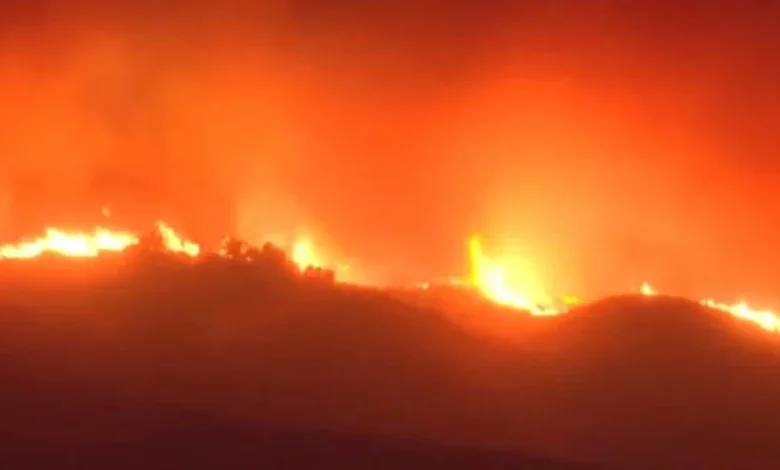
A massive, suffocating plume of wildfire smoke, originating from a sudden and intense outbreak in Ontario, Canada, has dramatically blanketed the sprawling New York-New Jersey metropolitan area, plunging air quality into unprecedented hazardous territory and leaving the open-air New York New Jersey Stadium (MetLife Stadium) vulnerable to an environmental crisis just ahead of the most anticipated match in global football. The iconic venue, typically a beacon of sporting grandeur, now stands under a pall of orange haze and acrid fumes, forcing local officials, health experts, and international sports bodies into a frantic scramble to assess risks and ensure public safety.
The Atmospheric Threat: Wildfires Rage, Smoke Travels
The crisis began unfolding earlier in the week, approximately Tuesday, July 15, 2026, when a series of aggressive wildfires ignited across vast swathes of remote forestland in Northern Ontario, Canada. Fueled by unusually dry conditions and persistent high temperatures, these fires rapidly escalated, generating immense quantities of smoke. Meteorological models quickly indicated a high-pressure system positioned over the Great Lakes region, acting as a powerful atmospheric pump, drawing the smoke southward and eastward. By Wednesday evening, the first wisps of smoke were detected over upstate New York, intensifying dramatically overnight.
By Thursday morning, the New York-New Jersey metropolitan area woke to an apocalyptic landscape. The sky had transformed into a deep, hazy orange, and a pervasive, pungent smell of burning wood permeated the air. The concentration of fine particulate matter ($PM_2.5$), microscopic particles capable of penetrating deep into the lungs, surged to alarming levels. According to data from the Environmental Protection Agency (EPA) and local air quality monitoring stations, PM2.5 concentrations in parts of New York City and East Rutherford, New Jersey, where MetLife Stadium is located, exceeded 400 micrograms per cubic meter ($µg/m^3$) at their peak. To put this in perspective, the World Health Organization (WHO) recommends an annual average PM2.5 exposure of no more than 5 $µg/m^3$ and a 24-hour average of no more than 15 $µg/m^3$. Levels above 250 $µg/m^3$ are typically classified as "Hazardous" on the Air Quality Index (AQI), posing severe health risks to the entire population.
Code Red at MetLife Stadium and Public Health Alarms
In response to the unprecedented air quality degradation, New York City Mayor Zohran Mamdani swiftly issued a "Code Red" alert, urging all citizens to severely limit outdoor activity. The city initiated an emergency distribution of KN95 masks at various public hubs, including subway stations and community centers, reminding residents that prolonged exposure to such hazardous air quality could exacerbate respiratory conditions, trigger asthma attacks, and even increase the risk of heart disease and stroke. Health advisories specifically warned vulnerable populations—children, the elderly, and individuals with pre-existing heart or lung conditions—to remain indoors with windows closed and air purifiers running.
The immediate concern, however, centered on the upcoming World Cup Final. MetLife Stadium, an 82,000-seat open-air venue, offers no structural protection against such atmospheric phenomena. The prospect of elite athletes engaging in high-intensity physical exertion for 90 minutes or more, coupled with hundreds of thousands of fans exposed to hazardous air, immediately triggered widespread alarm among medical professionals.
Dr. Courtney Howard, an emergency room physician and expert in environmental health, voiced grave concerns: "Elite athletes, by their nature, move massive volumes of air through their lungs during competition. Exposing them to hazardous wildfire pollution is profoundly risky. It can lead to acute respiratory distress, reduced lung function, and even long-term cardiovascular issues. For fans, particularly those traveling from different climates and potentially unaware of the severity, the risks of heat exhaustion compounded by respiratory stress are equally alarming." Dr. Howard highlighted that PM2.5 particles can bypass the body’s natural defenses, leading to inflammation and oxidative stress not just in the lungs, but throughout the cardiovascular system.
Adding another layer of complexity to the situation was a lingering heat wave across the Northeast. Temperatures hovered in the low 90s Fahrenheit (around 32-34 degrees Celsius) with high humidity, creating a dangerous dual-threat environment. The combination of extreme heat, which itself mandates strict hydration protocols and potentially cooling breaks, and severely compromised air quality presented a novel and formidable challenge for event organizers and medical staff alike.
FIFA Faces Scrutiny Over Contingency Planning
The unfolding crisis immediately brought FIFA, football’s global governing body, under intense scrutiny. As climate disruptions become an increasingly prevalent feature of global sports, critics pointed to a perceived lack of comprehensive preparedness on FIFA’s part. While the organization boasts highly detailed and robust protocols to combat extreme heat – including mandatory hydration breaks every 15 minutes, cooling stations, and specific guidelines for pitch watering – it has no public, formal framework specifically designed to handle sudden, severe air quality crises.
Sports management experts and environmental advocates highlighted this regulatory blind spot. "The 2026 World Cup is being hosted across multiple North American cities, many of which are increasingly susceptible to the impacts of climate change, from extreme heat to wildfire smoke," noted Dr. Eleanor Vance, a professor of sports administration. "For an event of this magnitude, with billions of dollars in revenue and global viewership at stake, the absence of clear, actionable protocols for hazardous air quality is a significant oversight. It suggests a reactive, rather than proactive, approach to climate resilience."
The structural limitations of MetLife Stadium further exacerbated the problem. Unlike some modern stadia with retractable roofs or advanced indoor air-filtration systems, MetLife Stadium, built primarily for American football, is an open-air facility. This means that if wind patterns were to shift unfavorably during the match, or if the smoke failed to clear as hoped, both players and spectators would have virtually zero structural protection from the airborne pollutants. The financial and commercial commitments tied to a World Cup Final, including massive broadcast rights, sponsorship deals, and travel arrangements for hundreds of thousands of fans, meant that postponing or relocating the match was a logistical and economic nightmare, making the decision to push forward highly likely, despite the risks.

Team Preparations Amidst Uncertainty
Amidst the swirling environmental concerns, the two finalists, Argentina and Spain, navigated their final preparations with varying degrees of apparent concern. The Spanish national team, having arrived from their semifinal match in Texas, trained outdoors at their designated facility on Thursday. Media reports indicated that while the air quality was noticeably poor, the team proceeded with their planned session, seemingly unfazed. Coach Luis de la Fuente did not issue specific statements regarding the smoke, but team medical staff were reportedly monitoring players closely.
Argentina, transitioning from their semifinal camp in Georgia, was scheduled to follow suit on Friday. Their medical team and coaching staff were reportedly in close communication with FIFA and local health authorities, assessing the risks. While both teams are composed of elite athletes accustomed to rigorous physical demands, the unique challenge of performing in heavily polluted air introduces an unpredictable variable. Reduced oxygen uptake, increased respiratory effort, and potential long-term health consequences loom large for players who push their bodies to the absolute limit.
The psychological impact on players cannot be understated. While their focus remains on the trophy, the visible and palpable environmental threat undoubtedly adds a layer of anxiety to their pre-match routines. Coaches face the dilemma of maintaining peak physical condition while safeguarding player health, a balance made precarious by the unforeseen circumstances.
A Glimmer of Hope: The Meteorological Outlook
Fortunately for soccer purists and the millions eagerly anticipating the final, meteorologists delivered a crucial update, offering a glimmer of hope: a last-minute assist from nature. Current forecast models, updated late Thursday, indicated a significant weather pattern shift. An incoming cold front, originating from the west and accompanied by a band of regional rain, was predicted to begin pushing the heaviest smoke concentrations out over the Atlantic Ocean by Sunday morning.
Dr. Sarah Jenkins, a senior meteorologist, explained the dynamics: "The cold front is expected to sweep through the region, bringing with it stronger northwesterly winds. This will effectively act as a broom, clearing the stagnant, smoke-laden air. Crucially, the associated rainfall will also help ‘wash out’ some of the particulate matter from the atmosphere."
While air quality was expected to shift from "unhealthy" (AQI 151-200) back down to "moderate" (AQI 51-100) just in time for the 3:00 PM EST kickoff, the severity of the initial scare remained a stark reminder. Even "moderate" air quality can still pose risks for unusually sensitive individuals, and the lingering effects of the previous days’ extreme pollution might still be felt. FIFA confirmed that they would be monitoring real-time air quality data right up to kickoff, with medical teams on standby for any player or spectator requiring assistance.
Broader Implications for Global Sports and Future Resilience
The 2026 World Cup Final air quality crisis transcends a single sporting event; it serves as a powerful microcosm of how deeply the climate crisis is beginning to rewrite the playbook for global sports. Major international competitions, once seemingly immune to such disruptions, are increasingly vulnerable to extreme weather events, from heatwaves and floods to, now, widespread wildfire smoke.
The incident at MetLife Stadium highlights several critical areas for immediate and long-term action:
- Enhanced Environmental Protocols: Sporting bodies like FIFA must develop and implement robust, scientifically-backed protocols for a wider range of environmental threats, including air quality. These protocols should include clear thresholds for postponement or relocation, as well as mitigation strategies.
- Infrastructure Resilience: Future stadium designs, especially in climate-vulnerable regions, will need to incorporate features like retractable roofs with advanced air filtration systems, or be built with climate-controlled indoor environments.
- Cross-Sector Collaboration: Effective response to such crises requires seamless coordination between sports organizations, national meteorological services, public health agencies, and local governments.
- Athlete and Fan Education: There is an urgent need to educate athletes on the physiological impacts of environmental stressors and to provide clear, accessible health guidance for fans attending events in potentially hazardous conditions.
- Climate Advocacy: The visibility of such events on a global stage can and should be leveraged to raise awareness about climate change and advocate for more aggressive mitigation and adaptation policies.
The estimated economic impact of the 2026 FIFA World Cup across North America is projected to be in the billions of dollars, with the final match alone drawing an estimated global television audience of over one billion people. The logistical nightmare and potential financial losses associated with a last-minute cancellation or severe disruption underscore the immense stakes involved.
As the world watches to see if the beautiful game will indeed be saved by a fortunate shift in wind patterns, the events leading up to the 2026 World Cup Final stand as an undeniable testament to the pervasive reach of climate change. It is a stark reminder that even the most meticulously planned global spectacles are no longer immune to the unpredictable and often severe impacts of a changing planet, demanding a fundamental re-evaluation of how major events are planned, executed, and safeguarded for the future.
For a comprehensive breakdown of the weather models and health protocols being evaluated ahead of Sunday’s match, and to understand how meteorologists expect the smoke to clear before kickoff and the specific respiratory risks the players face, a detailed World Cup Air Quality Report provides further insights.