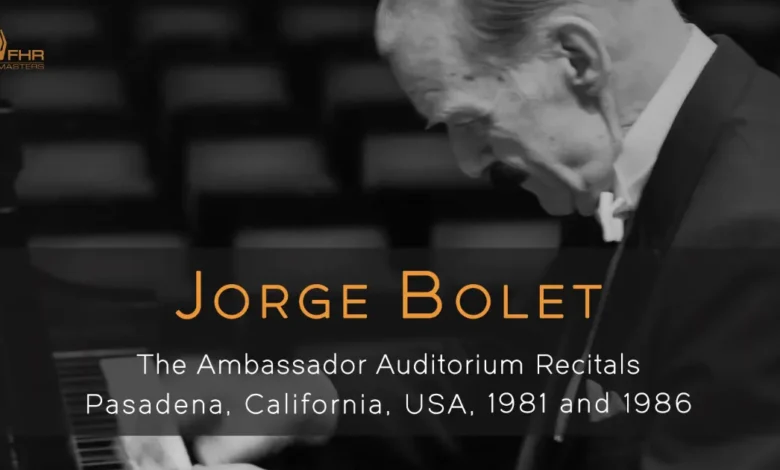
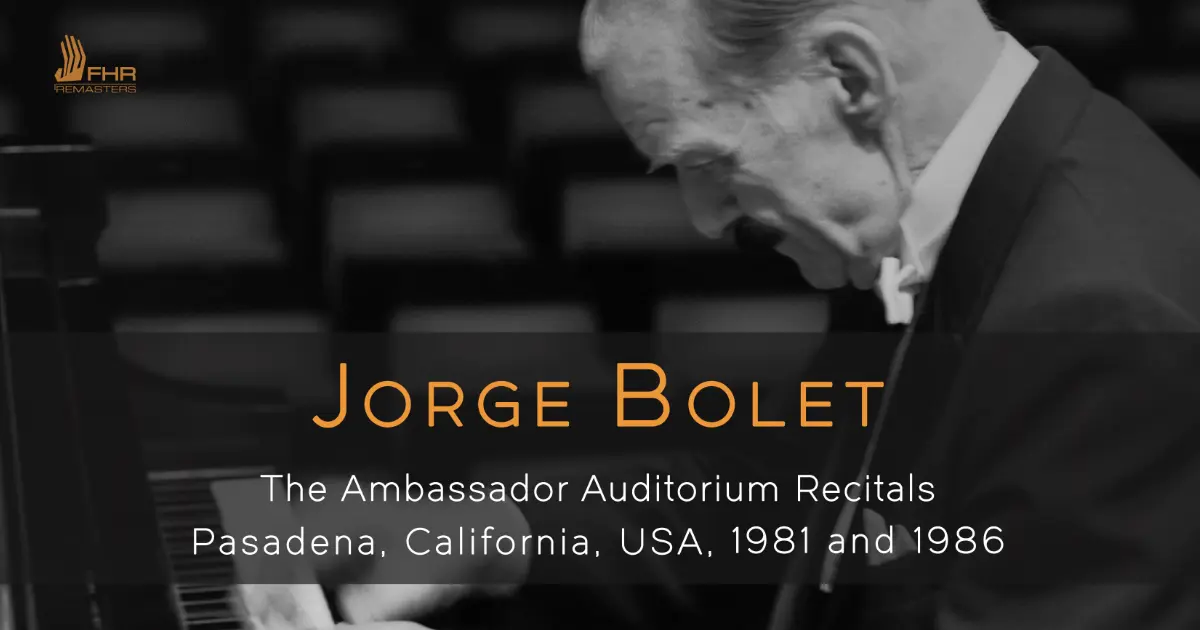
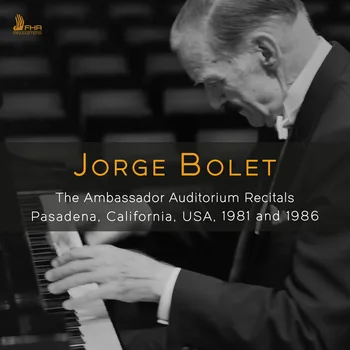
The release of the three-CD box set Jorge Bolet: The Ambassador Auditorium Recitals marks a significant milestone for classical music archivists and aficionados of the Great Romantic piano tradition. Produced by First Hand Records, this collection features two complete recitals performed by the legendary Cuban-American pianist Jorge Bolet at the Ambassador Auditorium in Pasadena, California, in 1981 and 1986. These recordings, originally captured for archival purposes on professional open-reel tapes, have undergone an extensive restoration and 24-bit/96 kHz remastering process, providing a rare and high-fidelity glimpse into the live artistry of a performer often cited as the last true representative of the 19th-century school of piano playing.
Jorge Bolet’s career was characterized by a late-blooming international recognition. While he was always respected by his peers, it was not until his later years, particularly through a series of recordings for the Decca label in the late 1970s and 1980s, that he achieved global superstardom. However, many critics and scholars have long maintained that Bolet’s studio recordings, while polished, often lacked the spontaneous fire and structural daring of his live performances. The Ambassador Auditorium recitals, recorded during the final decade of his life, serve as a vital corrective to this narrative, capturing the pianist in the environment he most favored: the concert stage.
The Significance of the Ambassador Auditorium
The choice of venue is as central to the importance of this release as the performer himself. The Ambassador Auditorium, which opened in 1974, was often referred to as the "Carnegie Hall of the West." Known for its exquisite acoustics, opulent interior, and the high caliber of its visiting artists, it was a preferred destination for the world’s leading virtuosos. For a pianist like Bolet, whose playing relied heavily on tonal color, subtle pedaling, and the ability to project a massive sound without harshness, the auditorium provided the ideal sonic canvas.
The recordings were never originally intended for commercial distribution. They were part of the venue’s archival efforts to document the legendary performances held within its walls. Because they were recorded by professional engineers using high-quality equipment, the source material offered a level of fidelity far superior to the "bootleg" audience recordings that often circulate among collectors. The restoration team, led by Kabir Hermon and John Croft, has managed to preserve the distinctive "Bolet sound"—a combination of deep, resonant basses, a singing melodic line, and a crystalline clarity in rapid passagework—while minimizing the technical limitations of 1980s tape technology.
The 1981 Recital: Romantic Grandeur and Nuance
The first portion of the box set is dedicated to the recital given on November 11, 1981. This performance captures Bolet at the height of his powers, tackling a program that demands both immense physical stamina and profound emotional depth. The centerpiece of this recital is Robert Schumann’s Fantasy in C Major, Op. 17.
Schumann’s Fantasy is widely regarded as one of the pillars of Romantic piano literature, a work of intense introspection and technical difficulty. Bolet’s interpretation of the work is notably extroverted when compared to the more reserved or contemplative readings of contemporaries like Sviatoslav Richter or Murray Perahia. In the first movement, Bolet utilizes emphatic dotted rhythms and punchy chords that initially seem to challenge the work’s inherent yearning. However, as the movement progresses, his interpretation reveals a deep understanding of the passionate, raw spirit of Schumann’s writing.
The middle movement showcases Bolet’s famous "joyous energy." Despite the occasional "wrong note"—a common occurrence in unedited live recordings of such demanding repertoire—the performance is uplifted by a rhythmic drive that is infectious. However, it is the final movement, marked Langsam, where Bolet truly distinguishes himself. Taking a more measured pace than virtuosos like Maurizio Pollini or Martha Argerich, Bolet focuses on the transcendent, hymn-like quality of the music. His use of flexible phrasing and strategic pauses adds a layer of expressivity that highlights the work’s spiritual dimensions.
The 1981 concert also features a selection of Schubert-Liszt song transcriptions. As a student of David Saperton and a spiritual heir to the tradition of Leopold Godowsky and Ferruccio Busoni, Bolet was a master of the transcription genre. In Der Müller und der Bach, he demonstrates impeccable voice leading, making the piano mimic the inflections of a human voice expressing grief and loss. His rendition of the famous Erlkönig offers a stark contrast to the aggressive, high-speed approach taken by Evgeny Kissin in his famous 1990 Carnegie Hall debut. Bolet opts for a more austere, inevitable presence, portraying Death not as a sudden terror, but as a chilling, unavoidable certainty.
The 1986 Recital: A Unified Exploration of the Ballade
The second recital, recorded in 1986, is a masterclass in program curation. Bolet organized the evening around the theme of the "Ballade," a genre that allows for narrative storytelling through music. The program included Edvard Grieg’s Ballade in G Minor, Op. 24, Johannes Brahms’s Four Ballades, Op. 10, and Franz Liszt’s Ballade No. 2 in B Minor, S. 171, all leading up to the definitive cycle of the four Ballades by Frédéric Chopin.
In Grieg’s Ballade, a work often overshadowed by the composer’s more famous Piano Concerto, Bolet navigates the eclectic and unpredictable spirit of the piece with conviction. He captures the tonal ambiguity of the opening theme and ties together the work’s varied moods—from whimsy to cataclysm—under a unified veil of Nordic melancholy.
The performance of Brahms’s Op. 10 Ballades provides a fascinating look at the composer’s early development. While these pieces lack the late-period profundity of Brahms’s Op. 116–119, Bolet finds the seeds of that future language within them. In the first Ballade (the "Edward" Ballade), he creates a palpable tension between soft, subtle passages and sudden, stormy surges. The third Ballade, an Intermezzo, allows Bolet to showcase his ability to handle off-kilter melodic material, moving from raging fury to some of the most tender playing found in the entire three-CD set.
The Chopin Ballades: A Career-Defining Performance
The four Chopin Ballades serve as the emotional and technical climax of the 1986 recital. These works are among the most frequently performed in the piano repertoire, yet Bolet manages to bring a fresh perspective through what critics have described as his "game of opposites."
In the Ballade No. 2 in F Major, Bolet emphasizes the dramatic interplay between the pastoral opening and the sudden, furious outbursts of the minor sections. In these moments, he displays a level of recklessness and fire that was often missing from his more "deliberate" studio recordings. The final Ballade No. 4 in F Minor, Op. 52, widely considered the most complex of the set, is rendered with the ease of a performer who has lived with the music for decades. Bolet’s sensitivity to Chopin’s harmonic shifts and his use of bel canto melodic lines capture the essence of the composer’s poetic intent. The concluding Coda is a tour de force of virtuosity, providing one of the most electric moments in the archival collection.
Technical Restoration and Historical Value
The technical achievement of this release cannot be overstated. Remastering recordings from 1981 and 1986 presents unique challenges, particularly regarding tape hiss and the preservation of dynamic range. The use of 24-bit/96 kHz transfers ensures that the nuances of Bolet’s touch—the way he voiced chords and his sophisticated use of the sustaining pedal—are audible to the modern listener.
For historians, these recordings provide valuable data on the evolution of Bolet’s style. By comparing these 1980s performances to his earlier recordings from the 1950s and 60s, one can observe a shift toward broader tempi and a greater emphasis on tonal weight. This box set documents a pianist who, in his 70s, remained a formidable technical force while gaining an even deeper level of musical wisdom.
Impact and Legacy
The release of Jorge Bolet: The Ambassador Auditorium Recitals by First Hand Records (Catalogue No. FHR178) is more than just a nostalgic trip for piano enthusiasts. It is a significant contribution to the recorded history of the 20th century’s greatest performers. In an era where modern piano playing is often criticized for a "homogenized" or "perfection-at-all-costs" approach, Bolet’s live recitals remind listeners of a time when individuality, tonal beauty, and narrative risk-taking were the hallmarks of a great artist.
The inclusion of these recitals in digital formats, such as Apple Music Classical, and their availability through distributors like Presto Music, ensures that a new generation of pianists can study Bolet’s unique approach to the Romantic repertoire. As the classical music world continues to digitize its archives, this collection stands as a gold standard for how historical live performances should be preserved and presented.
Ultimately, this three-CD set reaffirms Jorge Bolet’s status as a titan of the keyboard. It captures a master at home on the stage, communicating directly with his audience through a language of profound emotion and unparalleled technical mastery. For those seeking to understand the true essence of Jorge Bolet, these Ambassador Auditorium recitals are essential listening.