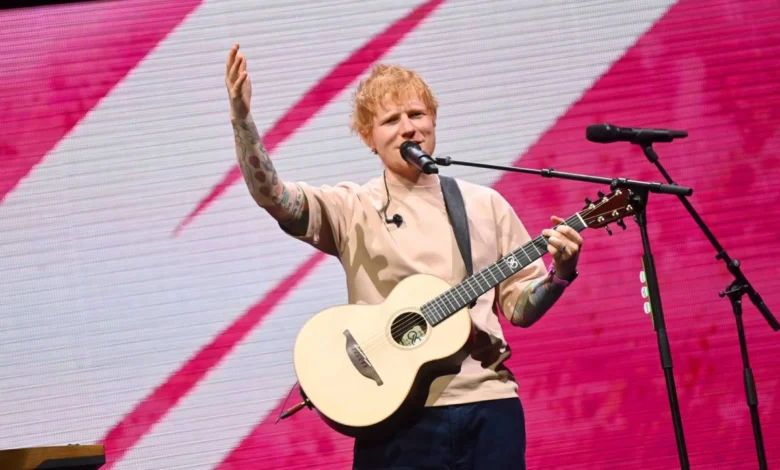
The global music community has been thrown into turmoil following a high-profile cascading boycott of Ed Sheeran’s ongoing tour, triggered by the controversial removal of rapper Macklemore over his onstage remarks regarding the conflict in Gaza. Prominent artists including Finneas, Danish pop band Lukas Graham, Irish folk-traditional band Beoga, and singer-songwriter Aaron Rowe have formally withdrawn from their respective support slots and touring commitments with the British pop superstar.
The developments highlight a deepening cultural and political fracture within the live entertainment industry, exposing the complex and often volatile intersection between mainstream pop culture, geopolitical activism, high-stakes corporate venue management, and the personal convictions of performing artists. As Palestinian advocacy groups push for wider fan boycotts and tour cancellations, the controversy underscores how international conflicts increasingly reverberate through Western commercial entertainment spaces.
Chronology of the Controversy
The series of events leading to the mass artist walkout began during Ed Sheeran’s high-profile stadium dates in New Jersey. Opening the concert series, Macklemore delivered an impassioned speech advocating for human dignity, respect, and equality. However, the performance quickly escalated into a flashpoint when the rapper explicitly called for a "Free Palestine," alongside mentions of other global geopolitical struggles, before launching into his pro-Palestinian track "Hind’s Hall" while accompanying visuals of Gaza were displayed on the stadium screens.
The remarks drew immediate criticism. The Israeli-American Council publicly called for Macklemore’s removal, alleging that the artist was utilizing a mainstream commercial platform to advance a one-sided political agenda. The pressure intensified when billionaire businessman Robert Kraft—owner of the New England Patriots and Gillette Stadium, where the concerts took place—instituted a campaign demanding that Sheeran drop the rapper, allegedly presenting an ultimatum that the shows could not proceed otherwise.
Macklemore was subsequently removed from the remainder of the tour. In response to his dismissal, the rapper issued a detailed public statement defending his position, asserting that striving for equality and basic human rights should never be considered controversial. He also emphasized that neither he, Ed Sheeran, nor fellow pop star Pink were the true victims in the scenario, redirecting the focus back to the ongoing humanitarian crisis in Gaza.
Following Macklemore’s removal, Ed Sheeran released a statement attempting to distance himself from the administrative decision, stating that he was "not complicit" and had spent over a week trying to bridge the gap between stakeholders to find a compromise, ultimately without success. Despite Sheeran’s clarifications, the removal catalyzed an unprecedented wave of solidarity walkouts from other supporting acts scheduled to appear alongside him globally.

Artist Walkouts and Solidarity Statements
The subsequent withdrawal of multiple supporting acts has severely disrupted the logistical framework of Sheeran’s tour schedule.
Finneas, the acclaimed Grammy-winning producer, songwriter, and frequent collaborator of Billie Eilish, was slated to join Sheeran’s itinerary in South America later in the year. Announcing his departure via Instagram, Finneas stated that artists must not be silenced when speaking up for the oppressed, firmly declaring his solidarity with Palestine.
Meanwhile, European and Irish acts deeply intertwined with the tour’s infrastructure also pulled out. Beoga, who famously collaborated with Sheeran on the hit tracks "Galway Girl" and "Nancy Mulligan" from his album ÷ (Divide) and were serving as his official touring band, announced their immediate departure from the remaining U.S. Loop tour. Citing their identity as Irish musicians with a historical understanding of colonialism, the band members—who are founding figures of the Irish Artists for Palestine movement—condemned what they described as the silencing of artists by lobby groups.
Aaron Rowe, an Irish artist who had been brought in to replace Macklemore for the remaining U.S. dates, similarly refused the slot. In a sharp critique, Rowe stated that he could not stand by and watch billionaires utilize positions of structural power to suppress voices highlighting the suffering of children in conflict zones.
Danish band Lukas Graham echoed these sentiments, directly addressing the financial power dynamics underpinning the controversy. In a public statement, the group asserted that money does not grant ownership over public discourse, arguing that a bank balance should not dictate which global populations are permitted to have their suffering acknowledged.
Corporate and Venue Responses
The decision to eject Macklemore from Gillette Stadium was defended by Robert Kraft, who released an extensive public statement clarifying the venue’s operational stance. Kraft maintained that the stadium does not serve as a platform for what he characterized as hate speech.

According to Kraft, Macklemore’s onstage remarks, combined with what the venue described as a broader history of rhetoric deemed offensive to the Jewish community, crossed a threshold that necessitated intervention. Kraft clarified that the decision was not intended to minimize the immense suffering of innocent Palestinian civilians, whose pain he acknowledged as real. However, he argued that humanitarian advocacy should not overshadow the responsibility of Hamas—a designated terrorist organization across the United States, European Union, United Kingdom, Canada, and Japan—whose actions he stated have caused profound devastation for both Palestinians and Israelis. Kraft concluded his statement by expressing a willingness to engage in a direct dialogue with Macklemore to pursue shared goals of peace and the eradication of hatred.
Broader Impact and Industry Implications
The fallout from the Ed Sheeran tour controversy reflects a broader, systemic shift within the live music industry. As global conflicts polarize public opinion, major concert promoters, venue owners, and corporate sponsors are increasingly forced to navigate the delicate balance between commercial liability and freedom of expression.
Historically, pop tours operated under the assumption that politics could be insulated from mainstream entertainment. However, the rise of socially conscious artistry, amplified by ubiquitous social media platforms, makes complete neutrality nearly impossible to maintain. When major financial stakeholders intervene to censor or remove artists for political speech, the resulting backlash often results in secondary and tertiary disruptions, as demonstrated by the voluntary withdrawals of Finneas, Beoga, Lukas Graham, and Aaron Rowe.
Furthermore, the involvement of prominent figures like Robert Kraft highlights the deep entanglement of corporate stadium ownership with geopolitical lobbying groups. As Palestinian campaign groups and international solidarity movements amplify calls for widespread consumer boycotts and tour cancellations, concert organizers face mounting operational challenges.
As of press time, Ed Sheeran has not issued a follow-up statement addressing the departure of his secondary support acts and band members. The long-term implications for his tour logistics, venue availability, and relationships within the broader musical community remain uncertain as the industry grapples with an increasingly fractured socio-political landscape.
Related posts: