The Evolution of a Zydeco Legacy
Corey Arceneaux’s journey in the music industry began in the early 1990s, a period of transition for zydeco as the genre moved from the "old school" sounds of Clifton Chenier and Boozoo Chavis toward the more R&B-influenced "zydeco soul" and "nouveau zydeco" styles. Arceneaux’s debut cassette in 1991 established him as a formidable accordionist capable of maintaining the rhythmic integrity of the frottoir (rubboard) while introducing modern melodic sensibilities. Over the following decades, Arceneaux navigated the shifting landscape of the American roots music scene, eventually relocating his primary base of operations to the East Coast.
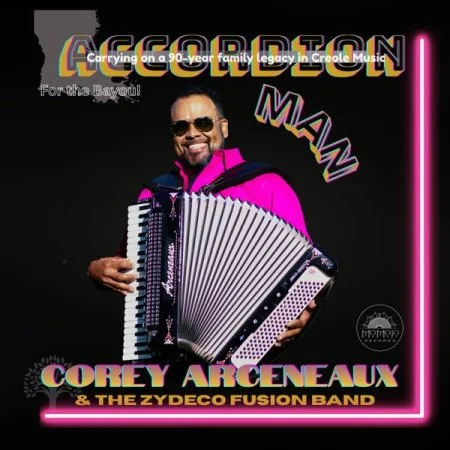
The 2026 release of Accordion Man functions as a thematic homecoming. While the artist is now a staple of the festival and club circuit in Maryland, New York, and West Virginia, the album’s recording origins remain firmly planted in the soil of Maurice, Louisiana. The tracking took place at the renowned Dockside Studio, a facility famous for capturing the authentic "swamp" sound of the Gulf Coast. However, the modern reality of digital production is evident in the album’s logistics; vocal and accordion tracks were completed in Fairfax, Virginia, bridging the gap between Arceneaux’s cultural heritage and his current geographic reality.
A Family Affair: Personnel and Production
One of the most compelling aspects of Accordion Man is its personnel lineup, which reinforces the long-standing tradition of family bands within the Creole music community. The album features Arceneaux’s three sons in roles that define the record’s rhythmic and structural backbone. Desmond Joseph, the eldest son, provides the bass lines that ground the fusion elements of the band’s sound. Tyler Arceneaux, the youngest, handles a complex array of percussion, including the drums and the essential zydeco scrubboard. The middle son, Corey Jr., stepped into the control room to co-produce the album alongside his father and brothers, ensuring that the final mix maintained a contemporary edge without sacrificing the raw energy of a live zydeco performance.
The ensemble is rounded out by a group of seasoned professionals who contribute to the "fusion" aspect of the band’s name. Joseph "Cookie" Chavis provides the electric guitar work, often weaving blues-inflected solos between Arceneaux’s accordion runs. Cecil Green provides texture on keyboards, while Erica Fox contributes backing vocals and a featured lead performance on the track "Louisiana Woman." Shane Bertrand adds additional percussion on selected cuts, contributing to the dense, danceable layers that define the album’s aesthetic.
Narrative and Track Analysis
The album’s structure is designed to take the listener on a journey through Arceneaux’s personal and professional life. It begins with "The Intro," a cinematic soundscape featuring the noise of a helicopter—a metaphorical arrival at Dockside Studio. This transitions into the subtitle "Pull That Thing," a direct nod to the physical demands of playing the accordion and a response to fan expectations for high-energy dance music.

The title track, "Accordion Man," serves as an autobiographical anthem. It establishes the central theme of the record: the artist’s identity is inseparable from his instrument. This is followed by "Good Old Days," a mid-tempo track that utilizes nostalgia to recount the early years of the zydeco scene. The song highlights the camaraderie of the Creole music circuit, bolstered by the harmonized backing vocals of Erica Fox, which lend the track a soulful, gospel-inflected quality.
"Chock-A-Block" and "She Taught Me How To Dance" focus on the social function of zydeco. In these tracks, the music is presented as a catalyst for community and movement. "Chock-A-Block" specifically references the crowded dance floors that characterize the Zydeco Fusion Band’s live shows. Conversely, "She Taught Me How To Dance" explores a more narrative-driven approach, telling the story of a narrator who is coaxed onto the floor, shifting the band into a rhythmic, soulful stride that emphasizes the "fusion" of their style.
Genre Fusion and Reinterpretation
A pivotal moment on the album is the cover of Little Walter Jacobs’ blues classic "Last Night." Reimagining a Chicago blues staple through the lens of Louisiana zydeco is a bold choice that highlights Arceneaux’s versatility. By replacing the original’s iconic harmonica lines with the bellows and buttons of the accordion, Arceneaux bridges two distinct branches of African American roots music. The tempo is slowed, allowing the emotional weight of the lyrics to resonate while showcasing the accordion’s ability to mimic the "crying" tone of a blues harp.
The collaboration with songwriter Denni Cravins on "Louisiana Woman" and "Oh Mon Dieu" introduces further stylistic diversity. "Louisiana Woman" features a surprising use of vocoder-like effects, a nod to 1970s funk and R&B that contrasts sharply with the traditional subject matter of riding in a truck through the bayou. "Oh Mon Dieu," the second Cravins co-write, shifts the tone toward a humanitarian message. The song expresses a plea for global peace and love, demonstrating that Arceneaux’s vision for zydeco includes its use as a platform for social commentary.
The album concludes with "Washboard Zydeco," an instrumental showcase for Tyler Arceneaux. By ending the record with a track focused on the frottoir, Corey Arceneaux pays homage to the most fundamental element of the genre, ensuring that even as the band experiments with fusion and modern production, the heartbeat of the music remains the traditional syncopated rhythm of the scrubboard.
Geographic Shift and Market Expansion
The release of Accordion Man underscores a broader trend in the 21st-century roots music market: the migration of regional genres to national and international stages. Corey Arceneaux’s current gig list, featuring heavy rotation in the Mid-Atlantic and Northeast, reflects the growing demand for authentic Louisiana sounds in urban centers far from the Gulf South.

Industry analysts suggest that artists like Arceneaux are instrumental in the "diasporic preservation" of zydeco. By maintaining a base on the East Coast while recording in Louisiana, Arceneaux acts as a cultural ambassador. MoMojo Records has positioned this release to capitalize on both the traditional zydeco market and the broader "Americana" and "Blues" markets, where the fusion elements of the band are likely to find significant crossover appeal.
Technical Specifications and Industry Reception
Accordion Man consists of ten tracks with a total runtime of approximately 38 minutes. This concise format is optimized for modern digital consumption while echoing the "all-killer, no-filler" philosophy of classic vinyl-era releases. The production quality has been noted for its clarity, particularly in the way the accordion is balanced against the electric guitar and keyboards—a common challenge in zydeco recording where the accordion can often overwhelm other instruments.
Early reactions from the blues and roots music community have been positive, with critics pointing to the album’s "honest" portrayal of the genre. The involvement of Arceneaux’s sons has been highlighted as a point of interest, suggesting a sustainable future for the band’s unique sound. The album’s ability to blend the rural origins of the music with a polished, professional delivery makes it a strong contender for year-end roots music honors.
Impact and Implications
The release of Accordion Man by Corey Arceneaux & The Zydeco Fusion Band is more than just a new collection of songs; it is a testament to the resilience of Creole culture and the adaptability of its music. By integrating family, modern production techniques, and a wide array of musical influences, Arceneaux has created a document that honors the past while firmly establishing his place in the future of the genre.
As the band prepares for a 2026 tour schedule that spans the East Coast and likely includes return trips to the festival circuits of the South, Accordion Man serves as their definitive calling card. It reaffirms that while the "Accordion Man" may have traveled far from the bayou, the soul of Louisiana travels with him, evolved and enriched for a new generation of listeners.