Remembering MF DOOM: The Life, Legacy, and Lasting Impact of Hip Hop’s Elusive Masked Villain

The global music community continues to reckon with the enduring legacy of Daniel Dumile, universally celebrated as MF DOOM, whose profound influence on hip hop remains as potent as ever. Though his passing on October 31, 2020, at the age of 49, was initially kept private by his family—only coming to light on December 31, 2020, via an announcement from his wife, Jasmine Dumile—the subsequent years have only deepened the culture’s appreciation for his unparalleled artistry. As one of the genre’s most enigmatic, innovative, and lyrically complex figures, Dumile transformed personal hardship and industry disillusionment into a sprawling, multi-layered musical universe that continues to be studied by scholars, aspiring producers, and devoted fans alike.
Early Beginnings and the KMD Era
Born in London, England, on January 9, 1971, Dumile relocated with his family to Long Island, New York, during his childhood. It was in the suburban landscape of Long Island that he first immersed himself in the burgeoning culture of hip hop. By the late 1980s, Dumile entered the professional music industry under the moniker Zev Love X, joining forces with his younger brother, DJ Subroc, and collaborator Onyx the Birthstone Kid to form the trio KMD (Kausing Much Damage).
KMD quickly carved out a distinct niche within the Golden Era of hip hop. Their debut major-label appearance came on 3rd Bass’s 1989 classic single "The Gas Face," which introduced audiences to Dumile’s intricate cadence and sharp wit. In 1991, the group released their debut studio album, Mr. Hood, through Elektra Records. The project was characterized by socially conscious lyricism, unconventional sample selection—often drawing from educational audio, cartoons, and vintage soul—and strong Afrocentric themes.
However, the trajectory of KMD was violently altered by tragedy. In 1993, just as the group was preparing to release its sophomore album, Black Bastards, DJ Subroc was struck and killed by a vehicle while attempting to cross the Long Island Expressway. The devastating loss crippled Dumile emotionally. Compounding the tragedy, Elektra Records dropped the group and shelved Black Bastards prior to its commercial release, deeming its provocative artwork and subversive themes too controversial. Left without a brother, a group, or a record deal, Dumile retreated entirely from the public eye, vanishing from the music industry for several years.
The Birth of the Mask: Reinvention as MF DOOM
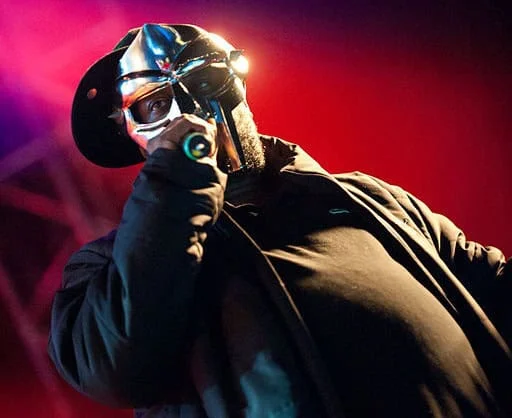
Dumile’s re-emergence in the late 1990s marked one of the most remarkable transformations in popular music history. Seeking to escape an industry that had exploited and discarded him, Dumile adopted a metal mask inspired by the Marvel Comics supervillain Doctor Doom. Shedding his identity as Zev Love X, he became MF DOOM—the self-proclaimed "supervillain" of rap.
This theatrical persona served a dual purpose: it functioned as a powerful critique of an industry overly obsessed with physical celebrity, materialism, and superficial marketing, while simultaneously granting Dumile total artistic liberation. Behind the mask, he could operate with complete anonymity, allowing his intricate wordplay, stream-of-consciousness rhyme schemes, and bizarre humor to take center stage.
In 1999, Dumile independently released his debut solo album, Operation: Doomsday, on Fondle ‘Em Records. The project was a masterclass in underground aesthetics, utilizing lo-fi production techniques, cartoon vocal snippets, and non-traditional song structures. Tracks like "Rhymes Like Dimes," "Doomsday," and "Gas Drawls" established a blueprint for independent hip hop artists in the new millennium, proving that an artist could achieve critical acclaim and cult-like devotion without major-label backing or commercial radio compromises.
Prolific Output and Collaborative Masterpieces
Throughout the 2000s, Dumile expanded his artistic footprint by recording under a constellation of aliases, each representing a distinct facet of his musical imagination. As King Geedorah, he released the sci-fi-infused Take Me To Your Leader (2003); as Viktor Vaughn, he delivered the gritty, narrative-driven Vaudeville Villain (2003).
His defining collaborative moment arrived in 2004 when he partnered with visionary West Coast producer Madlib under the moniker Madvillain. The resulting album, Madvillainy, is universally cited by music critics and historians as one of the greatest underground hip hop records of all time. Featuring legendary tracks such as "Accordion," "All Caps," and "Figaro," the album showcased an unprecedented synergy between Madlib’s kaleidoscopic, loop-driven beats and DOOM’s dense, internal rhyme patterns.
Later that same year, DOOM released MM..FOOD, a conceptual album that utilized food metaphors to analyze human behavior, street life, and the music industry itself. His commercial footprint expanded further in 2005 with The Mouse and the Mask, a successful collaboration with producer Danger Mouse released through Epitaph Records in partnership with Cartoon Network’s Adult Swim block. Over the subsequent decade, DOOM continued to build a formidable collaborative resume, working alongside artists such as Ghostface Killah, Czarface, Bishop Nehru, and Flying Lotus.
The Aftermath of His Passing and Medical Inquiries
The shock of MF DOOM’s passing in late 2020 gave way to poignant reflections from fans and collaborators worldwide. However, as the grief settled, questions surrounding the circumstances of his sudden death began to surface.
In 2023, a British coroner’s inquest shed light on the medical events leading up to his passing. It was revealed that Dumile had suffered a severe, adverse reaction to newly prescribed blood pressure medication, which induced angioedema—a dangerous, rapid swelling of the skin and underlying tissues that severely compromised his respiratory tract. Jasmine Dumile publicly raised significant concerns regarding the quality of care her husband received while hospitalized at St James’s University Hospital in Leeds, England, during the height of the COVID-19 pandemic, noting that monitoring and rapid response protocols fell short of acceptable standards. The inquest highlighted the vulnerability of artists navigating complex healthcare systems far from home.
Broader Impact, Cultural Implications, and Legacy
Six years after his passing, MF DOOM’s influence on modern music is both pervasive and profound. Long before the era of internet mystique and independent self-distribution, DOOM pioneered a template for artistic autonomy. He routinely challenged the traditional mechanisms of celebrity—on multiple occasions utilizing masked "stand-ins" to perform at his live shows, a subversive commentary on the commodification of the live music experience.
His intricate, multisyllabic rhyme schemes and refusal to adhere to standard 4/4 bar structures paved the way for a generation of abstract lyricists. Artists ranging from Tyler, The Creator and Earl Sweatshirt to Joey Bada$$ and Danny Brown have openly cited DOOM as a foundational inspiration. Furthermore, the commercial and critical success of his catalog proved that substantive, avant-garde hip hop could command a fiercely loyal global audience.
As the hip hop community preserves his monumental contributions, culture dictates adherence to one of the most famous edicts established by the masked icon: "All Caps when you spell the man’s name." Through his pioneering independent releases, brilliant collaborative efforts, and uncompromising commitment to his craft, Daniel Dumile secured a permanent, immortalized position in the pantheon of musical history. Rest in power, MF DOOM.