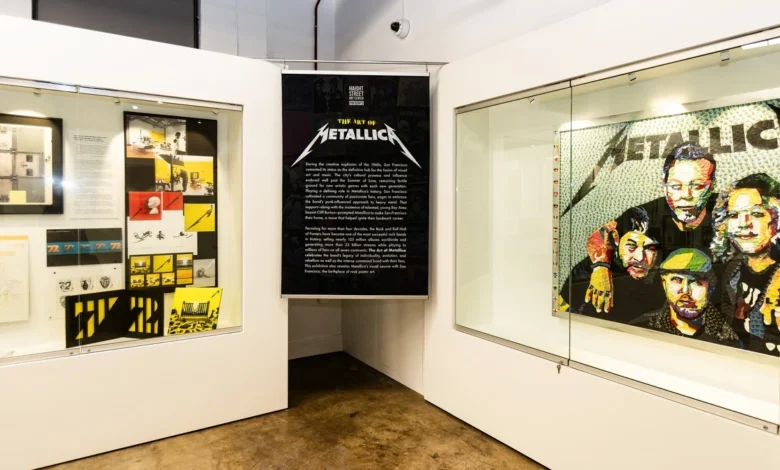
The Haight Street Art Center in San Francisco has officially unveiled a comprehensive exhibition titled The Art of Metallica, offering an expansive retrospective of the visual identity that has defined one of the most successful heavy metal bands in history. The exhibit, which opened its doors on November 5, 2026, serves as a cultural intersection between the band’s storied career and the city’s profound historical legacy as the cradle of rock poster art. For fans and art historians alike, the showcase provides an intimate look at the evolution of Metallica’s aesthetic, spanning from their thrash-metal origins in the early 1980s to their current status as global stadium-filling icons.
A Convergence of Music and Visual Culture
The choice of the Haight Street Art Center for this exhibition is far from coincidental. Located in the heart of San Francisco, the center is situated within a district synonymous with the 1960s counterculture movement and the rise of psychedelic graphic design. By hosting this collection, the institution reinforces the narrative that music and visual artistry are inextricably linked.
Kelly Harris, the Executive Director of the Haight Street Art Center, emphasized the thematic importance of the venue. "San Francisco has always been a place where art and music fuel one another, and it feels fitting that this exhibition lands here, steps from Haight Street’s own history as the birthplace of rock poster art," Harris stated. She noted that the band’s trajectory is reflective of the city’s own artistic evolution, adding, "Metallica’s story is San Francisco’s story—a band embraced early by this city’s community of fans, whose visual identity has grown right alongside its music. We’re honored to bring that legacy home."
The exhibition features a curated selection of rare posters, album cover concepts, stage design blueprints, and original illustrations that have become synonymous with the Metallica brand. From the raw, aggressive sketches of the early eighties to the sophisticated, high-concept visuals accompanying their recent "M72" world tour, the exhibit maps the transformation of the band’s visual language over four decades.
Chronology and Evolution of the Metallica Aesthetic
Metallica’s visual history is a study in creative adaptation. In the early 1980s, the band’s aesthetic was heavily influenced by the underground fanzine culture of the Bay Area. The DIY ethos of the time meant that tour posters were often crude, monochrome, and photocopied, focusing on the sheer intensity of the music.
As the band transitioned into the global spotlight with albums like Master of Puppets and the eponymous Metallica (The Black Album), their imagery became more polished and iconic. The collaboration with legendary designers and artists became a staple of their marketing strategy. The exhibit captures this shift, highlighting the work of artists like Pushead, whose skeletal and dark surrealist designs became a cornerstone of the band’s identity throughout the 1990s.
The timeline of the exhibit also touches upon the band’s recent experiments with technology. The inclusion of materials from their recent "Life Burns Faster" residency at the Las Vegas Sphere demonstrates how the band has moved from static, two-dimensional print art into the realm of immersive, digital, and architectural visual storytelling.
Supporting Data: The Business of Brand Identity
The impact of Metallica’s visual branding on their commercial success cannot be understated. Since their formation in 1981, the band has sold over 125 million albums worldwide. Industry analysts often point to the band’s ability to maintain a consistent visual "brand" as a primary reason for their enduring relevance across multiple generations of listeners.
Market research conducted within the music industry suggests that bands who invest heavily in high-quality visual art and merchandise design see significantly higher engagement rates among their fan base. Metallica’s extensive use of limited-edition screen-printed posters for every tour date has effectively turned their concert merchandise into a secondary market commodity, with some rare prints selling for thousands of dollars at auctions. The Haight Street Art Center exhibit highlights this phenomenon, validating the band’s posters not merely as promotional tools, but as legitimate works of contemporary graphic art.
Operational Details and Logistics
The exhibit is currently open to the public at the Haight Street Art Center in San Francisco. Management has set the operational hours for Thursday through Sunday, from 12:00 p.m. to 6:00 p.m. The exhibition is scheduled to run through January 10, 2027, allowing for significant traffic from local residents and traveling music tourists.
For those planning to attend, officials at the center recommend checking the official Haight Street Art Center website for updates regarding potential holiday closures or extended hours. Given the expected volume of visitors and the historical significance of the pieces on display, early arrival is encouraged.
Broader Impact: The Future of the "M72" Tour and Beyond
While the exhibit celebrates the past, Metallica remains firmly focused on the present. The band is currently in the concluding stages of their "Life Burns Faster" residency at the Las Vegas Sphere, a venue that has redefined the possibilities of live music performance through cutting-edge visual projection technology. The band is slated to return to the Sphere in January 2027, providing a direct link between the physical history displayed in San Francisco and the futuristic stagecraft currently being utilized in Nevada.
Beyond the Las Vegas dates, the band maintains a rigorous touring schedule. They have confirmed two high-profile performances at the Mohegan Sun Arena in Connecticut later this month, followed by a new North American leg of their expansive "M72" world tour, which is set to commence in May and June of 2027. This continued activity ensures that the band’s visual and auditory legacy remains a living, breathing entity rather than a static historical footnote.
Artistic Analysis and Cultural Significance
The "Art of Metallica" serves a dual purpose: it acts as a retrospective for longtime devotees and a primer for newer fans interested in the intersection of music and graphic design. By placing Metallica within the context of San Francisco’s broader art scene, the exhibit elevates the band from a heavy metal act to a cultural institution.
The curation process at the Haight Street Art Center has been praised for its attention to detail. By including the sketches and rejected concepts alongside the final products, the curators provide a rare look into the decision-making process of one of the world’s most guarded musical acts. This transparency adds a layer of depth to the visitor experience, illustrating that the band’s iconic look is the result of years of meticulous artistic refinement.
Furthermore, the exhibition underscores the resilience of the physical art form in an increasingly digital age. While much of modern music promotion has shifted to social media algorithms and ephemeral digital assets, Metallica’s continued commitment to physical, tangible art—posters, vinyl packaging, and physical installations—remains a hallmark of their success. It suggests that for all the advancements in streaming and digital consumption, the connection between a fan and a physical object remains a powerful driver of cultural loyalty.
Conclusion
The opening of "The Art of Metallica" marks a significant milestone in the preservation of modern music history. By documenting the visual evolution of a band that has consistently challenged the boundaries of its genre, the Haight Street Art Center has provided a valuable service to both the San Francisco community and the global Metallica fan base.
As the band continues their "M72" tour and their residency at the Las Vegas Sphere, this exhibition stands as a testament to the fact that their influence is not limited to their sound. It is a visual journey that spans decades, reflecting the shifting landscape of popular culture, the rise of digital technology, and the enduring power of the heavy metal aesthetic. Whether one is a lifelong fan or a casual observer of the arts, the collection at the Haight Street Art Center offers a compelling narrative of creativity, grit, and the relentless pursuit of visual excellence.
Visitors are reminded that the exhibit is a time-limited engagement, concluding on January 10, 2027. With tickets for their live performances continuing to see high demand, the exhibition serves as a vital touchstone for those looking to engage with the band’s identity on a deeper, more artistic level.