Remembering Patrick Stewart: A Legacy Across the Stage, Starfleet, and the Marvel Universe

The entertainment world was plunged into mourning following the announcement that legendary actor Sir Patrick Stewart has passed away after a brief and poignant battle with Alzheimer’s disease and Lewy body dementia. News of his death sent immediate shockwaves of grief across the globe, bringing an end to a stellar career that spanned more than six decades across classical theatre, television, and blockbuster cinema. Although the beloved actor had maintained a relatively private profile in recent years, his enduring talent remains captured on screen, including an upcoming appearance in the highly anticipated Marvel Cinematic Universe feature Avengers: Doomsday.
As colleagues, filmmakers, and millions of fans worldwide process the loss of one of the most distinguished performers of his generation, tributes have poured in celebrating his towering contributions to the arts. From the historic stages of the Royal Shakespeare Company to the bridge of the USS Enterprise and the hallowed halls of Xavier’s School for Gifted Youngsters, Stewart commanded every role with unmatched gravitas, intellectual rigor, and emotional depth.
A Storied Journey Across Theatre and Screen
Born in Mirfield, Yorkshire, England, in 1940, Stewart’s path to international stardom was paved through decades of rigorous theatrical training. He joined the Royal Shakespeare Company in 1966, quickly establishing himself as a formidable classical actor capable of plumbing the psychological depths of complex literary figures. Whether portraying the vengeful usurper in Macbeth, the tragic monarch in King Lear, or the visionary magician Prospero in The Tempest, Stewart brought an authoritative yet deeply human quality to the stage.
His transition to mainstream screen acting in the latter half of the 20th century transformed him into a household name. While he displayed immense versatility—ranging from commanding Shakespearean adaptations to gritty modern cinema, such as his terrifying turn as a skinhead gang leader in the 2015 thriller Green Room—two monumental roles ultimately defined his legacy for modern audiences: Professor Charles Xavier in the X-Men franchise and Captain Jean-Luc Picard in the Star Trek universe.
Taking the Helm: The Genesis of Jean-Luc Picard
When Paramount Television announced in 1987 that a new series titled Star Trek: The Next Generation would continue the iconic sci-fi franchise, initial reception from purists of the original 1960s series was skeptical, if not outright hostile. For two decades, William Shatner’s Captain James T. Kirk had been the definitive face of Starfleet. The idea of a classically trained British theater actor taking command of a new USS Enterprise felt jarring and unorthodox to traditional fans.
Yet, Stewart quickly dismantled all skepticism with his portrayal of Jean-Luc Picard. Unlike the swashbuckling, action-oriented persona of Kirk, Picard was portrayed as a cerebral, diplomatic, and philosophically inclined explorer. He possessed a profound respect for alien cultures, a deep love for literature and archaeology, and an unwavering moral compass. Across seven critically acclaimed seasons and four feature films—starting with 1994’s Star Trek: Generations—Stewart anchored the ensemble cast with quiet dignity, turning Picard into a cultural archetype of enlightened leadership.
The Long Road Back to the Bridge
Following the conclusion of the television series in 1994, the Next Generation film franchise experienced diminishing returns at the box office. The theatrical run culminated in 1998’s Star Trek: Insurrection and the critically and commercially disappointing 2002 release Star Trek: Nemesis. For over a decade, it appeared that Picard had been permanently consigned to the annals of television history.
However, the landscape of television shifted dramatically with the advent of streaming platforms. In 2018, Paramount+ officially announced the development of Star Trek: Picard, a serialized drama set roughly two decades after the events of Nemesis. The creative vision for the new series was intentionally distinct from its predecessor. Rather than chronicling episodic adventures aboard a deep-space vessel, the narrative focused on an aging, retired admiral grappling with his past, mortality, and the changing sociopolitical climate of the United Federation of Planets.
The first two seasons of the series deliberately favored a grounded, character-driven narrative set largely on Earth. While select alumni from The Next Generation—including Jonathan Frakes as William Riker, Marina Sirtis as Deanna Troi, Brent Spiner in various synthetic roles, and John de Lancie as the omnipotent trickster Q—made memorable guest appearances, the show remained fundamentally anchored to Picard’s individual reckoning.
A Triumphant Reunion and Final Farewell
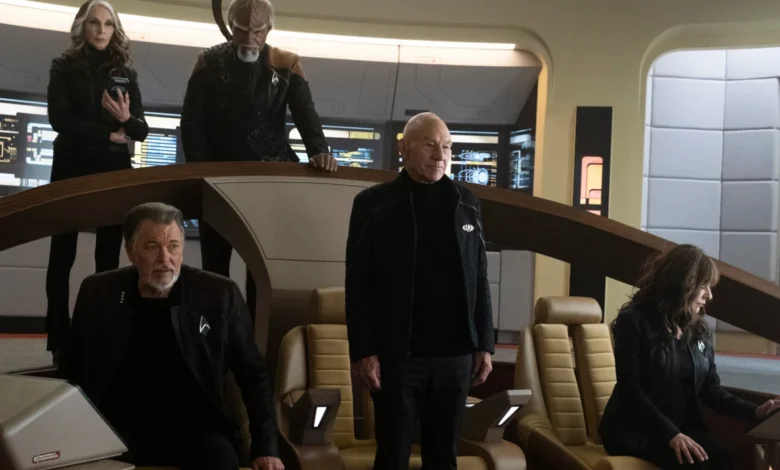
Everything changed for the third and final season of Star Trek: Picard, which premiered in 2023. Showrunner Terry Matalas and the creative team orchestrated a sweeping narrative event that invited back the entire surviving primary cast of The Next Generation for one final, high-stakes mission.
The emotional centerpiece of the season arrived when the legendary USS Enterprise-D—the iconic starship that had been absent from screens since its destruction in Star Trek: Generations—was painstakingly restored and brought back into active service. Seeing the original crew step back onto familiar command stations provided millions of longtime Trekkies with a profound sense of closure and emotional validation that the 1990s film era had failed to deliver.
The series concluded on a note of warmth and camaraderie. In the final scenes, the crew gathers at a Los Angeles bar to toast their shared history. Asked to speak, Captain Picard delivers a poignant reading from William Shakespeare’s Julius Caesar:
"There is a tide in the affairs of men, which, taken at the flood, leads on to fortune; omitted, all the voyage of their life is bound in shallows and in miseries. On such a full sea are we now afloat, and we must take the current when it serves, or lose our ventures."
The moment served as a brilliant synthesis of Stewart’s dual artistic identities, marrying his lifelong dedication to classical verse with his iconic science-fiction persona. Moments later, the series offered one final, nostalgic callback to the final episode of The Next Generation: Picard proposing a casual game of poker among old friends. The final lingering image of Stewart in the franchise showed him beaming with unbridled joy, surrounded by his closest colleagues and lifelong friends.
Implications and Cultural Legacy
The passing of Sir Patrick Stewart marks the end of an era for entertainment, leaving a void in both classical theater and modern blockbuster franchises. Beyond his contributions to Star Trek, his decade-spanning portrayal of Professor Charles Xavier in 20th Century Fox’s X-Men franchise helped pioneer the modern superhero cinema boom, establishing a template for gravitas and emotional resonance in comic book adaptations.
Industry analysts note that Stewart’s ability to transition seamlessly between high art and popular culture set a gold standard for contemporary actors. His refusal to look down upon genre television or blockbuster franchises—instead bringing absolute dedication and theatrical discipline to every role—elevated the material and earned him the lifelong respect of fans and peers alike.
Even in his final years, despite facing private health challenges, Stewart maintained his professional commitments. His upcoming appearance in Avengers: Doomsday stands as a testament to his tireless work ethic and dedication to his craft. While the global entertainment community mourns the loss of a true titan, his performances across stage and screen ensure that his legacy will endure indefinitely across the cosmos and in the hearts of generations of admirers.