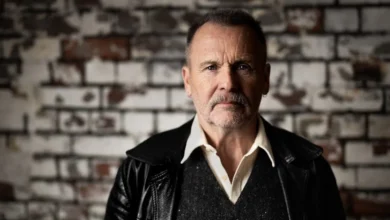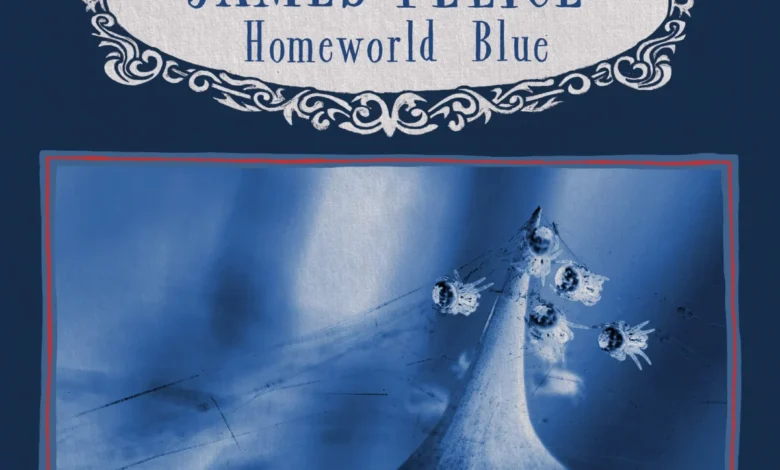
The boundaries separating the physical environment from the boundless, surreal landscapes of the human imagination have long served as fertile ground for visionary songwriters. In the case of acclaimed musician and multi-instrumentalist James Felice, this dichotomy has culminated in a sweeping, gravity-defying sophomore solo record titled Homeworld Blue. Developed over the course of more than four years, the album represents a dramatic departure from the quiet subtlety of his 2025 solo debut, The Little Ones. Crafted during the protracted isolation of the late COVID-19 pandemic and recorded in Omaha under the stewardship of Bright Eyes multi-instrumentalist Nathaniel Walcott, Homeworld Blue stands as a testament to the resilience of artistic creation under constraint, transforming confinement into an expansive orchestral odyssey.
Genesis in Isolation: The Pandemic Chronology
The chronology of Homeworld Blue traces its roots back to the height of pandemic-related lockdowns, a period that fundamentally reshaped how independent artists approached the creative process. Confined to his home, Felice—best known for his work alongside his brother Ian in the celebrated folk-rock outfit The Felice Brothers—found himself stripped of the traditional touring infrastructure that had dictated his professional schedule for over a decade and a half.
Left with limited physical mobility, Felice turned inward, utilizing the solitary confines of his attic as both a sanctuary and a laboratory. It was within this intimate domestic space that the foundational arrangements for Homeworld Blue were first conceived. While many artists responded to the lockdowns with minimalist acoustic recordings designed to reflect the quietude of isolation, Felice envisioned the exact opposite: a towering, maximalist sonic architecture.
By late 2022 and early 2023, as pandemic restrictions began to ease globally, these attic-born demos evolved into fully realized compositional blueprints. Recognizing that the realization of these grandiose arrangements required specialized production expertise, Felice relocated sessions to Omaha, Nebraska. There, he enlisted Nathaniel Walcott—whose extensive background with Bright Eyes and orchestrations for artists like R.E.M. and First Aid Kit made him uniquely qualified to translate Felice’s complex vision into reality. Over successive recording blocks spanning late 2023 through mid-2024, Walcott and Felice meticulously layered brass, woodwinds, percussion, and sweeping string arrangements over the core instrumentation, building a dense, cinematic soundscape.
A Maximalist Shift from The Little Ones
To fully contextualize the musical magnitude of Homeworld Blue, industry critics and musicologists look directly to its predecessor, The Little Ones, released in early 2025. That album was widely praised by contemporary music publications for its incandescent restraint. Relying primarily on hushed vocal deliveries, delicate acoustic guitar patterns, and understated piano lines, The Little Ones explored themes of domesticity and personal reflection through a magnifying glass, inviting listeners into a whisper-quiet world.
Homeworld Blue, by contrast, shatters those acoustic parameters. The sophomore release demands higher volume and a wider dynamic range, anchored by towering orchestrations that feature prominent timpani rolls, soaring horn sections, and swirling woodwind countermelodies. Despite this massive sonic expansion, Felice’s signature humility remains intact. His foundational piano-playing serves as the emotional anchor beneath the orchestral grandeur, proving that the songwriter’s core melodic sensibilities can withstand monumental arrangements without losing their intimacy.
Music industry analysts note that this pivot from minimalism to maximalism is a rare feat for an established artist transitioning into solo work. Where many singer-songwriters establish a singular sonic brand and remain within those stylistic boundaries, Felice has actively courted risk, demonstrating a compositional range that spans the delicate acoustics of a quiet room to the thunderous acoustics of a concert hall.
Lyrical Depth and the Human Condition
Beneath the towering wall of strings and horns lies a treasure trove of rich, lived-in characters possessing vivid inner emotional lives. Felice has built a reputation for taking minor autobiographical anecdotes and emotional nuggets from his own existence, expanding them outward until they achieve universal resonance.
The resulting songs are deeply human, engaging in philosophical ruminations on mortality, grief, and spiritual rebirth that transcend standard contemporary lyricism. This transcendence is particularly evident on tracks such as "Let Yourself Live," where Felice adopts the cadence of a secular preacher delivering hard-earned wisdom.
"For it is what it is / And it always shall be / The easiest answers provide no kind of relief," Felice sings with urgent conviction, before arriving at the song’s core thesis: "We get what we get / And we use what can be used / You gotta let yourself live my friend what else can you do?"
According to literary and cultural analysts who study contemporary songwriting, these lyrics capture the prevailing post-pandemic zeitgeist. Rather than offering platitudes or escapist fantasies, Felice confronts the inherent unpredictability of human existence with pragmatic acceptance. The synthesis of this world-weary lyricism with triumphant, swelling orchestral arrangements creates an emotional push-and-pull that defines the listening experience of the record.
Production and Instrumentation: The Nathaniel Walcott Collaboration
The partnership between James Felice and Nathaniel Walcott was instrumental in achieving the distinctive sonic profile of Homeworld Blue. Walcott, an accomplished composer and arranger known for his nuanced touch within the indie-rock ecosystem, brought a classical sensibility to Felice’s folk-rooted songwriting.
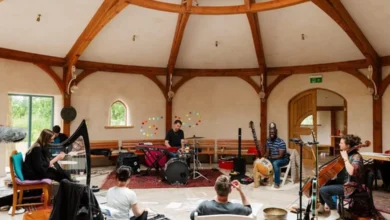
Sessions in Omaha were characterized by an exhaustive attention to detail. Rather than relying entirely on digital sample libraries to simulate orchestral textures, Felice and Walcott incorporated live session players to perform the intricate string and horn charts. The inclusion of timpani—often reserved for classical concertos or cinematic film scores—adds a dramatic, heartbeat-like pulse to several tracks, elevating the record from a standard collection of songs into a cohesive auditory narrative.
In statements regarding the collaborative process, industry observers have highlighted how Walcott’s arrangement skills allowed Felice’s vocal performances to cut through dense sonic arrangements without requiring artificial compression or excessive volume. The result is a masterclass in dynamic mixing, where quiet vocal passages coexist seamlessly with explosive instrumental crescendos.
Broader Impact and Market Implications
The release of Homeworld Blue arrives at a pivotal moment for independent music distribution and the evolving role of veteran artists in the modern streaming economy. As an artist with deep roots in the Americana and indie-folk communities through his work with The Felice Brothers, Felice’s expansion into orchestral solo work signals a broader trend of genre-fluid experimentation among established songwriters who emerged from the 2000s roots-rock revival.
Market analysts studying independent record sales and streaming habits note that crossover albums combining traditional folk storytelling with high-production orchestral elements frequently attract critical acclaim and sustainable long-term audiences. By distancing himself from the genre expectations of his past collaborative work, Felice has positioned himself as a versatile auteur capable of bridging the gap between intimate singer-songwriter traditions and modern chamber pop.
Furthermore, the album’s lengthy four-year development cycle underscores the changing economics of record production. In an era where artists often feel pressured by streaming algorithms to release frequent, low-concept content, Homeworld Blue demonstrates the commercial and artistic viability of deliberate, long-form craftsmanship. The investment of time, resources, and geographic relocation to Omaha has yielded a product that stands apart from standard industry output.
Conclusion and Future Outlook
As Homeworld Blue makes its way to streaming platforms and physical retailers worldwide, the critical consensus points toward a defining milestone in James Felice’s career. By turning the isolation of a global health crisis into an expansive, surreal exploration of the human psyche, the songwriter has successfully challenged his own creative limits.
Supported by Nathaniel Walcott’s pristine production and elevated by arrangements that stretch from whispered piano chords to thunderous timpani and string sections, the album proves that Felice’s artistic vision is as limitless as it is grounded in universal human truths. Whether performing to intimate club audiences or headlining theater spaces capable of housing his grander sonic ambitions, James Felice has cemented his status as one of the most compelling and unpredictable voices in contemporary independent music.