Neil Young Files New Lawsuit Against Donald Trump Campaign Over Unauthorized Use of Rockin In The Free World at Political Rallies

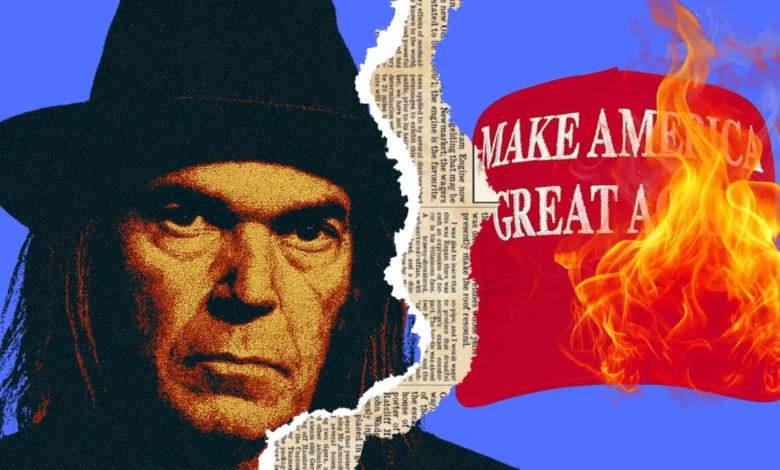
Legendary singer-songwriter Neil Young has once again taken legal action against Donald Trump and associated political fundraising committees, alleging copyright infringement over the repeated, unauthorized use of his 1989 protest anthem, Rockin In The Free World, at political campaign events. The fresh lawsuit, filed ahead of the closely watched United States midterm elections, targets the Trump 47 Committee and contends that the campaign willfully bypassed licensing restrictions to employ the track at pre-election rallies, most notably at a gathering in Youngstown, Ohio.
This legal confrontation marks the second time Young has initiated litigation against Trump for utilizing the classic rock track. In 2020, the Canadian-American artist filed a similar federal lawsuit after the Trump campaign played the song at a Mount Rushmore rally. That preceding legal challenge concluded when the Trump campaign organization settled out of court, ostensibly agreeing to cease using the composition without explicit authorization. The revival of the dispute brings renewed attention to the complex intersection of copyright law, public performance licensing, and political campaign event management in the United States.
Chronology of Legal Conflict and Campaign Music Disputes
The friction between prominent musicians and political campaigns utilizing unauthorized soundtracks is a recurring feature of modern American elections. The chronology of the Neil Young versus Donald Trump dispute highlights a persistent pattern of defiance and legal posturing.
In 2015, during the nascent stages of Donald Trump’s initial presidential campaign, Rockin In The Free World was famously played during his announcement event at Trump Tower. At that time, representatives for Young issued a public statement clarifying that the campaign had neither sought nor received permission to use the song, noting that Young supported Bernie Sanders for the Democratic nomination. Despite the initial public rebuke, the song periodically resurfaced at subsequent campaign rallies.
The tension escalated significantly in the summer of 2020. Following the deployment of the track at the Mount Rushmore Independence Day celebration, Young formally initiated a copyright infringement lawsuit in the U.S. District Court for the Southern District of New York. The legal documents filed in 2020 pointed out that the continuous, unauthorized broadcast of the song falsely implied Young’s political endorsement. The Donald J Trump For President organization ultimately opted against mounting a formal defense, settling the litigation and pledging to respect the artist’s licensing restrictions moving forward.
Despite that 2020 resolution, the current legal filing alleges that the successor political committee, the Trump 47 Committee, resumed playing the track at multiple rallies designed to galvanize Republican voters ahead of the midterm elections. Young’s legal team argues that the prior settlement serves as incontrovertible proof that the defendants possessed actual knowledge of the infringement and willfully disregarded copyright law.
The Lyrical Contrast and Ideological Incongruity
At the heart of Young’s grievance is a stark ideological contradiction between the message of Rockin In The Free World and the political rhetoric espoused by Donald Trump. Written during the late Cold War era, the song features blistering instrumentation juxtaposed with stark, melancholic lyrical portraits of societal abandonment, poverty, and addiction.
According to the legal complaint, the song functions as a direct critique of hollow political promises. The lyrics deliberately contrast the grand ideals of American prosperity with the harsh realities faced by marginalized populations, including the homeless, individuals struggling with substance abuse, and impoverished families. Young’s legal representatives state in the current filing that the composition represents "the opposite of everything that Donald J Trump stands for," transforming the use of the track into a source of bitter irony.
This thematic dissonance is not unique to Young’s catalog. Throughout successive presidential campaigns, the Trump organization has repeatedly faced public backlash and legal warnings from legacy artists for deploying music that directly conflicts with the creators’ political ideologies.
Notable Precedents: Eddy Grant, Village People, and Beyond
The legal landscape surrounding campaign music has yielded several high-profile disputes involving Donald Trump’s rallies and promotional media. In 2020, reggae icon Eddy Grant filed a copyright infringement lawsuit against the Trump campaign over the unauthorized use of his 1983 anti-apartheid and social justice protest song, Electric Avenue, in a campaign video.
In that case, U.S. District Judge John Koeltl ultimately ruled against the Trump campaign, affirming that the unauthorized synchronization of the song in a political video constituted copyright infringement rather than fair use. Legal experts noted that the ruling underscored a fundamental misunderstanding by campaign organizers regarding the distinction between public performance licensing and synchronization licensing for audio-visual media.
A similarly complex dynamic surrounds the frequent use of the Village People’s disco anthem, YMCA. The track has served as a staple walk-on and rally-closing song at numerous Trump events, frequently accompanied by the former president’s characteristic dance routine. While the song is historically recognized as a celebration of gay culture and community, its usage generated public debate regarding LGBTQ+ representation and political messaging.
Victor Willis, the co-founder and lead singer of the Village People, initially expressed disapproval of the campaign’s unauthorized use of the track. However, Willis later adopted a more accommodating stance, publicly stating that he had no legal objection to the song’s continued inclusion at rallies, while simultaneously disputing the cultural characterization of the track as an exclusive gay anthem. This divergence of views illustrates the varied approaches artists take when addressing the political appropriation of their intellectual property.
The Mechanics of Political Music Licensing
Navigating the rules governing music performance at political rallies requires an understanding of the mechanisms established by American performing rights organizations (PROs), such as the American Society of Composers, Authors and Publishers (ASCAP) and Broadcast Music, Inc. (BMI).
Typically, public venues—such as arenas, convention centers, and hotels—maintain blanket licenses with organizations like ASCAP and BMI. These standard commercial blanket licenses permit the venue to publicly perform any copyrighted musical composition within the PROs’ respective repertoires. However, a crucial exception exists specifically for political campaigns and rallies.
Under the operational frameworks of ASCAP and BMI, standard venue blanket licenses do not extend to political campaign events. Consequently, political candidates and their organizing committees are legally required to secure dedicated political campaign blanket licenses directly from the licensing organizations.
Furthermore, PRO rules historically incorporate a political opt-out provision. This mechanism allows individual songwriters and publishers to notify the licensing organizations that they explicitly withhold permission for their compositions to be included in political campaign licenses. When an artist exercises this opt-out right, the political license issued to a campaign or candidate explicitly excludes those specific works.
Legal scholars note that the enforceability of these political opt-out provisions remains an evolving area of intellectual property law. Because few music-use lawsuits against political campaigns proceed through a full trial to a judicial verdict—preferring instead confidential financial settlements—the courts have yet to definitively rule on whether PROs possess the regulatory latitude under their historical antitrust consent decrees to enforce individual songwriter political opt-outs.
Broader Implications and Industry Impact
The ongoing legal disputes involving Neil Young and other prominent musicians highlight broader structural challenges within the live events and political campaigning sectors. As modern political rallies increasingly resemble high-production entertainment spectacles, the demand for high-energy, recognizable soundtracks has intensified.
For copyright holders, unauthorized usage poses both economic and reputational concerns. While statutory damages and licensing fees provide a financial remedy, many artists are driven primarily by the desire to prevent their creative works from being weaponized to endorse political viewpoints or candidates they oppose.
Industry analysts suggest that the escalating frequency of such lawsuits may prompt political organizations to adopt more rigorous vetting protocols. Professional campaign management teams are increasingly turning to dedicated production music libraries, explicitly licensed tracks, or supportive artists willing to grant formal permission, thereby mitigating the risk of costly copyright litigation.
As the legal proceedings between Neil Young and the Trump 47 Committee progress, legal experts will closely monitor whether the case ultimately proceeds toward judicial scrutiny or concludes through a negotiated settlement akin to the 2000 litigation. Regardless of the immediate outcome, the dispute cements a precedent for how artists leverage intellectual property law to safeguard their creative autonomy against political appropriation in the United States.
Related posts: