Macklemore removed from Ed Sheeran tour following public controversy over political statements at concert venues

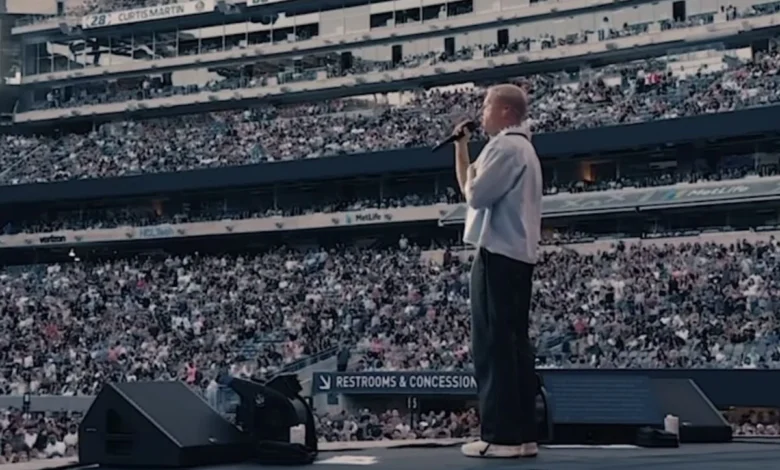
The professional relationship between Grammy-winning rapper Macklemore and global pop superstar Ed Sheeran has come to an abrupt conclusion, as the former has been removed from the remaining dates of Sheeran’s current U.S. stadium tour. The separation follows a high-profile controversy stemming from remarks made by Macklemore during his opening set at MetLife Stadium in New Jersey earlier this month, where he utilized the platform to voice strong, politically charged opinions regarding the ongoing Israel-Palestine conflict. The decision to remove the artist from the tour, which involves multiple major stadiums, was reportedly precipitated by pressure from venue owners, led by New England Patriots owner Robert Kraft.
A Chronology of the Controversy
The events that culminated in Macklemore’s departure from the tour began in early September 2026. During his performance at MetLife Stadium, the rapper engaged in an extended, nearly three-minute monologue directed at the audience. In his remarks, he expressed support for the Palestinian cause, calling for a "Free Palestine" and explicitly referencing the occupied West Bank and Gaza. Beyond these comments, the performance included rhetoric supporting Iran and the characterization of U.S. Immigration and Customs Enforcement (ICE) as a "terrorist organization."
The video footage of these remarks circulated rapidly across social media platforms, drawing immediate backlash from various corners of the music industry and public figures. By September 9, fellow musician Joe Bonamassa publicly criticized the rapper’s decision to use a high-profile opening slot for partisan political discourse, citing professional "etiquette" regarding supporting acts. Shortly thereafter, singer Pink, who has been vocal about her Jewish identity, issued a public response that criticized the nature of the remarks and explicitly condemned Hamas as a terrorist organization.
As the media cycle intensified, the business implications for the tour became apparent. According to statements released later by the rapper, Ed Sheeran was contacted by Robert Kraft regarding upcoming dates at Gillette Stadium. The communication reportedly served as an ultimatum: the venue owners would not permit the performance to proceed as scheduled if the opening act remained on the bill. This pressure was not confined to Foxborough; reports confirmed that other major venues, including Lincoln Financial Field in Philadelphia and AT&T Stadium in Arlington, expressed similar objections, threatening to withdraw hosting privileges for the remainder of the tour.
The Stance of the Kraft Group and Venue Owners
Robert Kraft, chairman and CEO of the Kraft Group, issued a formal and detailed statement addressing the decision. The statement emphasized that Gillette Stadium maintains a commitment to providing an environment free from what the organization defines as hate speech. The document explicitly linked the decision to a "broader history of antisemitic rhetoric and imagery" that the ownership group deemed harmful to the Jewish community.
"This decision is not about diminishing the suffering of innocent Palestinians or denying anyone the right to advocate on their behalf," the statement read. "Their pain and loss are real. But that advocacy should not come at the expense of the Jewish community or obscure the responsibility of Hamas, a United States and globally designated terrorist organization."
The statement highlighted a distinction between political activism and what the venue management perceived as divisive rhetoric. Kraft noted that his personal history includes significant philanthropic efforts in the Middle East, including support for entrepreneurial and athletic initiatives in Palestine. He argued that it is possible to advocate for the welfare of the Palestinian people while simultaneously standing against terrorism and antisemitism, suggesting that the rapper’s approach lacked the nuance required for a constructive dialogue. The statement concluded with an invitation for a private discussion, maintaining that the ultimate objective of the venue management is the promotion of peace and the mitigation of suffering.
Professional Standards and Venue Management
The incident has reignited a long-standing debate within the entertainment industry regarding the role of opening acts and the boundaries of political expression in stadium settings. Unlike solo headlining tours, where an artist has total autonomy over the stage and the message, opening acts operate under the umbrella of a larger contractual agreement that involves stadium operators, promoters, and the headlining artist’s management team.
Industry experts note that "morality clauses" and venue-specific policies often govern the behavior of performers in large-scale professional sports arenas. These venues are private property, and owners maintain the right to curate the content presented on their stages to align with their corporate values and local community standards. When an opening act’s performance leads to public outcry or potential security concerns, the stadium operators have the leverage to force changes in the lineup to protect their brand and the safety of the event.
The specific venues involved in the pushback—including Mercedes-Benz Stadium in Atlanta, Lucas Oil Stadium in Indianapolis, Bank of America Stadium in Charlotte, and Raymond James Stadium in Tampa—represent some of the largest entertainment hubs in the United States. For an artist like Ed Sheeran, whose "Loop Tour" is designed to be a family-friendly, global event, the friction created by a political firestorm presents a significant logistical and public relations challenge.
Broader Implications for Artists and Activism
Macklemore’s removal from the tour serves as a case study in the intersection of celebrity activism and corporate accountability. In recent years, artists have increasingly used their platforms to discuss complex global issues. However, the scale of a stadium tour requires a high degree of coordination between stakeholders who may not share the artist’s specific political leanings.
For many observers, the incident underscores the tension between free speech and the commercial requirements of the live music industry. While artists possess the creative freedom to speak their minds, the financial and operational reality of touring often means that speech has consequences. The fact that seven of the eight remaining venues expressed opposition to the act demonstrates a unified front among major stadium operators regarding the types of discourse they are willing to host.
Furthermore, the public discourse surrounding the incident highlights a deeper polarization in the music industry. The exchange between figures like Pink and Macklemore reflects the broader societal divide regarding the conflict in the Middle East. As artists continue to navigate these sensitive topics, the industry is seeing a move toward more stringent vetting processes for touring partners and a more proactive stance from venue management teams.
Conclusion and Future Outlook
The fallout from this tour cancellation is expected to have lasting impacts on how stadium tours are booked and managed. By framing the conflict in terms of "antisemitism" versus "advocacy," both parties have laid out fundamentally different interpretations of the responsibilities of a public figure.
Ed Sheeran has not issued a detailed personal statement regarding the specific circumstances of the termination of the professional relationship, though it is understood that the tour will continue as scheduled with adjustments to the lineup. For Macklemore, the incident represents a significant pivot point in his career, raising questions about how his future public engagements will be received by promoters and large-scale venues.
As the industry moves forward, the "Macklemore-Kraft" episode will likely be cited as a primary example of the limitations of political expression in the high-stakes world of arena rock. It serves as a reminder that in the modern entertainment landscape, the stage is a shared space, subject to the consensus of the stakeholders who maintain it. Whether this leads to a chilling effect on political discourse in music or a more standardized framework for how artists address global issues remains to be seen. For now, the focus remains on the logistical transition of the tour and the continued debate over where the line between personal conviction and professional conduct should be drawn.
Related posts: