Unearthing the Margins: Bird in the Belly Blends British Folk-Rock Tradition with Forgotten History in Fourth Album Only Dogs as Friends

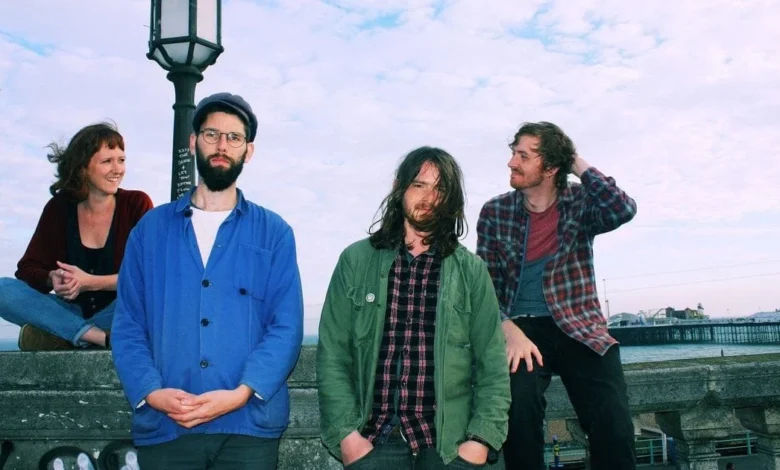
The Brighton-based contemporary folk-rock quartet Bird in the Belly has officially announced the release of their fourth studio album, Only Dogs as Friends, slated to drop on October 30, 2026, via GF*M Records. Comprising band members Ben “Jinwoo” Webb, Laura Ward, Tom Pryor, and Adam Ronchetti, the ensemble continues to carve out a singular niche within the modern musical landscape. Drawing heavy aesthetic inspiration from pioneering British folk-rock acts of the 1970s—such as Fairport Convention and Trees—the group marries classic instrumentation with unconventional historical narratives. Rather than relying solely on traditional pastoral themes, Bird in the Belly focuses on the darker, more obscure corners of historical record, giving voice to the downtrodden, the disenfranchised, and the historically marginalized.
The Evolution of Alternative Folk History
Since their inception, Bird in the Belly has operated on the premise that historical narratives, particularly those preserved in standard textbooks, often overlook the realities of society’s most vulnerable populations. By deliberately exploiting the porous boundaries between the past and the present, the Brighton quartet constructs an alternative folk history. Their songwriting process involves unearthing archival documents, broadside ballads, and forgotten legal cases, transforming them into cohesive musical compositions that maintain a broad allegiance to traditional folk structures.
Industry analysts and music critics have noted that this approach elevates folk music from mere preservation to an active form of historical reclamation. By resurrecting stories of individuals who lived centuries ago, the band manages to bridge the chronological gap, proving that systemic struggles, societal cruelty, and marginalized identities are as relevant in the contemporary social and political climate as they were during the medieval and early modern periods.
Track-by-Track Examination: The Intersection of History and Protest
Only Dogs as Friends features a diverse tracklist that balances tales of genuine villainy with poignant accounts of societal victims. Among the album’s most striking historical commentaries is the track Lambs. The song chronicles the life and execution of Giovanni de Giovanni, a 14th-century teenager in Florence who fell victim to increasingly punitive legislation targeting sodomy and perceived moral deviance. Set against a lush, melancholic chamber-folk arrangement, Webb’s vocal delivery employs a cracked, tender intensity. With homosexual acts still criminalized in numerous nation-states nearly seven hundred years later, Lambs functions simultaneously as a historical artifact and a contemporary protest anthem.
Similarly, Go Along Bobby reinterprets the traditional ballad Katie Cruel, shifting the narrative focus to a marginalized woman who turns to sex work to support her dying husband. Trading in the passive role often assigned to her in earlier iterations of the song, this version positions the protagonist as an empathetic figure caught within a larger, predatory societal structure. This theatrical sensibility extends to Old Holborn, which adopts the perspective of Margaret Clap—an 18th-century entrepreneur who operated a "molly house," providing a clandestine sanctuary for London’s outlawed gay communities.
Villainy, Folklore, and Macabre Masterpieces
While several tracks champion the disenfranchised, the album simultaneously delves into the lives of genuine historical villains, pulling back the curtain on weird, gory, and filthy historical details. The title track, which serves as the album’s brisk and rousing opener, recounts the true story of a Shoreham criminal killed during a burglary. In accordance with grim historical practices of the era, his unidentified corpse was publicly displayed until his faithful dog came forward to identify him. This narrative is propelled by Pryor and Ronchetti on violin and bodhran, complemented by the vocal partnership of Webb and Ward, which music critics have favorably compared to legendary folk pairings like Tim Hart and Maddy Prior.
The dark, percussive track Hen’s Egg tackles the grim historical reality of "baby farming" through the lens of notorious mass-murderer Amelia Dyer. Rather than resorting to cheap sensationalism, Webb weaves rich, allusive lyrics incorporating passages from classic literature, establishing a magpie approach to lyricism that reappears on I Once Built a Boy. The latter song interpolates Alfred Lord Tennyson’s poem Rizpah to tell the devastating story of a grieving mother who systematically dismantles the gallows-hung corpse of her son to reconstruct him at home for a proper Christian burial. Driven by Ward’s clear, plaintive delivery, the track extracts profound emotional resonance from deeply macabre source material.
Broader Cultural Implications and Critical Reception
The album continues its exploration of societal outcasts with 40 Elephants, a concise, sweet-melodied track detailing the century-long exploits of London’s all-female crime syndicate. Meanwhile, Fairweather MacGregor adapts a broadside ballad titled The Land of Poyais, originally penned by Scottish fraudster Gregor MacGregor as an advertising campaign for a completely fabricated South American utopia. The song chronicles the heartbreaking fate of hundreds of pioneers who fell victim to the scheme, heightened by Ward’s mournful flute arrangement.
Concluding with Black Annis—a haunting tale of a Leicestershire bogeywoman—and an unexpectedly dark adaptation of Big Rock Candy Mountain, the album finishes with the empowerment-focused Law of Kissing. This closing track retells a historical legal dispute wherein a court ruled in favor of a woman who bit off the nose of her assailant in self-defense. By infusing the conclusion with both humor and moral clarity, Bird in the Belly solidifies its reputation as a singular and valuable entity in modern music.
As cultural commentators evaluate the ongoing intersection of traditional folk music and contemporary socio-political discourse, Only Dogs as Friends stands out as a masterclass in historical synthesis. By drawing upon the golden age of 1970s British folk-rock while maintaining an uncompromising focus on the voiceless, Bird in the Belly has delivered a seminal work that defies easy categorization and sets a formidable benchmark for the genre.