A Triumphant Revival of Mozart’s Don Giovanni at the Royal Opera House Blends Victorian Aesthetics with Vocal Mastery

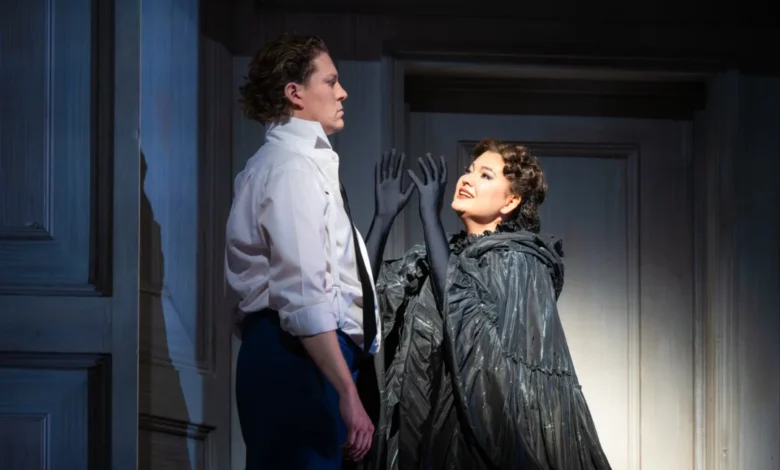
The Royal Opera House in London has once again opened its doors to one of the most enduring pillars of the classical repertoire, staging a striking revival of Wolfgang Amadeus Mozart’s masterwork. Formally categorized by the composer and his librettist, Lorenzo Da Ponte, as a dramma giocoso—a genre bridging comic opera and profound dramatic tension—this production reimagines the classic 18th-century Spanish narrative within the rigid moral framework and shadowy aesthetics of the 19th-century Victorian era. Directed originally by Kasper Holten in 2014 and revived by Greg Eldridge, the current mounting succeeds in delivering a feast for the senses, driven by an exceptional international cast and innovative stagecraft that probes the psychological depths of its titular antihero.
Main Facts and Production Design
At the core of the production’s visual and atmospheric success is Es Devlin’s monumental rotating set. The architectural marvel presents a towering Victorian mansion facade complete with functional levels, balconies, and doors. As the structure slowly revolves, it unveils the inner workings of a complex social labyrinth, featuring a central spiral staircase and interlocking pathways that function as a physical metaphor for a Pandora’s box of secrets. Complementing this architectural ingenuity are Luke Halls’ dynamic video graphics. Projected directly onto the set, these animations display the sprawling, handwritten registry of Don Giovanni’s conquests—a modern, digitized interpretation of Leporello’s famous catalogue—alongside swirling corridors, entwined figures, and vivid splatters of blood that map out the psychological decay and chaotic thought processes of the protagonist.
Bruno Poet’s lighting design further heightens the dramatic tension, employing stark, isolating spotlights and long, atmospheric shadows that isolate characters in their moments of moral crisis or vulnerability. Anja Vang Kragh’s costume designs anchor the production firmly in the Victorian period while incorporating clever sartorial engineering, allowing performers to occasionally blend invisibly into the animated projections cast across the stage. Musically, the Orchestra of the Royal Opera House delivered a technically pristine performance under the baton of conductor Stefano Montanari. While Montanari’s brisk tempi injected palpable adrenaline into the score, they occasionally tested the synchronization between the pit and the stage, though without eclipsing the overarching instrumental brilliance.
Chronology and Narrative Arc
The narrative structure of Don Giovanni follows a relentless, accelerated timeline compressed over roughly twenty-four hours of escalating chaos. The plot initiates in the dead of night within an 19th-century aristocratic enclave, where the serial seducer Don Giovanni attempts an illicit tryst with Donna Anna. Discovered by her father, the Commendatore, Giovanni engages the older man in a fatal duel before fleeing into the shadows with his long-suffering valet, Leporello.
Rather than exercising caution in the wake of homicide, Giovanni’s predatory momentum accelerates through the following day. He attempts to evade the furious pursuit of Donna Elvira, a former lover he abandoned, while simultaneously crashing the wedding festivities of a peasant bride, Zerlina, to seduce her. As the daylight wanes, the web of victims—led by Donna Anna and her hesitant fiancé, Don Ottavio—coalesces into a unified front determined to bring the libertine to justice. The narrative hurtles toward its supernatural climax when the stone statue of the murdered Commendatore returns to life, demanding repentance. Refusing to yield, Giovanni is dragged down into the fiery depths of damnation, reinforcing the immutable theatrical moral that earthly hubris and unchecked transgression inevitably face a transcendent reckoning.
Cast Performances and Vocal Analysis
Canadian bass-baritone Gordon Bintner commanded the stage in the titular role, projecting an aura of arrogant fearlessness and aristocratic entitlement. Bintner’s instrument possesses a rich, malt-like resonance, which he deployed to thrilling effect during his rapid-fire rendition of the iconic Champagne aria, "Fin ch’han dal vino." Yet, he also demonstrated admirable dynamic range, shifting effortlessly into a warm, melting tone for the seductive canzonetta "Deh, vieni alla finestra."
Vocationally and dramatically matching Bintner was Italian bass Roberto Tagliavini as Leporello. Tagliavini brought a stentorian depth and rich color to the role, anchoring the opera’s opening scenes with a weary, grounded gravitas in "Notte e giorno faticar." His comedic timing and dynamic interplay with Bintner provided vital levity, culminating in a brilliantly executed "Madamina, il catalogo è questo."
In the role of the steadfast yet psychologically complex Don Ottavio, tenor Bogdan Volkov offered a masterclass in vocal restraint and noble elegance. Despite the character’s traditional reputation for passivity, Volkov invested the part with quiet strength and genuine emotional urgency, delivering his second-act aria, "Il mio tesoro," with soaring lyricism that earned the warmest ovation of the evening.
Soprano Rachel Willis-Sørensen undertook the demanding role of Donna Anna, showcasing formidable technical security across her entire register. Her navigation of the demanding coloratura passages and soaring top notes in "Or sai chi l’onore" and the emotionally resonant "Non mi dir, bell’idol mio" displayed exceptional vocal discipline. However, the production’s directorial choices introduced notable controversy regarding her character arc. During Don Ottavio’s tender aria "Dalla sua pace," Holten’s staging required Donna Anna to briefly return upstairs to engage in an intimate, ambiguous encounter with Giovanni, her father’s murderer. While this directorial intervention aimed to interrogate the grey areas of trauma, obsessive desire, and Victorian social hypocrisy, critics noted that it risked undermining Donna Anna’s initial cries for vengeance by rendering her a complicit participant in the perpetrator’s psychological orbit.
Mezzo-soprano Aigul Akhmetshina triumphed in her role debut as the volatile and emotionally fractured Donna Elvira. Akhmetshina’s portrayal charted a turbulent course between lingering infatuation and righteous fury. Beginning with a cautious poise, she soon unleashed the full, distinctive timbre that has established her as one of the premier mezzo-sopranos of her generation. Her performance of "Mi tradì quell’alma ingrata" captured the profound internal conflict of a woman torn between betrayal and enduring affection, standing out as a musical high point of the evening.
Rounding out the principal cast, soprano Giulia Semenzato delivered a sparkling and stylish portrayal of Zerlina, balancing sweetness in "Batti, batti, o bel Masetto" with sassy resilience in "Vedrai, carino." Bass-baritone Dingle Yandell brought striking physical height and a clarion, commanding voice to the role of Masetto, perfectly embodying the frustrated, working-class fiancé. Finally, Andreas Bauer Kanabas utilized his resonant, cavernous bass to chilling effect as the spectral Commendatore, anchoring the opera’s apocalyptic moral conclusion with terrifying vocal authority.
Broader Impact and Artistic Implications
This staging of Don Giovanni at the Royal Opera House underscores the enduring viability of canonical opera within modern theatrical contexts. By fusing cutting-edge digital projection technology with traditional psychological interpretation, the production bridges the gap between 18th-century musical formalism and 21st-century visual expectations. While certain directorial liberties—such as the complex moral blurring between Donna Anna and her tormentor—continue to provoke debate among purists, the overarching artistic achievement of the ensemble demonstrates Mozart’s capacity to continually interrogate human desire, social hypocrisy, and moral accountability. As opera houses increasingly look for ways to attract contemporary audiences without alienating traditionalists, productions of this caliber offer a compelling blueprint for how timeless scores can be revitalized through bold design and world-class vocal execution.