Deconstructing the Modern Sonic Narrative: Pianist Peter Saltzman Challenges Traditional Mediums with Blues, Preludes and Feuds A Musical Diary

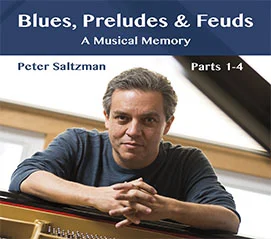
Pianist, composer, and conceptualist Peter Saltzman has officially released his latest solo project, Blues, Preludes & Feuds: A Musical Memory, challenging the traditional paradigms of how recorded music is consumed, packaged, and defined. In the opening liner notes of the release, Saltzman issues a direct provocation to his audience, declaring that the physical item they hold is explicitly "not a CD." Instead, the project manifests as a hybrid digital artifact—a combined music and e-book experience designed to upend conventional distribution models and immerse the listener in an interactive, multi-disciplinary auditory landscape.
The release marks a significant milestone in Saltzman’s expansive career, building upon the foundational framework established during his Kickstarter-funded project, Piano Diaries. Where that predecessor acted as a preliminary exploration of spontaneous composition, the new recording functions as a fully realized, stream-of-consciousness narrative. Drawing critical comparisons to the nonlinear prose of James Joyce, Saltzman weaves a dense, highly improvisational tapestry that bridges classical European structuralism with the restless innovation of American jazz.
Background Context and Artistic Evolution
Saltzman’s artistic trajectory has long been defined by a restless refusal to adhere to rigid genre boundaries. Classically trained at the outset of his musical education, he rapidly found himself drawn into the orbit of jazz, developing an aesthetic philosophy that worships at the altar of originality rather than replication. His early career included notable collaborations and performances with the boundary-pushing Revolution Ensemble, a group renowned for its commitment to free jazz and contemporary chamber music.
This dual foundation in rigorous European classical traditions and unbridled American improvisation forms the bedrock of Blues, Preludes & Feuds. Rather than treating these genres as distinct historical epochs, Saltzman approaches them as a continuous, living topography. Baroque masterworks—specifically the majestic inventions, preludes, and fugues of Johann Sebastian Bach—serve as vital architectural pillars throughout the new recording. However, Bach is not merely quoted; he is aggressively recontextualized, woven seamlessly into modern harmonic frameworks alongside the shadowy, angular phrasing of Thelonious Monk and the formal grandeur of Ludwig van Beethoven.
Industry analysts and cultural historians note that Saltzman’s approach reflects a broader contemporary movement among modern classical and jazz crossover artists. By stripping away the boundaries that separate historical composition from modern improvisation, creators like Saltzman are attempting to reconstruct a unified musical history that speaks directly to the fragmented consciousness of the twenty-first-century listener.
Chronology and Development of the Project
The genesis of Blues, Preludes & Feuds can be traced directly to the production and reception of Saltzman’s earlier effort, Piano Diaries. That campaign proved that a dedicated niche audience existed for unedited, deeply personal musical documentation. Encouraged by the response, Saltzman spent the subsequent months refining his compositional methodology, focusing on the psychological and historical factors that shape an artist’s creative output over decades.
The resulting four-part structure of the new album traces a deliberate, peripatetic journey across time and geography:
- Part 1 establishes the foundational themes, featuring compositions such as Prelude – Overt? Sure!!, Blues for the End of Time, and a sequence of contrasting preludes and counter-themes that set up the dialogue between classical structure and jazz improvisation.
- Part 2 delves into rhythmic complexity and tension, highlighted by pieces like Ostinato Asymmetrique, Contention in E, Fanatical in A, and the emotionally resonant Temporary Cessation of Hostilities, which bridges directly into a haunting rendition of Amazing Grace.
- Part 3 directly confronts the baroque heritage of the project, offering a series of reinterpretations including Bach Prelude #1 Remix, Bach Prelude #2, Bach Fugue #2ish, and a sweeping Fantasy on Bach Fugue #2.
- Part 4 concludes the chronological arc with socio-political reflections and stylistic shifts, encompassing Star Spangled Minor, Prevaricate, Similitude, Eggman’s Lament, and the concluding Blues en Français.
Sociopolitical Influences and the Chicago Connection
To fully understand the adversarial, uncompromising spirit embedded within the album’s title and execution, one must examine Saltzman’s formative years. Raised in the turbulent political and social climate of 1960s Chicago, Saltzman was immersed in an environment characterized by civic unrest, intellectual ferment, and radical artistic experimentation. The "Blues" and "Feuds" that populate the new recording are not merely abstract musical exercises; they are artistic manifestations of a militant, questioning worldview forged in the harsh winds of the Windy City.
This background manifests in the structural mechanics of the music itself. Tracks like Fanatical in A utilize short, jabbing phrases that evoke a sense of urgency and resistance, while the transitions between improvised passages and traditional hymns mirror the psychological negotiations required to navigate a fractured societal landscape. The whimsical yet calculated angularity borrowed from Thelonious Monk further cements this ethos, transforming the keyboard into an instrument of inquiry and critique.
Technical Innovations and the Hybrid e-Book Format
Perhaps the most disruptive element of Blues, Preludes & Feuds is its physical and digital distribution format. By packaging the audio content alongside an integrated e-book, Saltzman addresses a central dilemma facing modern independent musicians: how to establish tangible value in an era dominated by transient streaming platforms.
The e-book component provides listeners with contextual essays, analytical notes, and visual documentation that run parallel to the audio tracks. This multi-sensory approach transforms passive listening into an active, intellectual engagement. Musicologists and technology analysts have pointed to this strategy as a viable blueprint for independent artists seeking to bypass traditional record label bottlenecks while retaining complete creative and economic control over their intellectual property.
Implications for the Contemporary Music Landscape
The release of Blues, Preludes & Feuds arrives at a critical juncture for the classical and jazz recording industries. As major streaming algorithms increasingly favor short, easily digestible tracks designed for algorithmic playlists, Saltzman’s project swims resolutely against the current. By demanding sustained concentration, rewarding active listening, and refusing to conform to standard genre categorizations, the album reasserts the album format as a cohesive, long-form literary and sonic journey.
Furthermore, Saltzman’s rejection of the standard compact disc in favor of an interactive media object challenges manufacturers, retailers, and consumers to rethink the lifecycle of physical music products. Whether this hybrid model will inspire wider adoption among independent artists remains to be seen, but its execution provides a compelling case study in artistic independence.
As listeners engage with the complex interplay of Bach, Monk, and Saltzman’s original compositions, Blues, Preludes & Feuds stands as a testament to the enduring power of musical synthesis. It is a work that bridges centuries of Western music history while remaining resolutely anchored in the personal and political realities of the present day, inviting all who listen to step inside its meticulously constructed alternate universe.