Rosie Aldridge Tackles the Ultimate Dramatic Challenge in Staatsoper Stuttgart’s New Lady Macbeth of Mtsensk

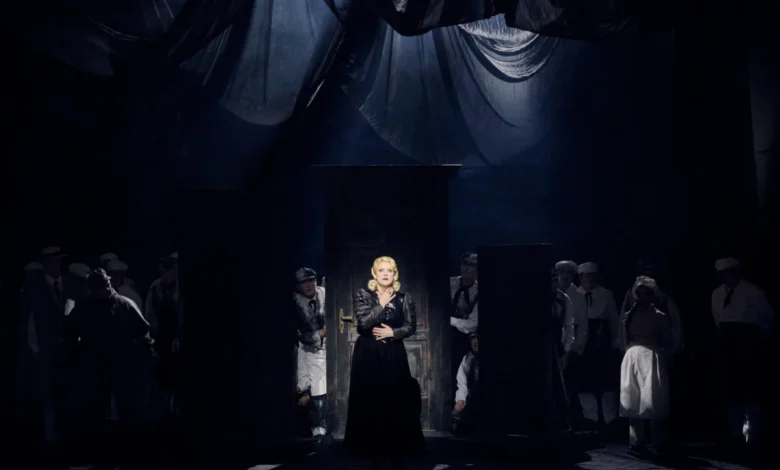
The international opera community turns its gaze toward Germany this week as the Staatsoper Stuttgart prepares to unveil a high-profile, highly anticipated new production of Dmitri Shostakovich’s masterpiece, Lady Macbeth of Mtsensk. Widely regarded as one of the most musically exhilarating and emotionally harrowing modern operas in the standard repertoire, the production brings together an all-star creative team and an elite cast of vocalists. At the epicentre of this theatrical event is acclaimed British mezzo-soprano Rosie Aldridge, who is stepping into the monumental leading role of Katerina Izmailova for the first time in her illustrious career.
Known for her commanding stage presence and a sprawling artistic repertoire that effortlessly bridges the stylistic chasms between Richard Wagner, Leos Janáček, Igor Stravinsky, Stephen Sondheim, and Mark-Anthony Turnage, Aldridge brings a formidable dramatic pedigree to the Stuttgart stage. As anticipation reaches a fever pitch ahead of opening night, OperaWire sat down with the soprano to discuss the exhaustive preparation, psychological complexities, and sheer vocal endurance required to breathe life into one of opera’s most fiercely debated anti-heroines.
The Genesis and Controversial History of a Masterpiece
To understand the weight of Aldridge’s role debut, one must examine the turbulent history of Shostakovich’s second opera. Composed between 1930 and 1932 during the early years of the Soviet regime, Lady Macbeth of Mtsensk is based on the 1865 Nikolai Leskov novella of the same name. The plot follows Katerina Lvovna Izmailova, a stifled, deeply unhappy merchant’s wife trapped in a loveless marriage in provincial Russia. Overwhelmed by isolation and unrelenting abuse, she embarks on a passionate affair with a charismatic farmhand named Sergei. What follows is a dark spiral of adultery, deception, and multiple murders—including the poisoning of her tyrannical father-in-law and the suffocation of her spineless husband—culminating in Katerina’s arrest on the way to Siberia and her tragic, self-inflicted death in the icy waters of a river.
When the opera premiered in Leningrad and Moscow in 1934, it was an instant, overwhelming sensation. Critics and audiences praised its daring orchestration, raw emotional power, and sympathetic portrayal of a woman pushed to the absolute brink by a patriarchal, suffocating society. However, the tide turned drastically in January 1936. Following an infamous visit to a Moscow performance allegedly attended by Joseph Stalin—after which an anonymous, scathing editorial titled “Muddle Instead of Music” was published in the state newspaper Pravda—the opera was officially denounced as "coarse, primitive, and bourgeois."
Shostakovich’s career was nearly destroyed, and the opera was effectively banned in the Soviet Union for nearly three decades. Today, however, it is universally recognized as a towering achievement of 20th-century music, celebrated for its brilliant synthesis of biting satire, sweeping lyricism, and relentless dramatic momentum. Bringing this complex work back to the forefront requires performers of extraordinary theatrical and vocal fearlessness—qualities that artistic directors and critics alike increasingly associate with Rosie Aldridge.
Embodying Katerina: A Complex Psychological Landscape
Stepping into the shoes of Katerina Izmailova is no minor undertaking for any singer, but Aldridge approaches the character with a profound sense of nuance, rejecting flat, one-dimensional interpretations that brand the protagonist as a simple villain.
Discussing what initially drew her to the role, Aldridge reflected on the rarity of being entrusted with such a multi-faceted character. “Roles like this don’t come along very often,” she noted. “Katerina is passionate, sensual, lonely, dangerous, vulnerable, and capable of terrible violence. To be entrusted with the dramatic engine of an entire evening—to play someone neither good nor bad, but contradictory and completely three-dimensional—is a huge privilege.”
For Aldridge, dismantling the traditional view of Katerina as a cold-blooded murderer is central to a modern, enlightened interpretation of the opera. She argues that labeling the character a villain is a reductive, sexist relic of centuries of male-dominated artistic critique.
“By the end of the performance, I want the audience to have retained compassion for Katerina,” Aldridge explained. “I find the notion of her as a ‘villain’ sexist and old-fashioned. It reduces a remarkable character to her terrible actions while ignoring everything that has brought her to that point. I believe this perception of Katerina as a villain owes much to centuries of male-dominated tradition that has taught us how to judge such women. I am more interested in asking what choices were actually available to her.”
Musical Lineage and Vocal Preparation
Preparing for a role of this magnitude requires a meticulous understanding of Shostakovich’s unique musical idiom. The vocal writing demands immense stamina, a wide dramatic range, and the ability to cut through a massive, roaring orchestra that frequently matches the psychological turmoil transpiring on stage.
Refining her approach over months of preparation, Aldridge found fascinating stylistic bridges between Shostakovich and other monumental 20th-century composers she has successfully interpreted throughout her career.
“When I first began working on this Shostakovich score, I felt a strong connection with Janáček, particularly in the relationship between text and rhythm,” Aldridge shared. “But the more I sang the role, the more I found myself thinking of Judith in Bluebeard’s Castle. There is something similarly concentrated and psychologically active in the writing, although Katerina ultimately has a much broader musical journey.”
Furthermore, Aldridge credits her past triumphs—most notably her acclaimed performances as Kundry in Wagner’s Parsifal—as indispensable preparation for conquering the harrowing vocal demands of Shostakovich.
“I’m also incredibly glad that I have sung Kundry. In retrospect, she was wonderful preparation for Katerina. With Kundry, I learnt that you have to be fearless—to trust the extremes of the writing and commit to them completely. That has certainly been one of the keys to unlocking Katerina musically. This score—and the character herself—demands that you take risks.”
Staging and Production Challenges: The Jet Plane of Shostakovich’s Score
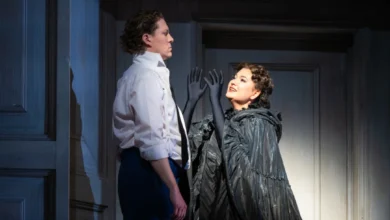
Musically and physically, Lady Macbeth of Mtsensk is an athletic marathon. Under the visionary eye of director Ulrike Schwab, the new Staatsoper Stuttgart production presents unique staging hurdles that amplify the sheer intensity of the performance.
“There is an extraordinary energy in this opera,” Aldridge observed, describing the unstoppable momentum embedded within the orchestration. “Shostakovich gives you that, and if you manage to tap into it, it carries you—perhaps even forces you along, like a kind of jet plane.”
The physical demands of Schwab’s staging compound this musical velocity. Unlike many operatic protagonists who enjoy extended stage absences, allowing them to rest their voices and gather their composure offstage, Aldridge faces a relentless physical trial.
“In Ulrike Schwab’s new production, I am in every scene; I never leave the stage,” she revealed. “I get to inhabit every pore of the production, and for a director to give you that level of trust with a role of so many dimensions is a special opportunity.”
Despite the grueling physical requirements, Aldridge emphasizes that the key to sustaining such a mammoth performance lies firmly in emotional and dramatic truth rather than purely mechanical vocalism. Having lived with the music and character in her thoughts for two years prior to this debut, she feels an unbreakable psychological bond with Katerina’s journey at every single moment of the opera.
A Deep Artistic Synergy in Stuttgart
For Rosie Aldridge, the Staatsoper Stuttgart has increasingly become a creative artistic home. Her history with the opera house is illustrious, having previously anchored several major role debuts within its walls.
“I feel enormously comfortable in this house, and this is actually my fourth role debut here,” Aldridge noted with pride. “My first Kundry in Parsifal, Kostelnička in Jenůfa, and the Witch in Hänsel und Gretel all happened in Stuttgart, so there is something very special about adding Katerina to that list.”
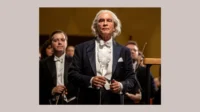
A critical component of her comfort and artistic daring in Stuttgart is her profound collaborative relationship with conductor Nicholas Carter. The artistic partnership between the singer and the maestro has been forged through intense, high-stakes rehearsals across European stages, most recently collaborating on Aribert Reimann’s Lear alongside visionary director Barrie Kosky in Berlin. In fact, the performance schedules for Lear overlapped directly with the initial two weeks of staging rehearsals for Lady Macbeth of Mtsensk in Stuttgart, requiring immense versatility and focus from both artists.
“I would trust our conductor Nicholas Carter with my life,” Aldridge stated emphatically. “He has been beyond supportive, and we’ve had quite a ride together recently! We have just done Reimann’s Lear together with Barrie Kosky in Berlin, and performances of that production actually overlapped with the first two weeks of rehearsals here in Stuttgart. So we have developed a fantastic understanding of each other musically, but I think emotionally too. With something as demanding as Katerina, having that trust between singer and conductor means an enormous amount.”
Adding an extra layer of historic significance to the event, this production marks Nicholas Carter’s inaugural opera run in his new capacity as Music Director at the Staatsoper Stuttgart, a milestone that elevates the emotional stakes for the entire company. “It’s also a real privilege for me that this will be Nick’s very first production as Music Director here in Stuttgart. It somehow makes the whole experience feel even more special,” Aldridge added.
The Convergence of Timing and Opportunity
In the opera world, major role debuts are rarely accidents of sudden inspiration; they are the result of years of quiet artistic development, strategic career planning, and the intuitive foresight of casting directors and artist management.
Reflecting on the timing of this career-defining moment, Aldridge credits the collaborative vision of her agent, Oliver Clarke, and Boris Ignatov, the Casting Director at the Staatsoper Stuttgart, who jointly orchestrated the plan for her to assume the mantle of Katerina.
“I’m ready to meet this character now—musically and dramatically,” Aldridge affirmed. “My agent, Oliver Clarke, and Boris Ignatov, the Casting Director here in Stuttgart, hatched this plan together for me to sing Katerina. I think somewhere in the back of my mind I had always thought that I might be able to do something with this remarkable role, but with roles like this, you can only ever hope that somebody will see that possibility in you and give you the chance.”
Implications for the Contemporary Opera Landscape
As the curtain rises on the Staatsoper Stuttgart’s new production of Lady Macbeth of Mtsensk, the broader implications for the operatic world are clear. In an era where regional and international houses are increasingly challenged to reinvent classic repertoire through fresh, psychologically acute lenses, performances anchored by deeply committed singing actors like Rosie Aldridge set a high benchmark for artistic integrity.
By stripping away dated moral judgments and viewing Katerina Izmailova through a lens of profound psychological empathy, Aldridge and the Stuttgart creative team promise an interpretation that honors Shostakovich’s revolutionary musical genius while speaking directly to modern sensibilities. For classical music enthusiasts and theatergoers alike, this production stands as an unmissable highlight of the European cultural calendar, marking a major triumph for both its leading lady and the venerable house on the Eckartstraße.