Post Malone Returns to Rap Roots with Chrome Heartbreaker Debut Amid The Eternal Buzz Double Album Speculation

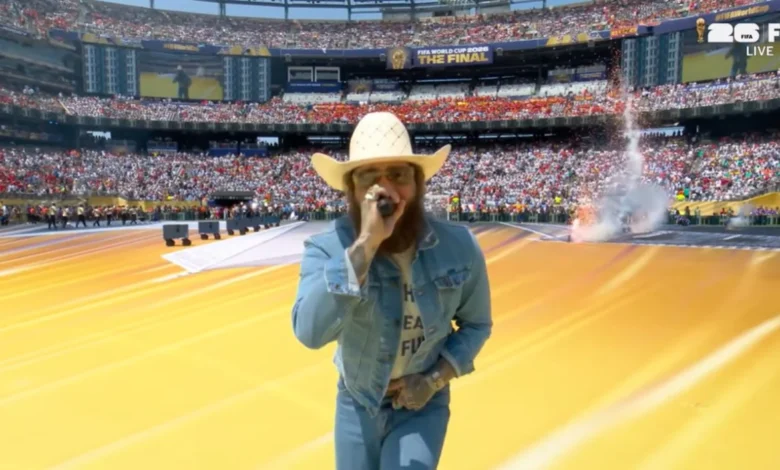
The landscape of contemporary music is witnessing a significant pivot as Austin Richard Post, known globally as Post Malone, signals a return to the sonic signatures that first propelled him to superstardom. Following a highly successful and immersive venture into the country music genre with his 2024 album F-1 Trillion, the Texas-raised artist appears to be bridging his diverse musical identities. This transition was solidified this afternoon in New Jersey, where Post Malone debuted a brand-new track titled "Chrome Heartbreaker" during the closing ceremony of the FIFA World Cup. The performance, which featured appearances by viral personality IShowSpeed and frequent collaborator Swae Lee, has reignited intense discussion regarding the artist’s upcoming project, The Eternal Buzz, and his long-term trajectory within the industry.
The debut of "Chrome Heartbreaker" serves as a stark departure from the steel guitars and honky-tonk aesthetics that defined Malone’s recent output. Musically, the track echoes the melodic trap and atmospheric production of his seminal works, Stoney (2016) and Beerbongs & Bentleys (2018). However, the lyrics suggest that Malone is not merely regressing to his old style but is instead synthesizing his various eras. By referencing his 2016 debut Stoney alongside a nod to Lucchese—the iconic 140-year-old Texas bootmaker—Malone is effectively signaling that his country influences and hip-hop foundations now coexist as a singular, unified brand.
The World Cup Performance and the Debut of Chrome Heartbreaker
The selection of the World Cup final as a venue for new music underscores Post Malone’s status as a global tier-one entertainer. Performing in front of a capacity crowd and a global television audience of millions, Malone utilized the platform to address the primary question lingering since his pivot to Nashville: whether he would ever return to the rap genre.
"Chrome Heartbreaker" features the signature vibrato and rhythmic delivery that defined Malone’s early career. The lyrics, "I would pop a bean, 2016 Stoney / I know them Lucchese gon’ stomp to this," act as a bridge between his past and present. The song’s production, characterized by heavy bass and ethereal synths, contrasts sharply with the acoustic-driven arrangements of F-1 Trillion. Industry analysts suggest that this move is a strategic effort to maintain his core urban and pop audience while retaining the massive new demographic he captured through the country music charts.
While "Chrome Heartbreaker" does not yet have an official digital release date, its debut at a high-profile international event suggests that the rollout for his next major project is reaching a critical stage. The inclusion of Swae Lee in the ceremony also sparked rumors of a potential sequel to their record-breaking diamond-certified hit "Sunflower," further hinting at a return to the pop-rap dominance Malone enjoyed in the late 2010s.
Decoding The Eternal Buzz: A 40-Song Strategic Play
The central focus for fans and industry observers is the upcoming album, The Eternal Buzz. First teased in April 2026, the project is rumored to be a sprawling 40-song double album. In the modern streaming era, the "deluxe" or "double album" format has become a potent tool for maximizing chart positions and streaming revenue, a tactic successfully employed by contemporaries like Morgan Wallen and Taylor Swift.
Evidence for the album’s dual nature has surfaced via the American Society of Composers, Authors and Publishers (ASCAP) ACE Repertory. Recent filings show a plethora of unreleased tracks registered under Post Malone’s name. Interestingly, the credits for these songs are split between two distinct groups of collaborators. On one side are Nashville heavyweights such as Ernest, Miranda Lambert, and Rhett Akins. On the other are Malone’s long-term pop and hip-hop producers, including Louis Bell, Ryan Vojtesak (Charlie Handsome), and Chandler Walters.
This bifurcation of talent suggests that The Eternal Buzz may be structured as a conceptual split: one half dedicated to the country-rock sound of F-1 Trillion and the other returning to the alternative hip-hop and R&B sounds of his early career. When asked directly about his return to rap during a recent fan interaction, Malone remained cryptic, stating only that he had been "in the studio working very, very hard" on "a lot of awesome f** sh*t."
Contextualizing the Country Era: Commitment or Cameo?
To understand the weight of Malone’s return to rap, one must examine the depth of his commitment to the country genre over the past two years. Unlike other pop artists who have experimented with country aesthetics for a single cycle, Malone’s immersion appeared permanent. He headlined major festivals such as Stagecoach, made multiple appearances at the Grand Ole Opry, and established a physical presence in Nashville with the opening of his bar, "Postys," on the historic Broadway strip.
Commercial data supports the success of this transition. His collaboration with Morgan Wallen, "I Had Some Help," became one of the fastest-streaming songs in history, dominating the Billboard Hot 100 for multiple weeks. His subsequent album, F-1 Trillion, received critical acclaim for its authenticity, featuring collaborations with legends like Dolly Parton and contemporary stars like Luke Combs.
The skepticism regarding his longevity in the genre stemmed largely from the historical precedent of "genre-hopping" in the streaming age. However, Malone has consistently maintained that his interest in country music was not a marketing ploy but a return to the music he grew up with in Grapevine, Texas. The emergence of "Chrome Heartbreaker" suggests that Malone is not "leaving" country, but rather expanding his repertoire to include it as a permanent facet of his musical identity.
Timeline of Post Malone’s Genre Evolution
The trajectory of Post Malone’s career reveals an artist who has consistently defied traditional categorization:
- 2015–2017: Rise to fame with "White Iverson" and the album Stoney. Malone is categorized primarily as a hip-hop artist, though his use of folk-like melodies sets him apart.
- 2018–2019: Release of Beerbongs & Bentleys and Hollywood’s Bleeding. These albums solidify him as a pop-rock powerhouse, breaking streaming records and earning multiple Diamond certifications.
- 2022–2023: A period of introspection with Twelve Carat Toothache and the guitar-heavy Austin. Malone begins to move away from trap beats toward a more organic, alternative sound.
- 2024: The "Country Era" begins in earnest with F-1 Trillion. He achieves massive success in Nashville, bridging the gap between mainstream pop and country radio.
- 2026: The announcement of The Eternal Buzz and the debut of "Chrome Heartbreaker," signaling a multi-genre approach that incorporates all previous styles.
Broader Implications for the Music Industry
Post Malone’s ability to navigate between rap and country reflects a broader shift in the music industry where genre boundaries are increasingly porous. The rise of "streaming-native" listeners, who curate playlists based on mood rather than genre, has allowed artists to pivot their sound without alienating their audience.
Furthermore, the scale of The Eternal Buzz—if the 40-song tracklist holds true—represents a significant challenge to traditional album cycles. By releasing such a high volume of content across multiple genres, Malone is essentially competing with himself for airplay and playlist placement. From a business perspective, this strategy ensures a high "floor" for streaming numbers, as the album appeals to country fans, rap enthusiasts, and pop listeners simultaneously.
Industry insiders note that this "amalgamation" strategy is risky but potentially highly rewarding. "Post Malone is one of the few artists with enough cultural capital to be taken seriously in both a Nashville honky-tonk and a hip-hop festival," says one veteran music critic. "By refusing to choose one path, he is positioning himself as a genre-less entity, much like the playlists his fans listen to."
Upcoming Tour and Future Outlook
As Malone prepares for the release of new material, he is also set to embark on the "Big A** Stadium Tour Part Two." The tour dates announced thus far focus on large-scale North American venues, indicating that the production will be his most ambitious to date.
Confirmed Tour Dates:
- Tue Jul 21: Missoula, MT – Washington-Grizzly Stadium
- Fri Jul 24: Edmonton, AB – Commonwealth Stadium
- Tue Jul 28: Salt Lake City, UT – Rice-Eccles Stadium
These stadium shows are expected to feature a setlist that spans his entire career, from the trap-influenced "Congratulations" to the country-rock "I Had Some Help," and now the hybrid sound of "Chrome Heartbreaker."
As the music world awaits further details on The Eternal Buzz, Post Malone has successfully reclaimed the narrative. He is no longer just a rapper who went country; he is an artist who has successfully integrated the disparate threads of American popular music into a singular, cohesive brand. Whether "Chrome Heartbreaker" represents a full-scale return to hip-hop or merely one chapter in a 40-song epic remains to be seen, but for now, the "Eternal Buzz" surrounding his career shows no signs of fading.