Justin Timberlake and Janet Jackson Set to Revisit 2004 Super Bowl Halftime Controversy in Upcoming Apple TV Docuseries

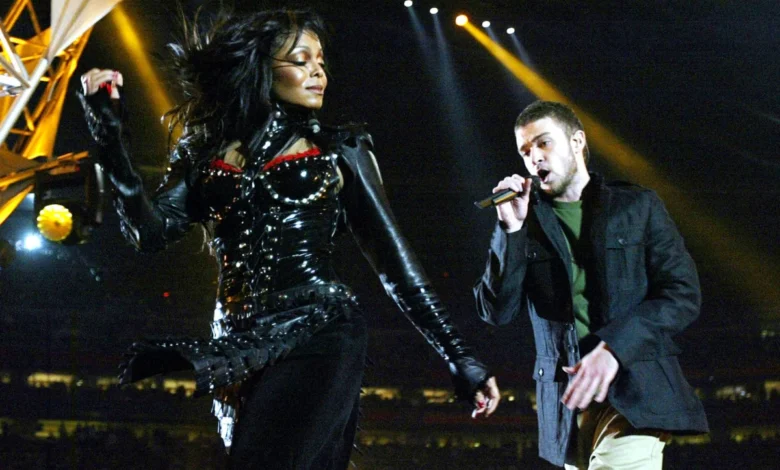
More than two decades after one of the most polarizing and culturally significant moments in modern live television history, pop icons Justin Timberlake and Janet Jackson are reportedly set to revisit the infamous 2004 Super Bowl halftime show. According to industry reports originating from Variety, Apple TV is preparing to release a four-legged, multi-part documentary series next month that will examine the events leading up to, during, and after Super Bowl XXXVIII, offering a renewed look at the severe fallout that followed the broadcast.
Industry sources describe the upcoming December release as a comprehensive, tell-all project. Significantly, the series is expected to feature direct commentary from Janet Jackson herself, detailing her perspective on the unexpected wardrobe malfunction that dominated global headlines, reshaped television broadcasting standards, and triggered a massive disparity in how male and female artists were treated by the media, industry executives, and the public. Representatives for Justin Timberlake, Janet Jackson, and Apple have thus far declined to issue immediate statements or formal confirmations in response to ongoing media inquiries.
Anatomy of a Broadcast Milestone: The Events of February 1, 2004
Super Bowl XXXVIII, held on February 1, 2004, at Reliant Stadium in Houston, Texas, featured a halftime show produced by MTV that was designed to be a high-energy spectacle. Headlined by Janet Jackson—one of the best-selling music artists in history—the performance featured a medley of her greatest hits before concluding with a guest appearance by Justin Timberlake, who was then ascending to superstardom as a solo act following the disbandment of NSYNC.
Toward the end of a high-tempo rendition of Timberlake’s hit single "Rock Your Body," Timberlake sang the final line of the refrain: "Gonna have you naked by the end of this song." As he delivered the lyric, he reached across Jackson’s chest and pulled at a portion of her leather costume. The action detached a piece of the garment, briefly exposing Jackson’s right breast to an estimated television audience of more than 140 million viewers worldwide.
The immediate aftermath was swift and chaotic. Within seconds, the broadcast feed cut to a wide-angle shot of the stadium, and network executives scrambled to implement damage control. The incident instantly sparked widespread outrage among conservative watchdog groups, Federal Communications Commission (FCC) regulators, and conservative politicians, fundamentally altering the landscape of live television broadcasting.
The Immediate Aftermath and the Culture of Double Standards
In the wake of what quickly became known in popular culture as "Nipplegate," the professional consequences for the two performers diverged sharply, illuminating deep-seated gender double standards within the entertainment industry.
Justin Timberlake issued a public apology shortly after the event, famously characterizing the occurrence as an accidental "wardrobe malfunction." While Timberlake faced brief initial scrutiny, his career suffered virtually no long-term professional penalties. He continued his promotional schedule, attended the Grammy Awards just weeks later, and was eventually welcomed back to headline the Super Bowl halftime show as a solo artist during Super Bowl LII in Minneapolis in 2018.
Conversely, Janet Jackson bore the overwhelming brunt of the cultural backlash, institutional punishment, and professional isolation. In the days following the broadcast, CBS and MTV executives barred her from attending the Grammy Awards, where she had been scheduled to present an award. Viacom-owned media outlets, including MTV, VH1, and numerous major radio conglomerate networks across the United States, instituted an unofficial blacklist, pulling her music videos from rotation and refusing to play her new singles. Her subsequent studio albums faced suppressed commercial performance, and her status as a pioneering pop royalty figure was sidelined for years by mainstream media institutions.
The Reckoning: Shifts in Public Perception and 2021 Apologies
For nearly two decades, the narrative surrounding the incident largely favored Timberlake’s framing, leaving Jackson to navigate the professional damage in relative isolation. However, public sentiment began to shift dramatically in the late 2010s and early 2020s, catalyzed by broader cultural reckonings regarding misogyny, media ethics, and the systemic mistreatment of female celebrities in the 1990s and 2000s.
The release of the 2021 documentary Framing Britney Spears—which examined the intrusive and damaging media treatment of pop star Britney Spears, a former partner of Timberlake—prompted a wider re-examination of media culture during that era. Social media users and cultural critics began to actively re-evaluate Timberlake’s conduct during the 2004 Super Bowl fallout, pointing out that he had successfully leveraged Jackson’s disgrace to shield his own burgeoning solo career from accountability.
Faced with mounting public criticism, Justin Timberlake issued a public statement via social media in February 2021, offering formal apologies to both Britney Spears and Janet Jackson.
"I specifically want to apologize to Britney Spears and Janet Jackson both individually, because I care for and respect these women and I know I failed," Timberlake wrote at the time. "The industry is flawed. It sets men, especially white men, up for success. It’s designed this way. As a man in a privileged position, I have to be vocal about this. Because of my ignorance, I didn’t recognize it for all that it was while it was happening in my own life, but I do not want to ever benefit from others being pulled down again."
Regulatory Repercussions and Long-Term Broadcasting Changes
Beyond the personal and professional tolls taken on the artists involved, the 2004 Super Bowl halftime incident triggered permanent changes in how live television is produced and broadcast in the United States.
The Federal Communications Commission received a record number of complaints regarding the broadcast, leading to intense congressional scrutiny of broadcast indecency. Consequently, major television networks, including CBS, ABC, NBC, and Fox, instituted a mandatory tape-delay system for virtually all high-profile live events, including award shows, parades, and sporting broadcasts. This technical adjustment allowed production crews to monitor audio and video feeds in real-time, inserting brief delays to censor or cut away from any unforeseen or unscheduled occurrences before they could reach home viewers.
Furthermore, the National Football League (NFL) instituted rigorous vetting procedures for future halftime shows, routinely partnering with established, legacy-act musical directors and conservative booking agencies to minimize creative risks during the broadcast.
Broader Implications of the Apple TV Docuseries
The upcoming Apple TV project arrives at a time when documentary series focusing on historical media events have become powerful tools for re-evaluating past narratives and restoring the legacies of marginalized artists. By providing a dedicated platform to examine the events of 2004 through a contemporary analytical lens, the four-part series aims to offer a comprehensive historical record rather than a superficial recap.
Analysts suggest that the documentary will likely explore the complex intersections of race, gender, corporate media self-preservation, and shifting public morality at the turn of the 21st century. For Janet Jackson, the series represents another significant milestone in a broader narrative of legacy reclamation, following her critically acclaimed 2022 self-titled documentary and her continued induction into the Rock and Roll Hall of Fame.
As the December premiere approaches, industry observers will be watching closely to see how the series addresses the institutional accountability of media executives, network gatekeepers, and corporate entities that shaped the initial narrative two decades ago. With official confirmations and promotional trailers anticipated in the coming weeks, the project is poised to reignite national dialogue regarding the ethics of live broadcasting, accountability in pop culture, and the enduring resilience of one of music’s most influential figures.