Robert Kraft Confirms Decision to Bar Macklemore from Gillette Stadium Following Pro-Palestine Statements and Tour Fallout

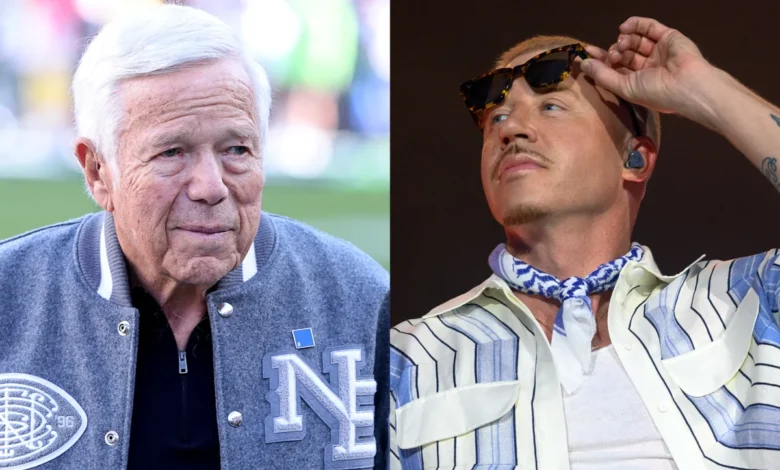
New England Patriots owner and prominent billionaire philanthropist Robert Kraft has officially confirmed that he personally intervened to bar the Seattle rapper Macklemore from performing as an opening act at Gillette Stadium. The decision, which ultimately resulted in the artist being dropped from the remainder of pop singer Ed Sheeran’s Loop tour, was triggered by Macklemore’s outspoken pro-Palestinian remarks and political demonstrations held during recent live concert performances.
The controversy highlights an increasingly fraught intersection between live entertainment, corporate venue management, and geopolitical expression. As public figures navigate the complexities of the ongoing Israel-Hamas war, concert stages have increasingly become platforms for socio-political advocacy, forcing venue executives, tour promoters, and artists to grapple with the boundaries of free speech, corporate responsibility, and community safety.
The Genesis of the Controversy
The friction surrounding Macklemore’s presence on the tour came to a head in early September during the opening leg of Ed Sheeran’s stadium tour. The trek kicked off with two high-profile consecutive performances at MetLife Stadium in East Rutherford, New Jersey. During these opening shows, Macklemore used his platform to voice explicit solidarity with Palestinians living in Gaza and the occupied West Bank.
Addressing tens of thousands of concertgoers, the rapper yelled "Free Palestine" from the stage, displaying visual imagery depicting the widespread destruction resulting from military conflict in Gaza. Furthermore, he performed his newly released protest song, "Hind’s Hall"—a track written to honor pro-Palestinian student demonstrators who occupied buildings at Columbia University earlier in the year.
"A big part of the reason why I wanted to do this tour in the first place is so I could stand up in stadiums like this and say two words that are very near and dear to my heart: ‘Free Palestine,’" Macklemore told the audience. "I said, ‘Free Palestine!’ I want those words to be loud and clear, so that people all the way in Gaza to the occupied West Bank know that we have not forgotten about them."
While political speech by musicians on tour is not a novel phenomenon, the scale of these stadium-level platforms heightened the urgency for venue operators. Shortly after the New Jersey concerts, word spread that the rapper’s participation in upcoming dates—most notably at Gillette Stadium in Foxborough, Massachusetts—was in serious jeopardy.
Robert Kraft’s Official Response and Rationale
In a detailed statement provided to media outlets, Robert Kraft articulated the reasoning behind his decision to block the rapper from performing at his venue. Kraft, who is Jewish and has a long-standing history of supporting Jewish philanthropic causes and combating antisemitism, stated that the action was taken to prevent Gillette Stadium from serving as a platform for hate speech.
"The decision was based on Macklemore’s recent actions, material shared from the stage during Ed Sheeran’s shows in New Jersey, and a broader history of antisemitic rhetoric and imagery that we believe has been deeply offensive and hurtful to the Jewish community," Kraft said.
Venue representatives emphasized that Gillette Stadium strives to maintain a welcoming environment for all guests. According to Kraft, Macklemore’s stage presentation and prior controversies—including a widely publicized 2014 incident where the rapper wore a costume that critics labeled an antisemitic caricature, for which he later apologized—crossed a definitive line.
At the same time, Kraft took pains to clarify that his decision was not intended to silence humanitarian concerns for Palestinians. "This is not about diminishing the suffering of innocent Palestinians or denying anyone the right to advocate on their behalf," Kraft maintained. "However, that advocacy should not come at the expense of the Jewish community or obscure the responsibility of Hamas."
Kraft further elaborated on his personal track record regarding the Middle East, noting that he has directed financial resources toward Palestinian communities over the decades, creating entrepreneurial and athletic opportunities for individuals he deeply respects. "Standing with the Palestinian people and standing against Hamas, antisemitism, and hate should not be mutually exclusive," he added.
Macklemore’s Allegations and Counter-Statement
The public fallout intensified when Macklemore released his own statement addressing his removal from the tour. The rapper alleged that Kraft did not merely bar him from Gillette Stadium, but actively coordinated a broader industry boycott against him.
According to Macklemore, Kraft telephoned Ed Sheeran directly to inform him that the rapper was prohibited from performing in Foxborough. Furthermore, Macklemore claimed that Kraft "rallied some of the other stadium owners and collectively they gave [Sheeran] an ultimatum: If Macklemore stays on the tour, you will not be allowed to play in our venues."
While representatives for Kraft did not immediately respond to inquiries concerning the alleged industry-wide ultimatum, the practical outcome was clear: Macklemore was removed not only from the Gillette Stadium dates but from the remainder of the Loop tour entirely.
In his public response, Macklemore pushed back vigorously against accusations of antisemitism, arguing that legitimate criticism of Israeli military actions and government policies is frequently mischaracterized.
"Antisemitism is real," Macklemore wrote. "And that is exactly why the word matters too much to be used as a shield against criticism of the Israeli state. When criticizing Israel, opposing Zionism, or saying ‘Free Palestine’ gets conflated with hatred of Jewish people, it doesn’t protect Jewish people. It protects Israel from accountability."
Broader Implications for Live Entertainment and Geopolitical Discourse
The clash between Kraft and Macklemore underscores a growing operational challenge for the live entertainment industry. Stadiums and arenas are privately owned or managed corporate venues, yet they function as public assembly spaces hosting massive cultural events. Venue owners increasingly face difficult dilemmas regarding where to draw the line between protected artistic expression and speech that management deems harmful, divisive, or contrary to corporate values.
For tour headliners like Ed Sheeran, political controversies involving supporting acts can create logistical nightmares, forcing major artists into uncomfortable positions between their supporting talent, venue conglomerates, and ticket-buying publics. Tour routing depends heavily on relationships with major stadium ownership groups, giving powerful executives like Kraft significant leverage over tour lineups.
Furthermore, the incident highlights the polarizing nature of cultural discourse surrounding the Israel-Hamas conflict. Proponents of pro-Palestinian advocacy argue that artists have a moral obligation to speak out against human rights crises and civilian casualties. Conversely, community leaders and philanthropists argue that unchecked rhetoric at public events can exacerbate domestic tensions, alienate Jewish concertgoers, and blur the lines between geopolitical critique and antisemitism.
Looking Toward Future Dialogue
Despite the high-stakes confrontation and the cancellation of tour dates, Robert Kraft concluded his public remarks by extending an olive branch to the rapper. Expressing "tremendous respect" for Ed Sheeran and his capacity to foster unity through music, Kraft stated that he would welcome a direct conversation with Macklemore.
"I would welcome the opportunity to sit down with Macklemore and discuss the facts, because ultimately our goal is the same—peace for all people, an end to suffering, and an end to all hate," Kraft said.
As of press time, representatives for Macklemore had not responded to requests for comment regarding Kraft’s invitation for dialogue, leaving the status of any potential reconciliation uncertain as the broader debate over politics on the concert stage continues to unfold.