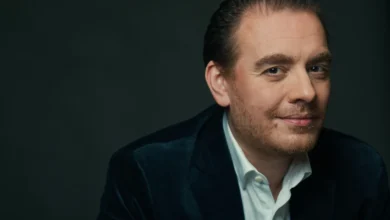
Master of the Baroque: Conductor Nicholas McGegan on Handel, Milton, and Historical Performance Practice Ahead of Warsaw Debut


The world of classical music constantly negotiates the delicate boundary between historical fidelity and modern relevance, a tightrope that few artists navigate with the effortless authority of conductor Nicholas McGegan. Now well into his sixth decade on the podium, McGegan has established himself as one of the planet’s most trusted and insightful interpreters of Baroque and Classical repertoire. Celebrated by critics as a preeminent authority on eighteenth-century stylistic execution, he combines rigorous academic scholarship with an infectious, theatrical vitality that makes centuries-old scores feel urgent and immediate. Following a celebrated, transformative 34-year tenure as Music Director of the Philharmonia Baroque Orchestra and Chorale—where he now holds the title of Music Director Emeritus—alongside leadership roles across Europe, McGegan is preparing for a high-profile engagement in November 2026. He will lead the Warsaw Philharmonic Orchestra and Choir in a performance of George Frideric Handel’s sophisticated moral oratorio, L’Allegro, il Penseroso ed il Moderato, joined by a stellar quartet of soloists featuring Robin Johannsen, Fflur Wyn, Robin Tritschler, and Matthew Brook.
As anticipation builds for this landmark performance at the Filharmonia Narodowa, McGegan reflects on a lifetime spent plumbing the depths of Handel’s output, the fascinating friction between historical source materials and modern performance conditions, and the enduring relevance of eighteenth-century aesthetic philosophies.
A Lifetime Champion of Handel and the Miltonic Libretto
McGegan’s relationship with L’Allegro, il Penseroso ed il Moderato spans decades, marked by notable milestones that include directing the American premiere of Mark Morris’s iconic choreography for the piece in 1991. Yet, his introduction to the work’s textual foundation began much earlier, rooted in the standard English educational curriculum of his youth.
"It is one of Handel’s most imaginative works," McGegan explains. "Unlike his usual librettos, which are sometimes merely serviceable, this score pairs great music with great poetry, specifically the very academic English of John Milton. I grew up in England; Milton was part of our school education, so I knew the words even before the music. The poems are nearly as old as Shakespeare and sometimes harder to understand. Even now, I sometimes have to look up words."
The architecture of the piece relies heavily on the brilliant editorial hand of Charles Jennens, the wealthy and famously idiosyncratic librettist who also assembled the text for Messiah. Rather than setting Milton’s companion poems—which contrast the cheerful, party-seeking extrovert (L’Allegro) with the contemplative, candlelight-reading introvert (Il Penseroso)—as separate entities, Jennens ingeniously interleaved them. By weaving the two temperaments together, Jennens created a dramatic tension that drives the musical narrative from the opening bars.
Furthermore, Jennens appended a third section of his own creation to introduce a moderating force, effectively advocating for a balanced, middle way of existence. "It’s almost Buddhist, really—finding the middle way," McGegan notes. "Don’t party all day long, don’t spend your whole life reading by candlelight either. It’s not a religious piece; it’s a moral oratorio."
Navigating Historical Performance and Modern Concert Realities
Bringing a work of this scale to a modern symphonic institution like the Warsaw Philharmonic requires careful logistical and artistic curation. For the upcoming Warsaw engagement, McGegan and his forces will perform a trimmed version of the score, deliberately omitting portions of Part Three. Interestingly, this editorial decision mirrors practices from Handel’s own lifetime, streamlining the overarching moral argument to ensure a cohesive and engaging concert experience that culminates in a triumphant final chorus.
This pragmatic approach extends to the vocal casting. While Handel’s original 1740 premiere utilized five performers—including a boy soprano—economic and logistical realities of modern orchestral touring dictate a leaner profile. The Warsaw production utilizes a tightly optimized quartet comprising two sopranos, a tenor, and a bass. The lighter soprano covers the traditional boy soprano lines, while the darker soprano assumes the remaining weight of the vocal writing.
When integrating his specialized historical knowledge into modern symphonic ensembles, McGegan relies on careful preparation and clear communication. "I do my homework. I always bring my own prepared orchestral parts—all computerized, clear, with exact bowings and written-out cadenzas," he states. Recognizing the stylistic gear-change required for an orchestra that may have performed Romantic repertoire just days prior, McGegan provides comprehensive advance materials, including reference recordings of previous interpretations, ensuring a unified artistic vision before the first downbeat.
Historical Evidence and the Pursuit of Authentic Tempos
A central challenge in performing eighteenth-century music lies in determining accurate tempos and stylistic nuances in the absence of audio recordings. For L’Allegro, McGegan benefits from a rare historical artifact: documentation left by Handel’s amanuensis, John Christopher Smith. Shortly after Handel’s death in 1759, Smith was commissioned to transfer works onto mechanical barrel organs. Though the physical barrels have perished, the exact duration index survived, documenting nineteen individual pieces from L’Allegro—more than any other Handel composition.
"It gives us a direct window into his tempos," McGegan observes. "It turns out some pieces I thought were fast were indeed intended that fast! These historical sources aren’t rigid rules, but invaluable guides."
These insights are complemented by period measurement techniques, such as the use of human pulse rates, pendulums, and clock second-hands. Yet, McGegan emphasizes that historical fidelity must always coexist with theatrical common sense and the biological limitations of modern performers. While an eighteenth-century premiere with its complete three-part structure and improvised organ concertos could easily sprawl across a four-hour evening with two intervals, contemporary audiences and concert hall programming demand a more concise, tightly paced format.
Broader Implications: Genre-Crossing and Future Horizons
McGegan’s career reflects a broader evolution within the classical music industry, characterized by an increasing cross-pollination between period-instrument specialists and modern symphony orchestras. Whether discussing Iván Fischer’s re-seating of the Berlin Philharmonic to match historical Mahler layouts or applying unwritten late-nineteenth-century rubatos to Elgar, McGegan champions an inclusive, highly informed approach to performance practice. However, he issues a pragmatic warning regarding ensemble mechanics: while splitting first and second violins across the stage suits the spatial counterpoint of Mozart and Haydn, it proves disastrous for Handel, whose violin sections frequently write in unison and require side-by-side placement to achieve optimal acoustic cohesion.
Looking beyond his Warsaw engagement, McGegan’s relentless artistic schedule maintains its international scope. He is slated to conduct the opening concert of the Halle Handel Festival, where artistic director Florian Amort has curated a deliberately provocative program pairing Handel’s traditional Coronation Anthems with Sir Peter Maxwell Davies’s harrowing exploration of royal madness, Eight Songs for a Mad King. By juxtaposing eighteenth-century pomp with twentieth-century expressionistic dissonance—a work that explicitly quotes Messiah amidst hysterical vocal pyrotechnics—McGegan continues to challenge audiences and bridge historical divides.
As the Warsaw Philharmonic prepares to tackle Milton’s intricate English verse under McGegan’s direction, the event stands as a testament to the enduring power of Baroque masterworks when filtered through a lifetime of deep scholarship, witty theatricality, and profound musical intelligence.