From Roc Nation Intern to Powerhouse Attorney: Shardé Simpson Inspires the Next Generation at LIU’s Roc Nation School

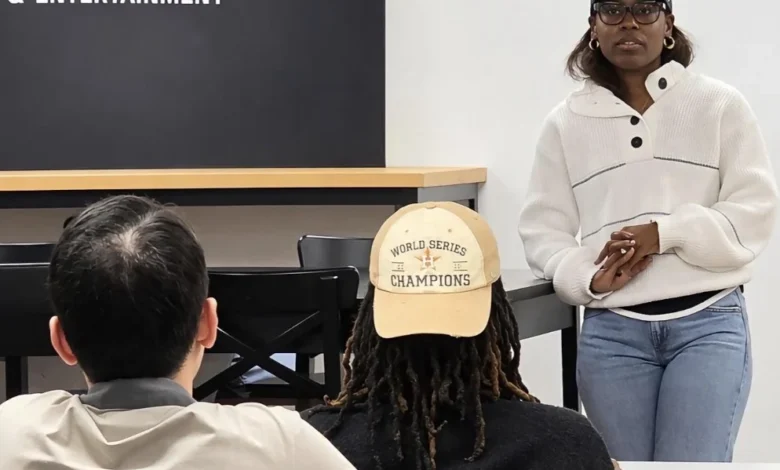
The trajectory of modern entertainment law is frequently defined by the rare professionals who manage to bridge the gap between high-stakes corporate negotiation and grassroots artist advocacy. Shardé Simpson occupies this exact intersection. With a career spanning more than 15 decades—marked by foundational beginnings as a corporate intern, four consecutive Billboard Top Music Lawyer honors, and the establishment of her own boutique practice—Simpson has emerged as a premier architect of modern artist representation. On November 4, her professional narrative came full circle in a deeply symbolic homecoming, as she returned to the Roc Nation ecosystem not as an entry-level hopeful, but as an industry titan, executive mentor, and guest lecturer at Long Island University’s Roc Nation School of Music, Sports & Entertainment.
Speaking directly to undergraduates enrolled in the institution’s rigorous Legal Aspects of the Music Industry course, Simpson delivered an unvarnished masterclass on the realities of navigating the modern entertainment business. Her appearance underscored a broader institutional mission: connecting theoretical classroom instruction with the pragmatic, often volatile realities of the global music marketplace. By sharing the podium of experience, Simpson provided students with a rare blueprint for career longevity, strategic networking, and the unyielding resilience required to thrive in a cutthroat industry.
From the Ground Up: The Formative Years and Career Chronology
To fully understand the weight of Simpson’s return to the Roc Nation fold, one must examine the timeline of her ascent. Long before she was negotiating multi-million-dollar recording contracts, global touring riders, and complex publishing buyouts for some of hip-hop and R&B’s most influential voices, Simpson was simply a determined law student attempting to secure a foothold in an intensely insular industry.
Her professional journey commenced with an internship at Roc Nation, the entertainment company founded by Shawn "Jay-Z" Carter in 2008. In the fast-paced environment of a premier management and record label firm, Simpson quickly realized that raw ambition required a foundation of rigorous legal acumen. She utilized her time as an intern not merely to complete administrative tasks, but to absorb the macro-level mechanics of artist management, brand partnerships, and intellectual property stewardship.
After completing her legal education and earning her credentials to practice law, Simpson did not immediately enter a vacuum of corporate comfort. Instead, she spent over fifteen years carving out a reputation as a fierce litigator and transactional attorney who understood both the artistic vision and the bottom line. Over her career, her client roster expanded to include industry heavyweights such as Meek Mill, Rod Wave, H.E.R., and Roc Nation co-founder Tyran “Ty Ty” Smith.
Achieving recognition as a Billboard Top Music Lawyer four times is no small feat; it requires managing catastrophic public relations moments, complex contract disputes, catalogue acquisitions, and the shifting paradigms of digital streaming royalties. Simpson navigated these treacherous waters with a composure that eventually led her to step out on her own, founding The Simpson Group PLLC—a testament to her desire for entrepreneurial autonomy and direct client advocacy.
Demystifying the Legal Landscape: The Classroom Experience
The atmosphere inside the lecture hall at LIU’s Roc Nation School on November 4 was charged with anticipation. Students studying the legal frameworks governing modern copyright law, 360-deals, sync licensing, and trademark protection were given a rare opportunity to hear from an attorney who handles these exact instruments on a daily basis.
Simpson’s lecture cut through the romanticized notions of the music business, offering a stark, realistic assessment of what it takes to protect creative assets in the digital age. She walked students through the anatomy of a record deal, detailing how poorly drafted clauses regarding digital distribution, merchandise splits, and royalty audits can siphon millions of dollars from an unsuspecting artist’s career.

Crucially, Simpson emphasized that success in entertainment law and management relies heavily on soft skills that cannot be taught out of a textbook. She stressed the importance of adaptability, emotional intelligence during high-stakes negotiations, and the cultivation of authentic professional relationships. Furthermore, she urged students to embrace entry-level opportunities—such as internships—even when those roles do not immediately appear to align with their ultimate career destinations.
"Success is rarely a straight line," Simpson imparted to the class, drawing from her own transition from an intern fetching documents to a principal attorney counseling platinum-selling artists. She explained that every station along a career path offers vital institutional knowledge that will eventually separate an average practitioner from an indispensable industry leader.
Bridging the Accessibility Gap: The Birth of Hello Wilma
While Simpson’s pedigree as a high-priced corporate attorney places her firmly in the upper echelon of legal representation, her acute awareness of the industry’s systemic inequities led her to address a pressing market failure: the lack of accessible legal resources for independent, unsigned, and emerging creators.
Historically, elite entertainment legal counsel has been an exclusive luxury reserved for artists who have already secured major-label backing or substantial venture capital. Independent creators—who make up the vast majority of the modern streaming economy—frequently operate without legal protection, exposing themselves to predatory contracts, unauthorized sample usage, and lost copyright revenues.
To combat this disparity, Simpson founded Hello Wilma, an innovative, artist-focused digital platform designed to democratize access to essential legal and business tools. Hello Wilma seeks to remove the traditional financial and informational barriers that often prevent grassroots musicians from safeguarding their intellectual property.
The platform provides a suite of practical resources, including customizable agreement templates, copyright timestamping tools, and educational modules that break down complex legal terminology into digestible, actionable advice. By empowering artists to understand the mechanics of their business before they sign on the dotted line, Hello Wilma acts as an upfront shield against predatory industry practices.
In a powerful gesture of mentorship during her LIU visit, Simpson extended complimentary access to the Hello Wilma platform to all students enrolled in the Roc Nation School’s music industry courses. This move allowed the next generation of managers, executives, and lawyers to stress-test the platform firsthand, integrating real-world technological solutions into their academic training.
Institutional Impact: The Role of the Roc Nation School
The partnership between seasoned industry leaders like Shardé Simpson and institutions like the Roc Nation School of Music, Sports & Entertainment highlights a vital shift in modern vocational education. Established to provide comprehensive training across the entertainment sectors, LIU’s specialized school operates on the premise that traditional curricula must be continuously fertilized by active industry practitioners.
Higher education in the arts and entertainment business has historically suffered from a lag between academic theory and fast-moving industry realities—particularly in an era defined by artificial intelligence integration, shifting algorithmic distribution models, and rapidly evolving copyright legislation. By bringing in alumni and trailblazers like Simpson, the institution ensures that its student body receives immediate, unfiltered intelligence from the front lines of commerce.

Industry analysts note that programs bridging the gap between mentorship and corporate access are crucial for diversifying the executive pipeline. For decades, the upper echelons of music law and label management have suffered from a lack of demographic and socioeconomic diversity, largely due to the "who-you-know" nature of industry networking. By embedding platforms like Hello Wilma into the classroom and inviting minority trailblazers back to speak, the institution actively dismantles traditional entry barriers.
Broader Implications for the Future of Entertainment Law
Simpson’s journey from intern to founder, coupled with her commitment to educating and equipping upcoming professionals, carries significant implications for the broader entertainment ecosystem.
As the music industry continues to decentralize—driven by independent distribution networks, self-publishing platforms, and social media monetization—the demand for accessible legal infrastructure has never been higher. Traditional gatekeepers are losing their absolute monopoly over artist discovery, but they have frequently been replaced by sophisticated digital pitfalls that trap unwary DIY artists.
Attorneys like Simpson who operate at the vanguard of this transition are redefining the social contract of the music business. By proving that high-level legal practice can coexist with grassroots advocacy and technological democratization, she is helping to shape a more equitable ecosystem for the next generation of culture-shapers.
Furthermore, the integration of practical legal technology, such as the resources provided through Hello Wilma, signals a growing trend toward preventative law in the creative sectors. Rather than stepping in to untangle a catastrophic contract dispute after the damage is done, modern legal innovators are shifting toward education and proactive compliance, ensuring artists retain ownership of their life’s work from day one.
Conclusion: A Legacy of Mentorship and Resilience
As the music industry navigates the complexities of the mid-2020s and looks toward the future, figures like Shardé Simpson serve as both compass and catalyst. Her return to the Roc Nation School of Music, Sports & Entertainment was far more than a sentimental visit; it was a strategic investment in the future architects of the culture.
By laying bare the realities of her climb from an unpaid intern to a four-time Billboard Top Music Lawyer, Simpson demystified the pathways to power in an industry notoriously resistant to outsiders. Through her ongoing legal practice, her innovative technological platform Hello Wilma, and her dedication to mentorship, she continues to prove that true industry leadership is measured not only by the magnitude of the clients one represents, but by the doors one leaves open for those who follow.