Fracture Sounds, a developer recognized for its commitment to providing high-quality, accessible virtual instruments, has unveiled its latest offering within the acclaimed Blueprint collection: Textural Sax. This new release, freely available to users, expands the collection’s focus on experimental cinematic sound design by introducing a novel approach to the tenor saxophone. Unlike traditional sample libraries that aim for precise instrumental replication, Textural Sax delves into the core essence of the saxophone, weaving its fundamental character with innovative textural elements, experimental sound design, and resonant qualities. The objective is to inspire composers and producers to explore unconventional applications of the saxophone beyond its conventional sonic boundaries.
This release marks a significant departure from standard saxophone libraries due to its polyphonic capabilities. A key design consideration, according to the developers, was to ensure that the polyphonic nature did not result in an ensemble sound or a generic cinematic synth pad. Instead, Textural Sax aims to retain the characteristic warmth and breath-like texture inherent to each note played on a saxophone, seamlessly integrating these organic qualities into atmospheric textures. This approach allows the instrument to function as a foundational element for ambient soundscapes while still evoking the distinct timbral signature of a tenor saxophone.
The genesis of Textural Sax lies in a premium instrument of the same name, which is featured within Fracture Sounds’ recently launched "Trails II" library. The free Blueprint version inherits a curated selection of features from its professional counterpart. It incorporates all four of the primary articulations, a blend of microphone mixes encompassing close, room, and resonant contact perspectives, and a single "Atmosphere" layer derived from the full instrument. This thoughtful curation ensures that even the free version offers a substantial and versatile sonic palette for creative exploration.
Articulation Breakdown and Sonic Potential
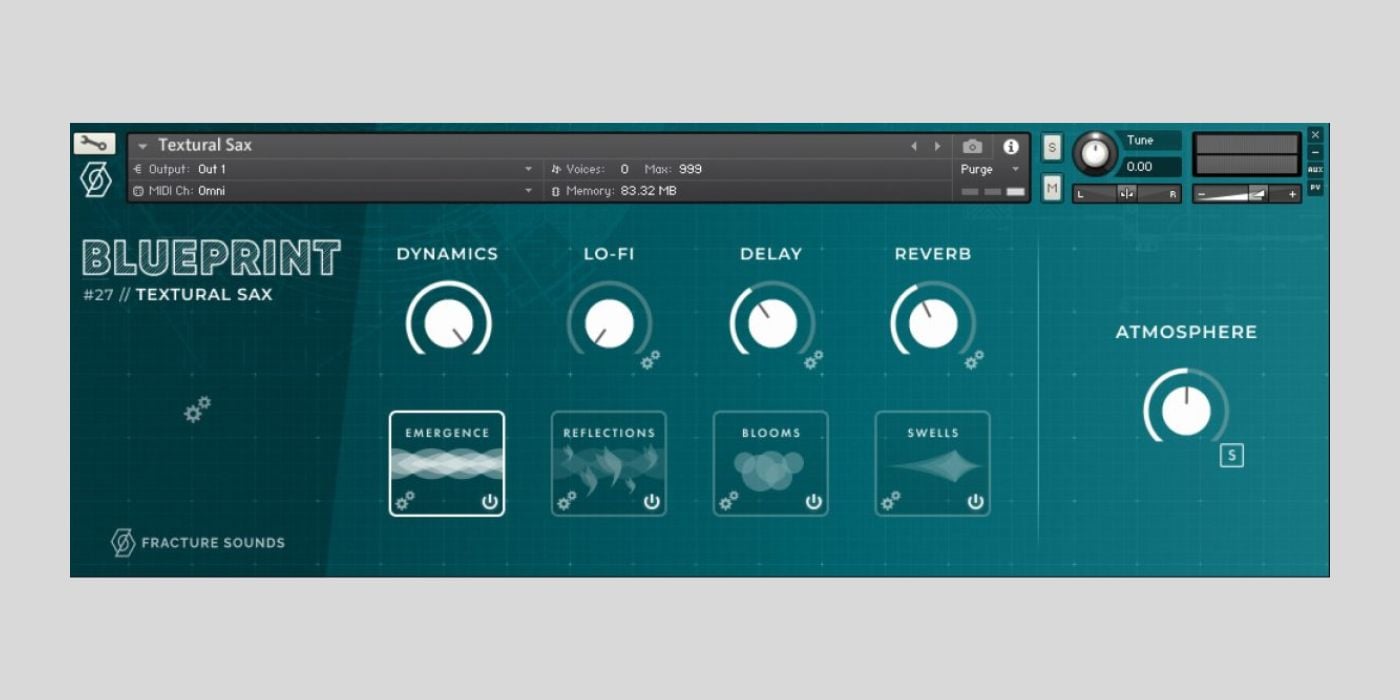
Textural Sax offers four distinct articulations, each designed to provide a unique textural and expressive quality:
-
Emergence: This articulation is characterized by a strong adherence to the traditional tenor saxophone sound, featuring a wavering texture that is particularly well-suited for creating cinematic beds and atmospheric layers across a wide spectrum of moods. Its inherent expressiveness allows for the development of evolving sonic backdrops that can support narrative tension or emotional depth.
-
Reflections: Possessing a distinctly rhythmic quality, "Reflections" offers a modern and emotive sonic character. This articulation lends itself to compositions that require a sense of forward motion and emotional resonance, potentially finding application in contemporary film scores, game soundtracks, or electronic music productions.
-
Blooms: Described as highly contextual, "Blooms" is designed to be versatile and adaptable to various musical settings. A notable characteristic highlighted by the developers is its somber quality, suggesting its utility in creating melancholic, introspective, or dramatic passages.
-
Swells: Less ambiguous than the other articulations, "Swells" provides a more defined harmonic foundation. This feature is instrumental in helping composers solidify harmonic choices, particularly when working with more improvisational or freeform sonic elements, offering a stable anchor within complex arrangements.
The "Atmosphere" Layer and Choral Textures
A significant enhancement available in Textural Sax is the "Atmosphere" layer. This element is derived from recordings made by attaching contact microphones to a thunder sheet, a technique that generates rich, resonant, and often unpredictable sonic textures. When utilized independently, the "Atmosphere" layer can produce almost choral-like qualities, offering a sublime and ethereal sound. This layer can be employed as a standalone ambient element or, more powerfully, in conjunction with other external sounds and instruments to create expansive and immersive sonic environments. The interplay between the saxophone articulations and the "Atmosphere" layer opens up vast possibilities for textural layering and atmospheric development.
Integrated Effects for Enhanced Sound Design
To further empower users in shaping their sonic creations, Textural Sax includes four built-in effects: Dynamics, Lo-Fi, Delay, and Reverb.
- The Dynamics parameter is crucial for fine-tuning the expressive range of the instrument, allowing for subtle nuances in performance and intensity.
- The Lo-Fi effect offers a versatile tool for introducing desirable analog imperfections, from subtle tape saturation and vintage warmth to more transformative sonic degradation.
- The Delay and Reverb effects are essential for crafting spacious and atmospheric sound design, enabling users to place the saxophone textures within virtual acoustic spaces and create a sense of depth and diffusion.
Context and Availability
The introduction of Textural Sax as a free Blueprint release is part of Fracture Sounds’ ongoing initiative to democratize access to high-quality sound design tools. The Blueprint collection, known for its exceptional free offerings, aims to provide musicians and producers with professional-grade instruments and sound libraries without financial barriers. This strategy not only benefits individual creators but also contributes to a broader ecosystem of sonic experimentation and innovation.
The "Trails II" library, from which Textural Sax originates, represents a further exploration by Fracture Sounds into cinematic and experimental sound design. The premium instrument likely offers a more extensive range of articulations, mic positions, and advanced control parameters, catering to professional users seeking the utmost in sonic detail and flexibility. The decision to release a curated selection of its features as a free Blueprint title demonstrates a commitment to community engagement and product discovery.
Historical Context and Broader Impact
Fracture Sounds has consistently delivered valuable additions to the virtual instrument landscape. The Blueprint collection, in particular, has garnered a loyal following for its consistent quality and generous free offerings. Past releases within the Blueprint series have spanned a diverse range of instruments and sound palettes, each adhering to the core philosophy of providing creative inspiration without cost. For newcomers to the Fracture Sounds ecosystem, exploring the complete Blueprint collection is recommended as a pathway to discovering a wealth of exceptional free resources.

The release of Textural Sax coincides with a broader trend in the music production industry towards more experimental and textural sound design. As digital audio workstations become more sophisticated and sample libraries more diverse, composers are increasingly seeking unique sonic elements that can imbue their work with a distinctive character. Instruments like Textural Sax, which move beyond traditional sonic paradigms, are instrumental in this evolution, pushing the boundaries of what is considered possible with virtual instruments.
The compatibility of Textural Sax with the free Kontakt Player is a critical factor in its accessibility. Native Instruments’ Kontakt Player is a widely adopted platform within the music production community, ensuring that a vast number of users can seamlessly integrate Textural Sax into their existing workflows without requiring a full version of Kontakt. This widespread compatibility further amplifies the impact of Fracture Sounds’ free offerings.
The availability of such high-caliber, free instruments also has implications for music education and emerging artists. For students and those on a limited budget, these resources provide an invaluable opportunity to experiment with professional-grade tools, hone their production skills, and develop their unique artistic voice. The democratization of sound creation tools is a powerful force in fostering creativity and innovation across all levels of the music industry.
The lasting impact of Textural Sax, like other Blueprint releases, will be measured not only by its immediate utility but also by the creative works it inspires. By offering a novel perspective on a familiar instrument and embedding it within a framework of experimental sound design, Fracture Sounds has provided a potent catalyst for artistic exploration. The ability to blend the organic warmth of a saxophone with ethereal textures and atmospheric depth offers composers a rich palette for crafting evocative and original sonic narratives.
The ongoing updates and releases from Fracture Sounds, as indicated by the "Last Updated" date of July 22, 2026, reflect a dynamic and engaged development team. This commitment to continuous improvement and expansion of their sonic offerings ensures that their user base remains inspired and well-equipped with cutting-edge tools. The inclusion of a reminder about a limited-time offer for Baby Audio’s Super VHS plugin, while tangential to the core news of Textural Sax, highlights the broader context of the music production software market and the ongoing availability of valuable deals for producers.
In conclusion, Blueprint: Textural Sax represents a significant and welcome addition to Fracture Sounds’ free Blueprint collection. Its innovative approach to the tenor saxophone, its polyphonic capabilities, its curated selection of articulations and effects, and its seamless integration with the Kontakt Player make it an exceptionally valuable resource for composers, producers, and sound designers seeking to explore new sonic territories and enrich their creative projects with unique and inspiring textures. The commitment to providing such high-quality tools freely underscores Fracture Sounds’ dedication to fostering a vibrant and accessible music creation community.