AKAI MPC Sample Returns to Stock with Feature-Rich Firmware Update 1.3.0

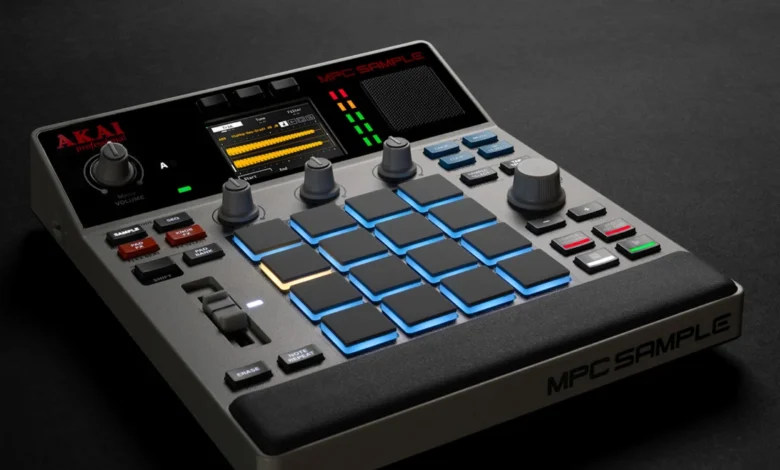
The highly anticipated AKAI MPC Sample, a compact beatmaking workstation that experienced an immediate sell-out upon its initial release, is now back in stock. Alongside this replenishment, AKAI Professional has rolled out firmware update 1.3.0, introducing significant new features and addressing user feedback. This update signifies AKAI’s commitment to refining the user experience of its latest offering, which aims to recapture the intuitive and inspiring workflow of classic MPC units.
Immediate Demand and Restocked Availability
The AKAI MPC Sample, unveiled just under three weeks prior to the firmware announcement, garnered unprecedented attention, swiftly "breaking the internet" according to industry observers. This surge in demand led to an immediate sell-out of the initial production run, highlighting a clear market desire for a more focused and accessible MPC experience. Retailers, including Thomann, have confirmed the return of the unit to their inventories, making it available for purchase once more. The swift return to stock suggests that AKAI has effectively managed its supply chain to meet the overwhelming consumer interest.
Firmware Update 1.3.0: Enhancing User Control and Functionality
Released on April 13, 2026, firmware update 1.3.0 addresses several key areas of the MPC Sample’s functionality. A significant point of contention among early adopters and reviewers was the use of standard rotary potentiometers instead of endless encoders for the unit’s three main control knobs, particularly given the lack of initial control over their behavior. Firmware 1.3.0 directly tackles this by introducing three distinct knob takeover modes:
- Pickup Mode: The value of a parameter will only change when the physical knob reaches the currently displayed value. This prevents sudden jumps in parameter settings and offers a more controlled adjustment.
- Relative Mode: The knob’s movement is relative to its current position, allowing for more intuitive and immediate parameter manipulation without needing to match the knob to the on-screen value first.
- Absolute Mode: Similar to traditional potentiometers, the knob’s position directly corresponds to the parameter value.
This update offers crucial flexibility, allowing users to select the mode that best suits their workflow and preferences, thereby enhancing the tactile control and precision of parameter editing.
Furthermore, the update introduces a highly requested "Normalize Sample" function. Accessible by holding the Shift key within the Sample Trim screen, this feature allows users to quickly normalize audio samples to 0dB. This is a time-saving utility for ensuring consistent sample levels without delving into deeper editing menus.

Beyond these headline features, firmware 1.3.0 also incorporates a range of smaller improvements and bug fixes. AKAI Professional has published a comprehensive list of these enhancements on its official website, where users can also download the update. This ongoing support underscores AKAI’s dedication to the product and its user base.
AKAI MPC Sample Review: A Return to Beatmaking Fundamentals
The AKAI MPC Sample was designed with a clear mission: to rekindle the joy and immediacy of beatmaking that defined the early MPC era. Stripping away the complexity often associated with modern MPCs, the Sample focuses on on-the-fly sampling and straightforward sequencing. This review delves into whether AKAI has successfully revived the magic of its legendary lineage.
The MPC Legacy and the Need for Simplicity

For decades, the AKAI MPC series has stood as the gold standard for hardware-based, DAW-less beat production, particularly within genres like hip-hop. The allure of its tactile workflow, built around iconic pads and intuitive sampling, has drawn countless producers away from computer-centric environments. However, the evolution of these machines, exemplified by current models like the MPC Live III and MPC XL, has seen them transform into powerful, hardware DAWs. While offering immense capability, this complexity can inadvertently mirror the learning curves and sometimes uninspiring workflows of software counterparts.
This trend has led many producers to look back fondly at the simplicity and directness of earlier MPCs such as the MPC3000, MPC2000(XL), and the compact MPC1000. These units, while less feature-rich, offered an unfiltered path to creativity, minimizing opportunities for users to become lost in intricate menus or overwhelming options. Their enduring popularity serves as a testament to the fact that for many, the modern MPCs are simply too feature-laden, especially for those whose primary focus is sampling and beat creation.
The market has responded to this demand for streamlined beatmaking tools. Competitors like the Roland SP-404 series, the Teenage Engineering EP-133 K.O. II, and the Sonicware SmplTrek have garnered significant followings, often at more accessible price points. AKAI Professional, recognizing this shift, has positioned the MPC Sample as a direct answer to this market trend, aiming to reintroduce the core tenets of the MPC experience: straightforward sampling, intuitive sequencing, and an inspiring, uncluttered workflow.
Hardware Design: Compact and Functional
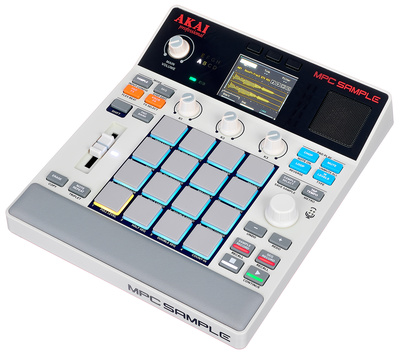
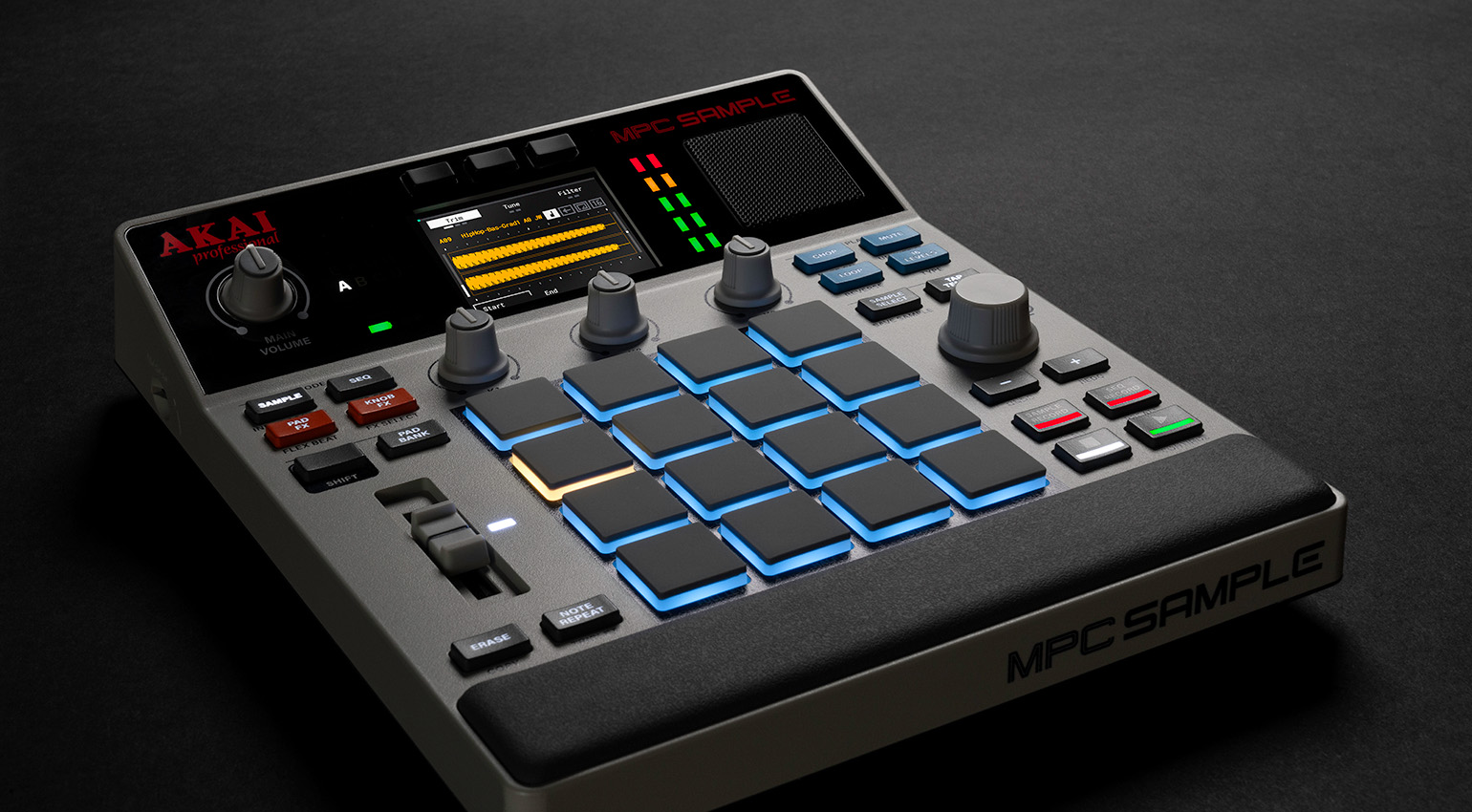
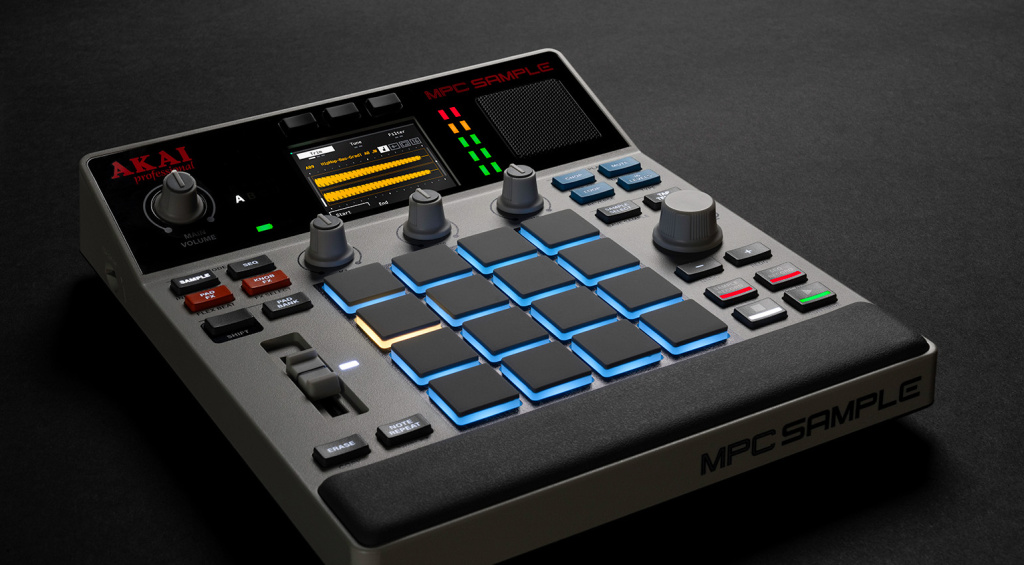
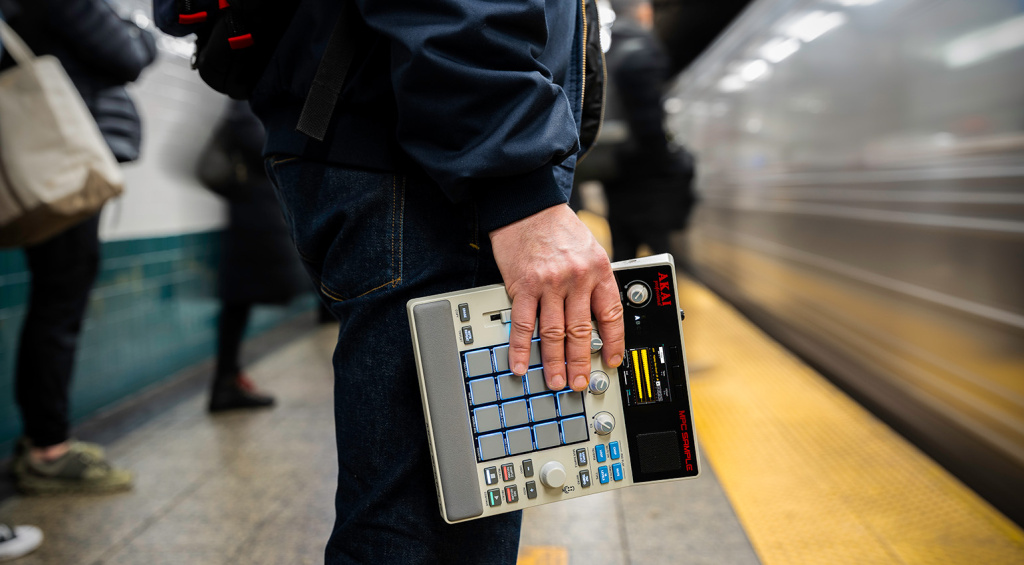
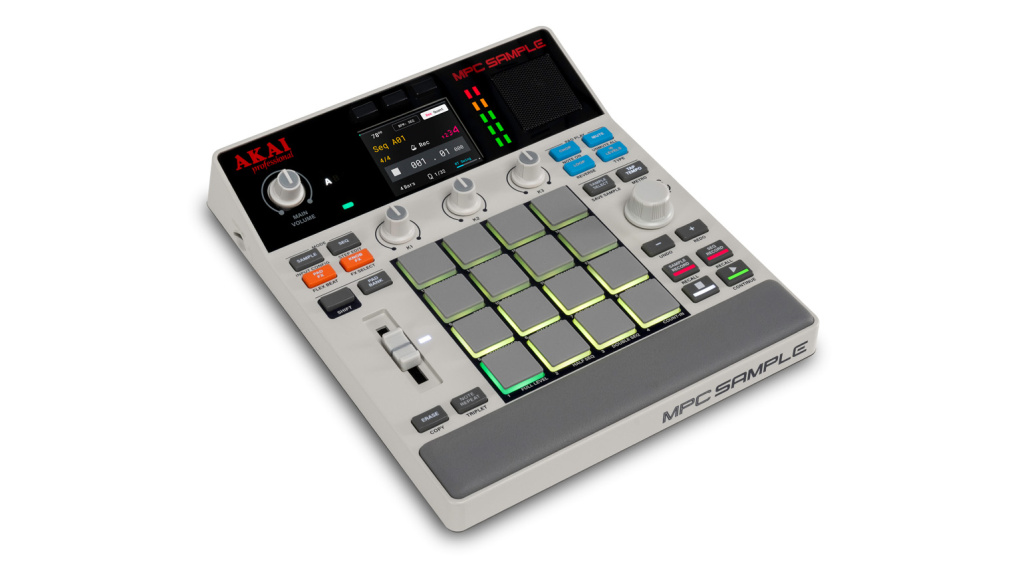
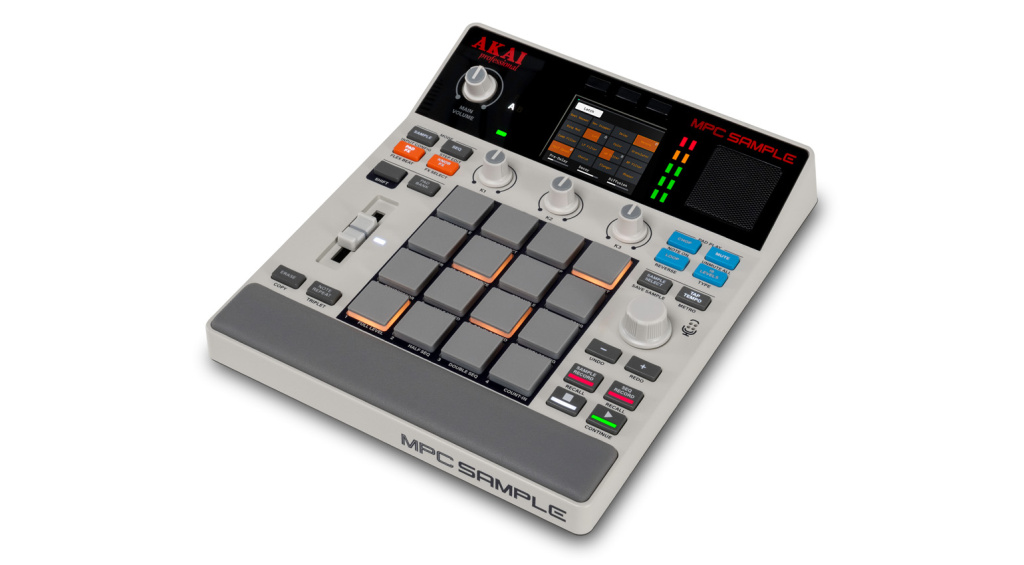
The AKAI MPC Sample’s physical design immediately reflects its compact ethos. Significantly smaller and lighter than its larger MPC siblings, the unit is constructed entirely from plastic, yet feels robust and well-built. The angled top section provides an ergonomic advantage, ensuring the LCD screen remains easily visible during use.
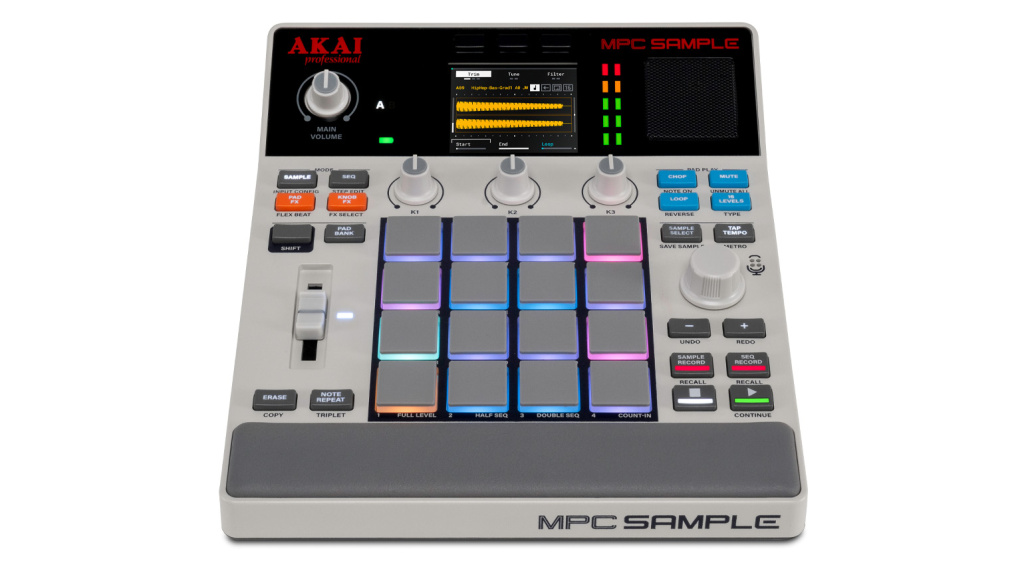
The 16 velocity-sensitive RGB pads, a hallmark of the MPC experience, are smaller than those found on other MPCs but retain the responsive feel and polyphonic aftertouch capabilities that producers expect. To the left of the pads sits the classic MPC-style parameter slider, while the right side hosts a rotary encoder and essential transport controls.
A familiar array of buttons adorns the interface, offering quick access to core functions. These include dedicated buttons for Sample and Sequence modes, Pad Banks (providing access to 8 banks for up to 128 pads), Note Repeat, 16 Levels, Mute, Loop, Chop, Tap Tempo, and various effects. The Shift button unlocks a secondary layer of functions, expanding the device’s capabilities without cluttering the primary interface.
The 2.4-inch color LCD screen, while not boasting the resolution of modern OLED displays, is sufficiently clear for editing samples, sequences, and effects. Above the screen, three function buttons adapt their role based on the current mode, complementing the three rotary knobs situated beneath the display.
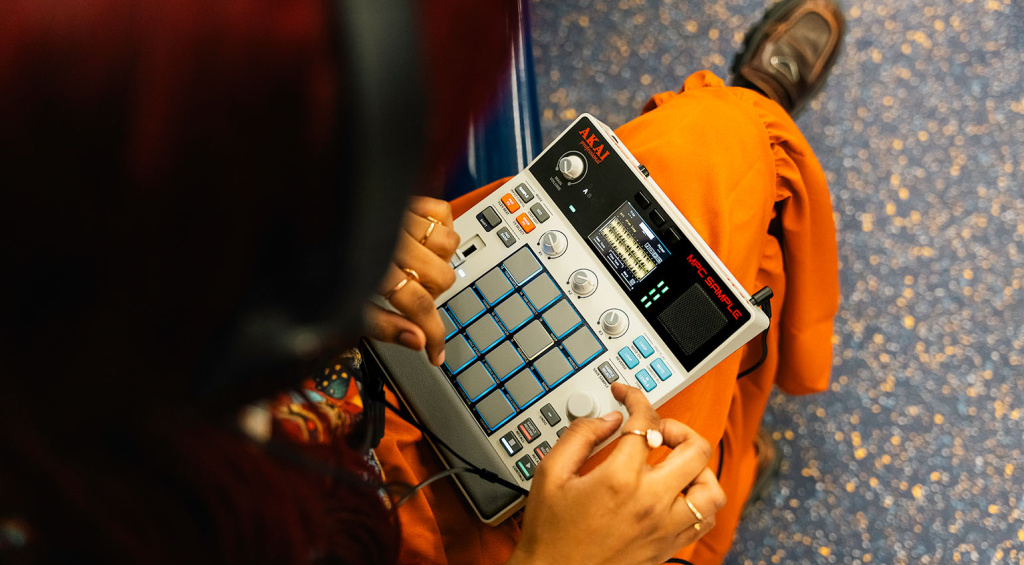
A notable feature for portability is the integrated rechargeable battery, offering up to five hours of operation. This, combined with the built-in speaker, makes the MPC Sample an ideal companion for on-the-go creativity. While the speaker’s output is understandably limited by its size, it serves well for quick jamming and idea sketching. The inclusion of a built-in microphone further enhances the device’s immediacy, allowing for instant sampling of any sound source without the need for external equipment.
Connectivity and I/O: Thoughtful Compromises
On the rear panel, alongside the power button and USB-C port, the MPC Sample features a pair of 1/4-inch audio inputs and outputs. The adoption of standard 1/4-inch jacks for audio I/O is a welcome detail, differentiating it from some competitors that opt for smaller connectors. A dedicated gain knob allows for precise adjustment of input recording levels.
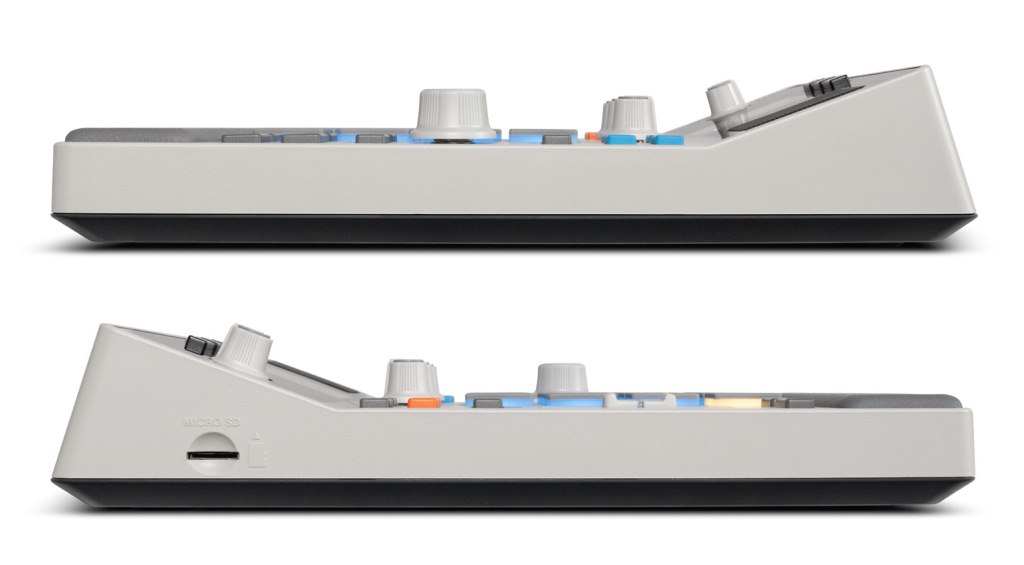
For MIDI and synchronization needs, the unit employs 1/8-inch sockets for MIDI I/O, analog Sync Out, and the headphone output. While some may prefer full-sized connectors, these smaller jacks represent a practical compromise for an ultra-portable sampler, maintaining a compact footprint. A microSD card slot on the left side provides convenient expansion for sample storage.
First Impressions: Instant Gratification and Intuitive Workflow
Upon powering on the MPC Sample straight out of the box, the device immediately presents a demo project, inviting immediate interaction. The core functions – triggering samples, managing pads, switching sequences, and recording/overdubbing – are remarkably intuitive, even for users new to the MPC ecosystem. While the included quick start guide offers a foundational overview, a deeper dive into the complete PDF manual is highly recommended to unlock the full potential of the device.
The factory content is substantial, featuring a selection of demo projects and a comprehensive sample library encompassing over 100 kits, ensuring users can begin creating from the moment they power on the unit.
Sampling and Editing: Precision and Discovery
The process of recording new samples is streamlined and familiar to MPC users. Samples can be captured via the built-in microphone, the stereo input (accommodating line, instrument, or microphone signals), or directly from a computer over USB-C, a feature that proved seamless with a Mac.
The workflow mirrors classic MPC sampling: initiate "Sample Record," select the input, adjust the gain, and press a pad to assign the recording. An optional threshold setting enables automatic sampling when an audio signal is detected.
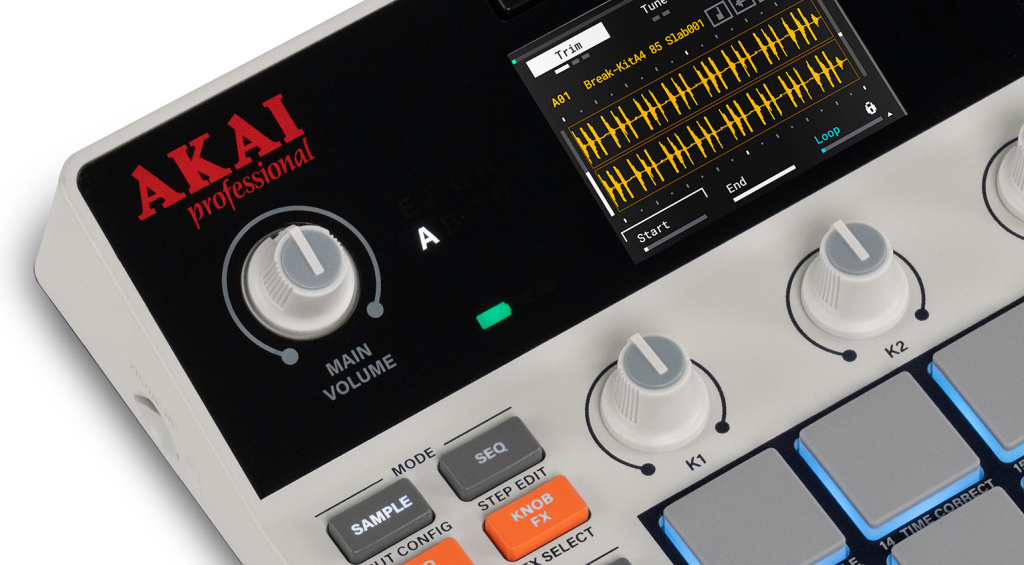
Once a sample is recorded, it’s immediately ready for playback. The initial editing process involves tuning, trimming, and looping using the rotary knobs. Early attempts at precise trimming might prove challenging due to the screen resolution and knob sensitivity. However, the manual reveals a crucial "zoom function" for sample editing. This feature, not explicitly marked on the unit or in the quick start guide, is essential for accurate waveform manipulation and highlights the importance of consulting the full manual.
The Sample menu offers advanced editing capabilities, including Warp for time-stretching and pitch-shifting, an amp envelope for shaping sample dynamics, and a multimode filter with its own envelope. Samples can also be assigned to mute groups for enhanced arrangement control.
The Chop function, a cornerstone of MPC workflow, is integrated into the Pad Play modes. Alongside options like Mute, Loop, Reverse, and 16 Levels, Chop mode divides a sample into slices, distributing them across the pads. Slicing can be performed manually, through transient detection, or into equal segments (4, 8, or 16). The zoom function proves invaluable for precise slice editing.
A notable difference from larger MPCs is the absence of a direct "convert to kit" function for chopped samples. While individual slices can be extracted and assigned to new pads, this manual process is more time-consuming than experienced MPC users might expect.
Sequencing: Classic MPC Feel with Modern Nuances
The MPC Sample adheres to the classic MPC real-time sequencing paradigm, eschewing the piano roll editor found in more complex MPCs. Sequences are recorded in real-time, with options for quantized or unquantized recording. The movements of the three knobs and the slider can also be recorded, allowing for expressive automation.
In Sequence Mode, pads facilitate seamless switching between project sequences. The addition of Song Mode enables users to arrange sequences into a complete track and export the result as an audio file. Crucially, the pads and sequencer are capable of outputting MIDI data, expanding the unit’s integration possibilities.
A wealth of shortcuts, accessible via the Shift button and various pads, streamlines sequence editing. Functions such as halving or doubling sequence length or tempo, resampling the entire sequence into a new sample, and adjusting quantization settings are readily available.
The Step Edit menu provides granular control over individual sequence events, including timing and velocity. The ability to subtly manipulate micro-timing with the slider is particularly noteworthy, enabling the creation of nuanced, humanized rhythms akin to the celebrated "Dilla Time."
Performance Effects: Inspiring Creativity and Exploration

The MPC Sample boasts an impressive array of four distinct effect types, primarily designed for creative performance rather than intricate mixing.
-
Pad FX: Sixteen effects are accessible directly via the pads, with four capable of being used simultaneously. These effects respond dynamically to polyphonic aftertouch, adding an expressive layer to performances. Pad FX are ideal for transitions and building sonic tension, offering a range of filters, modulation effects (chorus, flanger, phaser), a ring modulator, lo-fi and granulator effects, and Beat Repeat.
-
Knob FX: These effects can be applied to specific pads, allowing for selective processing of individual samples while others remain untouched. This feature is invaluable for adding unique textures like delays or choruses to specific elements of a beat. The library includes 28 Knob FX, spanning delays, reverbs, filters, compressors, limiters, amp simulation, and even vinyl and tape emulation. Only one Knob FX can be active at a time.
-
Flex Beat: This mode provides DJ-style effects, such as Beat Chop and Trance Gate, which manipulate sequence playback in real-time. Visual feedback on the corresponding menu page helps users understand the sonic impact of these effects.
-
Master Compressor: Positioned as a "color compressor," this effect is designed for noticeable sonic enhancement, capable of delivering pronounced sidechain-style pumping or more subtle dynamic control for a sequence.
AKAI MPC Sample: Defining Its Role
The AKAI MPC Sample delivers an immediate and infectious beatmaking experience. Its workflow is characterized by speed, intuition, and an inspiring lack of complexity. Within a short period, users can grasp its core functionalities, making it an exceptionally accessible "idea machine." This directness recaptures the essence of what made the original MPCs so beloved, positioning the Sample as an excellent entry point for aspiring producers.
However, it’s important to delineate the MPC Sample’s scope. While it excels at on-the-fly sampling and rapid idea generation, it is not intended as a complete replacement for larger MPC units. The primary limitation lies in its single-track architecture. Unlike its siblings, which offer multiple tracks for drums, bass, and other instruments, the MPC Sample effectively functions as a single track. This means that loading a drum kit precludes the loading of a separate bass kit or instrument onto another track. While individual samples can be added to available pads, constructing a multi-instrument arrangement can become cumbersome.
Despite this limitation, MPC Sample projects are fully compatible with the MPC software and larger standalone MPCs, allowing users to seamlessly transition their work to a more comprehensive platform for final production.
Conclusion: A Welcome Return to Form
The AKAI MPC Sample represents a significant and welcome addition to the MPC lineup. In an era where standalone MPCs have evolved into sophisticated hardware DAWs, the Sample successfully harks back to the intuitive and fun-focused spirit of the early MPCs. Its focus on immediate sampling and beatmaking, coupled with its accessible workflow, makes it an inspiring tool for both seasoned producers and newcomers. While it doesn’t replicate the full multi-track capabilities of its larger counterparts, its strength lies in its focused design, offering an abundance of creative potential without overwhelming the user. AKAI may have entered the compact performance sampler market later than some competitors, but the MPC Sample stands as a compelling and highly capable alternative in its price bracket, poised to capture the hearts of beatmakers seeking pure, unadulterated creative flow.
Pros and Cons
Pros
- Highly intuitive and immediate workflow, ideal for quick idea generation.
- Captures the fun and inspiration of classic MPCs.
- Excellent for on-the-fly sampling and beatmaking.
- Robust build quality for its size and price point.
- Feature-rich firmware update (1.3.0) addresses key user feedback.
- Comprehensive factory content, including a substantial sample library.
- Integrated battery and speaker enhance portability.
- Compatible with MPC software and larger standalone MPCs for project continuation.
- Affordable price point.
Cons
- Single-track architecture limits multi-instrument arrangements within the device itself.
- Some editing functions (e.g., sample zoom) are not immediately obvious and require consulting the full manual.
- LCD screen resolution is basic compared to higher-end units.
- 1/8-inch connectors for MIDI and headphone outputs may not suit all users.
- Chopping samples and converting them to new kits is a more manual process than on larger MPCs.
Price and Availability
The AKAI MPC Sample is currently available at retailers such as Thomann for approximately $375 USD, £342 GBP, or €389 EUR.
Related posts: