Album Review: María Dueñas Pays Inspired Tribute to Jascha Heifetz with Gustavo Dudamel and the Simón Bolívar Symphony Orchestra

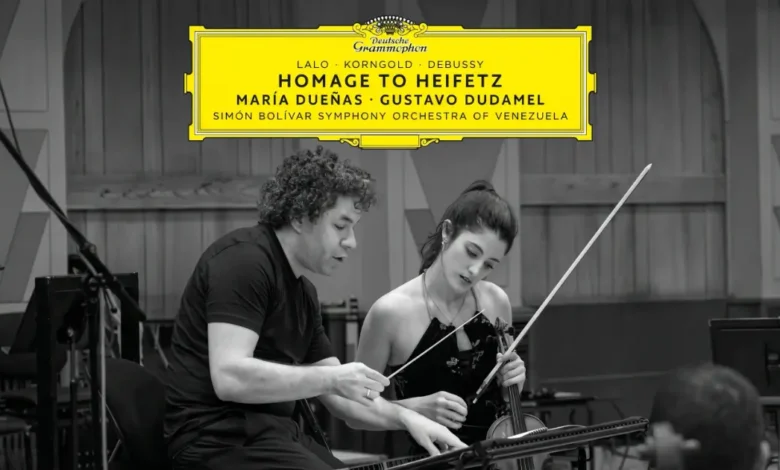
The release of Homage to Heifetz, a landmark new recording issued by Deutsche Grammophon under catalogue number 4867487, brings together acclaimed Spanish violinist María Dueñas, conductor Gustavo Dudamel, the Simón Bolívar Symphony Orchestra of Venezuela, and pianist Itamar Golan. This ambitious project serves as both a deeply personal tribute and a high-profile artistic collaboration, centering on the core repertoire popularized by the legendary twentieth-century virtuoso Jascha Heifetz—specifically Édouard Lalo’s Symphonie espagnole and Erich Wolfgang Korngold’s Violin Concerto. Beyond the orchestral masterworks, the recording holds historical and instrumentological significance, as Dueñas was granted the rare opportunity to perform three accompanying shorter works on the 1731 “Heifetz, Piel” Stradivarius, an instrument intimately linked to Heifetz’s legacy.
Background and Artistic Context
Jascha Heifetz remains an iconic figure in the history of classical music, renowned for his flawless technical precision, blazing intensity, and distinctive sonic warmth. For María Dueñas, who grew up listening to the vinyl recordings of Heifetz playing major concertos, the legendary virtuoso has long served as a primary artistic inspiration. The decision to record Homage to Heifetz is the culmination of years of artistic development shaped by the stylistic lineage of Heifetz.
Collaborating with Gustavo Dudamel and the Simón Bolívar Symphony Orchestra of Venezuela adds a powerful dimension to the project. The orchestra, celebrated globally for its vibrant energy and exceptional technical standard, provides a robust, highly responsive foundation that matches the extroverted, passionate demands of the repertoire. The integration of collaborative pianist Itamar Golan for the smaller-scale pieces rounds out an ensemble of top-tier musical forces.
Chronological Breakdown and Repertoire Analysis
The album’s sequencing moves strategically from grand orchestral concertos to intimate chamber arrangements, offering a comprehensive look at Dueñas’s technical facility and interpretive range.
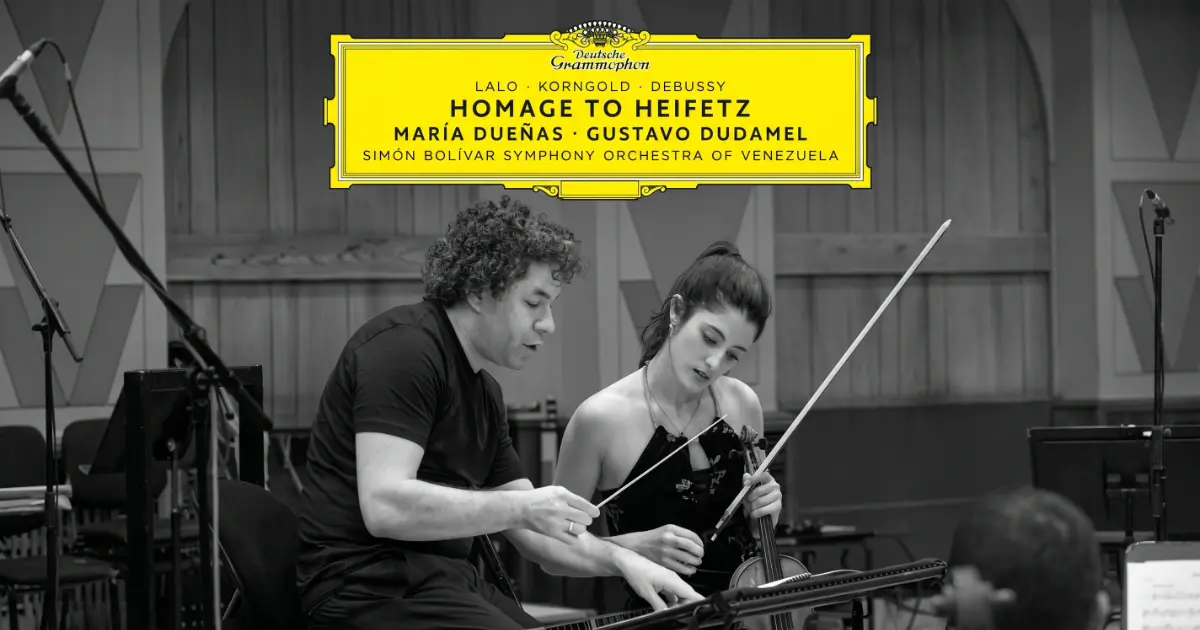
Lalo’s Symphonie espagnole
The album opens with Lalo’s Symphonie espagnole, a work that demands both virtuosic verve and refined lyricism. From the punchy orchestral entrance in the Allegro non troppo, the Simón Bolívar Symphony Orchestra commands immediate attention, driving the movement’s passionate spirit. Dueñas approaches the opening with an emphatic intensity that surpasses historical benchmarks, yet she balances this fire with a poignant, lyrical sensitivity.
In the middle register, Dueñas draws a warm, resonant presence that invites direct comparison to Heifetz’s signature tone. The subsequent Scherzando introduces a playful, coy innocence, underpinned by the orchestra’s neat pizzicatos and trills, which allows Dueñas to craft an improvisatory feel. While the Intermezzo maintains a vibrant character, the Andante captures a profound sense of pathos. Supported by the ensemble’s thick sostenuto background texture, Dueñas navigates an expansive expressive range—shifting effortlessly from near-whispered melancholy to powerful, tragic declarations. Her interpretation of this movement showcases a distinct artistic voice, diverging from Heifetz’s more inwardly reflective approach while remaining deeply compelling.
Korngold’s Violin Concerto
Erich Wolfgang Korngold’s Violin Concerto shifts the musical language toward advanced harmonies and expansive phrasal architecture. In the Moderato nobile, Dueñas demonstrates immense staying power across sustained high-register notes and sparkling fingerwork, illuminating Korngold’s lush, cinematic soundscape.
When compared to historical recordings by Heifetz, Dueñas’s reading exhibits a headier, occasionally angular tone, amplified by the bright timbre of her instrument. This complements her rhapsodic treatment of virtuosic passages, contrasting with Heifetz’s smoother, highly nostalgic resonance. The Romance highlights Dueñas’s ability to shift into a gossamer, dreamy sound, met seamlessly by the orchestra’s nuanced color changes. The swashbuckling Finale brings the concerto to a close through expertly synchronized, texturally clear execution between soloist and ensemble.
The Shorter Works and the Stradivarius Connection
A unique highlight of Homage to Heifetz is the inclusion of three shorter works performed on the 1731 “Heifetz, Piel” Stradivarius. Leon Roques’s arrangement of Claude Debussy’s La plus que lente immediately demonstrates the unique acoustic profile of the historic instrument. Dueñas achieves a husky, vocal timbre combined with lithe phrasing and delicate soft dynamics, creating an ethereal atmosphere.
Similarly, Heifetz’s arrangement of La chevelure from Debussy’s Chansons de Bilitis highlights intimate, enigmatic qualities. Pianist Itamar Golan matches these dark, suspenseful undertones with precision, ensuring that the chamber selections maintain the same high standard of execution as the major concertos.
Supporting Data and Album Specifications
For classical music consumers, Homage to Heifetz is available across physical and digital formats, supported by major streaming and purchase platforms.
| Album Parameter | Detail |
|---|---|
| Album Name | Homage to Heifetz |
| Record Label | Deutsche Grammophon |
| Catalogue Number | 4867487 |
| Primary Artists | María Dueñas (violin), Itamar Golan (piano), Simón Bolívar Symphony Orchestra of Venezuela, Gustavo Dudamel (conductor) |
| Featured Instrument | 1731 "Heifetz, Piel" Stradivarius (on select tracks) |
| Distribution Channels | Deutsche Grammophon physical/digital releases, Apple Music Classical, Presto Music |
Implications and Industry Reception
The release of Homage to Heifetz reinforces María Dueñas’s status as one of the most compelling violinists of her generation. By pairing contemporary virtuosity with historical reverence, Dueñas bridges the gap between twentieth-century performance traditions and modern classical interpretation. The involvement of Gustavo Dudamel and the Simón Bolívar Symphony Orchestra further underscores the global collaborative nature of the project, highlighting the ongoing vitality of standard romantic and cinematic violin repertoire in the twenty-first century. As classical music institutions continue to seek meaningful ways to honor historical legacies while advancing new artistic perspectives, this Deutsche Grammophon release stands as a benchmark for thematic programming and technical execution.
Related posts: