Pierce Brosnan and Helen Mirren Blindsided by False Tom Hardy Rumours on the Set of MobLand

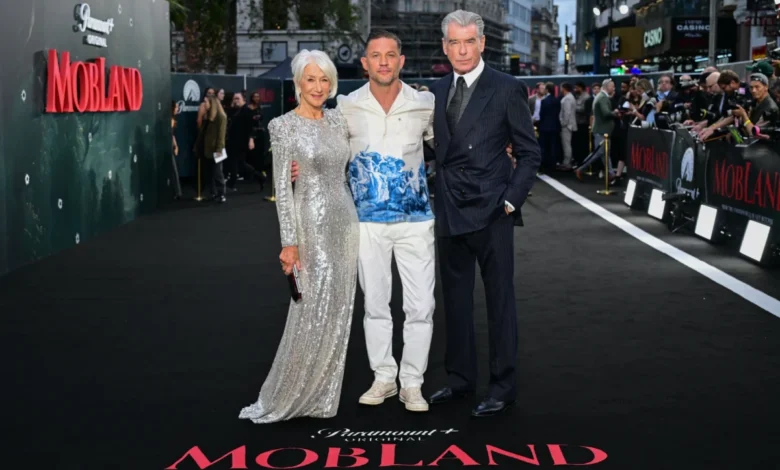
The entertainment industry is frequently a breeding ground for hyperbole, speculation, and unverified gossip, but few recent rumors generated as much turbulence as the alleged on-set friction surrounding British actor Tom Hardy during the production of Paramount+’s hit crime drama MobLand. Created and steered by acclaimed filmmaker Guy Ritchie, the series has captured global audiences with its gritty portrayal of organized crime, familial loyalty, and high-stakes power struggles. However, earlier this year, the show’s off-screen narrative briefly overshadowed its on-screen achievements when tabloid reports claimed that Hardy—who portrays the enigmatic fixer Harry Da Souza—had been fired following fiery altercations with producers and persistent behavioral issues, including allegedly leaving his co-stars waiting for hours in his trailer.
Months after the initial storm of speculation captivated entertainment media, co-stars Pierce Brosnan and Dame Helen Mirren have broken their silence, revealing that they were entirely blindsided by the false allegations. Speaking candidly in a joint interview with industry publications, the legendary actors offered a robust defense of their colleague, characterizing the ordeal as a manufactured controversy that bore no resemblance to the collaborative, highly professional atmosphere maintained on the MobLand set. Their statements provide definitive clarity on a saga that tested the patience of the production team, while highlighting the precarious nature of reputation management in the modern digital age of television production.
Chronology of the Controversy: From Tabloid Reports to Season Three Confirmation
To understand the weight of Brosnan and Mirren’s recent statements, it is necessary to examine the timeline of events that unfolded behind the scenes of Paramount+’s flagship series. The friction began earlier this year when anonymous sources leaked stories to various media outlets suggesting that tensions between Tom Hardy and the show’s creative leadership had reached a breaking point.
By May, the rumors escalated significantly, with multiple reports claiming that Hardy had been unceremoniously axed from MobLand following the completion of production for the show’s second season. The narrative painted a picture of an uncooperative star whose demands and alleged temperament had disrupted the rigorous filming schedule managed by Guy Ritchie.
Almost immediately, however, the rumor mill met swift resistance from within the production infrastructure. In late May, a well-placed production source pushed back against the narrative, signaling that industry chatter had grossly exaggerated minor creative discussions and that efforts were already underway to resolve any outstanding concerns. This was followed in June by definitive reports confirming that Hardy was officially back in the fold. The resolution came after high-level, face-to-face discussions held in London, which involved Hardy, the show’s executive producers, and Guy Ritchie himself.
The culmination of these behind-the-scenes diplomatic efforts arrived in late summer, when Paramount+ officially confirmed that Tom Hardy would not only remain an integral part of the ensemble but had also officially signed on to return for a highly anticipated third season of MobLand. The swift turnaround underscored the high commercial value of Hardy’s character and the mutual respect shared between the actor and the creative team, effectively rendering the earlier termination reports obsolete.
Co-Stars Defend Tom Hardy: Inside Brosnan and Mirren’s Reactions
Addressing the media barrage for the first time, Pierce Brosnan detailed how he first became aware of the sensationalized headlines while vacationing away from the set. Rather than reacting to the media narrative with skepticism toward his peer, Brosnan’s immediate instinct was one of personal concern and solidarity.
"I think we’re all blindsided by it, really. It was my son who sent me the text one morning," Brosnan recounted. "I was away on vacation, and I couldn’t believe it. I reached out to Tom, saying, ‘I love you, mate. I love you’."
Brosnan emphasized the creative kinship he shares with Hardy, noting that their off-screen bond extends beyond the boundaries of script-reading and blocking. "And he and I, you know, we communicate. He’s a painter. I’m a painter. Both actors. But anyway, just to say, ‘I’m there. We’re there. We love you.’ So for me, it was kind of a storm in a teacup."
Dame Helen Mirren echoed her co-star’s sentiments, drawing upon decades of collective experience navigating the often volatile waters of international stardom and tabloid journalism. Mirren had previously taken to social media in May to offer public reassurance, sharing a photograph of the Venom star on Instagram accompanied by the straightforward caption: "Love you now and always."

Reflecting on her decision to speak out publicly during the height of the rumors, Mirren explained the rationale behind her swift defense. "We live in the world of being talked about and interviewed in newspapers and so on and so forth. Pierce and I have both had many years of this and experience of it," she stated. "False rumours just should be knocked on the head ASAP, which is why I did my post about Tom, not for Tom, but my absolutely genuine love of Tom."
Furthermore, Mirren highlighted a systemic issue within the entertainment press regarding how blame is frequently allocated during production delays or creative differences. "You know, it’s par for the course, and it’s important, especially in a show like this where we are all so mutually supportive of each other," she noted. "Very often the actors get blamed for this sort of thing, and if there is a rumour, the immediate sort of blame can fall on actors. That’s usually completely unfair."
Setting the Scene: The Creative Landscape of MobLand
As MobLand returns for its second season, the timing of these revelations provides a fascinating backdrop to the show’s ongoing commercial and critical trajectory. Developed under the distinct directorial and stylistic vision of Guy Ritchie, the Paramount+ crime drama thrusts viewers into a visceral underworld of high-stakes criminality and familial dynasties.
At the narrative center of the series are Conrad and Maeve Harrigan, portrayed with gravitas and veteran command by Pierce Brosnan and Helen Mirren, respectively. Operating as the patriarch and matriarch of the notorious Harrigan crime family, the characters rely heavily on their inner circle to maintain authority and navigate rival factions. Tom Hardy’s character, Harry Da Souza, functions as the ultimate "fixer" for the syndicate—a role that requires physical presence, psychological intensity, and a delicate balance of loyalty and autonomy.
The ensemble cast further bolsters the show’s prestige, featuring acclaimed performances from Paddy Considine, Joanne Froggatt, Lara Pulver, and Anson Boon. This dense web of talent forms the backbone of Ritchie’s signature aesthetic, which blends stylized violence, sharp dialogue, and intricate plotting.
Critical reception to the series has been steady, though occasionally reflective of Ritchie’s well-worn cinematic trademarks. Upon the release of the show’s inaugural run, reviews evaluated the series as an entertaining, albeit familiar, entry into the director’s established filmography. Critics have frequently noted that while the production values, pacing, and performances operate at a high industrial standard, the thematic territory often echoes Ritchie’s earlier benchmark works in British crime cinema. Despite these critical observations, the audience appetite for the series remains robust, translating into strong viewership metrics for Paramount+ and cementing its status as a priority franchise for the streaming platform.
Implications for Production Integrity and Industry Media
The episode surrounding Tom Hardy’s purported firing and subsequent exoneration serves as a compelling case study in contemporary entertainment journalism, the speed of digital rumor propagation, and the resilience of collaborative production environments.
In an era where streaming platforms rely heavily on continuous engagement and social media buzz, unverified leaks can rapidly transform from minor gossip into mainstream crises. For a high-budget enterprise like MobLand, rumors suggesting behavioral toxicity among lead talent pose immediate financial and reputational risks, potentially impacting investor confidence, marketing strategies, and talent morale.
However, the rapid mobilization of co-stars like Brosnan and Mirren—combined with the swift intervention of executive producers and Guy Ritchie—demonstrates a maturing approach to crisis management within major television productions. By actively dismantling false narratives through direct communication and public solidarity, the cast and crew effectively neutralized the damage of the tabloid cycle.
As MobLand rolls out its second season and looks ahead toward the newly confirmed third installment, the production stands as a testament to professional cohesion. Far from buckling under the weight of fabricated friction, the core creative team has emerged with a unified front, ensuring that the primary focus of the audience remains securely on the intricate criminal empires depicted on screen rather than the speculative headlines generated off it.