Throng: A Surreal 3D Visualization of the Modern Social Media Experience

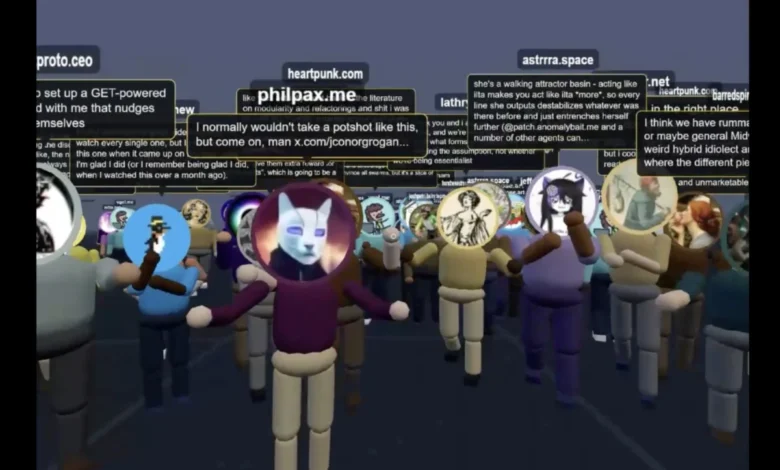
The digital landscape is currently witnessing an experimental intersection of web development, data visualization, and social commentary through a new project titled "Throng." Developed as an interactive 3D interface for the decentralized social media platform BlueSky, Throng transforms the standard text-based feed into an immersive, auditory, and spatial experience. By pulling real-time data from user accounts and rendering them as a cascading, chatty swarm of avatars, the project offers a stark, visceral representation of the information overload inherent in 24/7 digital connectivity. The tool, accessible via the web browser at throng.cee.wtf, serves as both a functional interface and a satirical critique of the mechanisms governing contemporary social interaction.
The Mechanics of the Digital Horde
At its core, Throng operates by interfacing with the BlueSky API to ingest public post data. When a user inputs their handle or a specific tag into the interface, the software generates a three-dimensional environment—often depicted as a campfire or a desolate, open space—where digital entities representing the accounts in a user’s feed begin to materialize. These entities do not merely appear as static images; they approach the user’s viewpoint, vocalizing the text of their posts in a layered, cacophonous stream.
The design philosophy behind Throng embraces what some developers colloquially call "vibecoding"—an approach that prioritizes the experiential, sometimes slightly unpolished aesthetic over rigid, enterprise-grade functionality. The result is a browser-based application that feels like a glitch-art experiment. Users navigate the space using standard controls, with the "ESC" key providing access to configuration menus that allow for the scaling of the "throng." By adjusting the density of the incoming voices, users can oscillate between a solitary, peaceful observation and an overwhelming, chaotic deluge of information that effectively simulates the neurological stress of high-frequency social media consumption.
A Chronology of Digital Overload
The emergence of Throng occurs against a backdrop of increasing discourse regarding the psychological toll of the "infinite scroll." Throughout the early 2010s, social media platforms shifted from chronological, human-scale interactions to algorithmic, engagement-driven feeds. This transition marked a significant departure from the original intent of social networking, which was ostensibly to foster community, toward a model optimized for attention retention.
The timeline of this phenomenon is well-documented:
- 2006–2010: The rise of microblogging platforms established the "stream" as the primary method of information consumption.
- 2012–2016: The implementation of proprietary algorithms replaced chronological feeds, leading to the "algorithmic feed" model that prioritizes viral content over direct social connection.
- 2020–2023: As platforms like Twitter/X and BlueSky gained prominence, the sheer velocity of data consumption reached a saturation point, with users reporting increased symptoms of digital fatigue and "doomscrolling."
- Late 2024: The introduction of experimental interfaces like Throng signals a pivot toward artistic, critical, and interpretive layers that attempt to visualize the intangible nature of these digital streams.
Data-Driven Analysis of Attention Economy
The fundamental issue highlighted by Throng is the incompatibility of human cognitive processing with the speed of digital updates. Research from the University of California, Irvine, has indicated that the average time a human spends on a single computer screen before switching tasks has dropped from 2.5 minutes in 2004 to approximately 47 seconds in recent years. This fragmentation of attention is precisely what Throng simulates; as the "throng" approaches, the user is forced to process multiple, disjointed threads of information simultaneously.
In an environment where every update—whether it be a geopolitical crisis, a mundane personal update, or an advertisement—is presented with equal visual weight, the user’s ability to prioritize information is systematically degraded. Throng strips away the "User Interface" (UI) comfort of standard apps, which hide the chaotic nature of the feed behind clean white backgrounds and polite notifications, and instead presents the user with the reality of the "firehose" of data.
Theoretical Implications and Philosophical Perspectives
Critics and researchers in the field of human-computer interaction (HCI) have long warned of the "Borg-like" assimilation of individual identity into collective digital noise. In science fiction, the trope of hearing all thoughts at once is often used to signify a loss of self. Throng inadvertently realizes this trope, forcing the user to occupy the center of a hive mind.
The project draws stylistic inspiration from early 2000s virtual worlds like Second Life, combined with the raw, text-heavy nature of Internet Relay Chat (IRC). By evoking these retro-futuristic aesthetics, Throng forces a reflection on how far social media has drifted from its origins. Whereas early chat rooms required active participation and localized focus, modern platforms demand passive, persistent observation.
Broader Impact on Social Media Design
While the developer of Throng maintains that the project is intended as a creative exploration rather than a formal critique, the implications for interface design are profound. The current standard for social media is to maximize engagement, often at the expense of user wellbeing. Throng provides an alternative: a visualization that makes the invisible visible. By allowing users to control the density of their feed—reducing the "throng" to a manageable 1-4 voices—the tool offers a potential blueprint for future "mindful" interfaces that could prioritize depth over breadth.
Industry experts suggest that as platforms continue to decentralize, there will be an increased demand for "middleware" and alternative clients that allow users to curate their experience. Throng is a leading example of this trend. It is a client that does not seek to optimize engagement, but rather to reveal the nature of the engagement itself. Whether or not this leads to a shift in how major platforms design their interfaces remains to be seen, but the success of such projects suggests a growing appetite for tools that help users navigate the noise.
Future Outlook
As the digital environment becomes increasingly saturated with AI-generated content and automated bot traffic, the "throng" will only grow larger and more cacophonous. Projects like this serve as a necessary intervention—a way to step back from the feed and observe it as an objective entity.
For the casual user, Throng is a moment of levity and technical curiosity. For the digital analyst, it is a sobering visualization of a broken communication model. By providing a spatialized, auditory, and interactive environment, the project effectively highlights the absurdity of expecting the human brain to function as a high-speed data processor. As we look toward the future of the decentralized web, the ability to visualize and filter our digital surroundings will likely become as essential as the ability to connect to them in the first place. The "throng" is coming—but for the first time, we have the tools to choose whether to listen, or to simply turn it down.