Beyond the Conventional Format: Pianist Peter Saltzman Challenges Medium and Melody in Blues, Preludes & Feuds: A Musical Diary

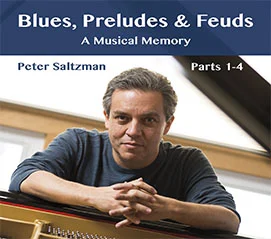
Pianist and composer Peter Saltzman has once again disrupted traditional paradigms within the contemporary music landscape, declaring at the outset of his liner notes that listeners are holding something that is, strictly speaking, “not a CD.” Released as an innovative hybrid music-eBook, Saltzman’s latest project, Blues, Preludes & Feuds: A Musical Memory, bridges the gap between physical and digital media while expanding the boundaries of solo piano performance.
The release follows Saltzman’s previous Kickstarter-backed campaign, Piano Diaries, which served as the conceptual and developmental genesis for this multi-layered project. While Piano Diaries functioned largely as an exploratory work in progress, Blues, Preludes & Feuds represents a fully realized, stream-of-consciousness narrative. Drawing comparisons to the dense, evolving prose of James Joyce, Saltzman’s latest opus is an autobiographical journey informed by decades of classical training, a deep reverence for jazz improvisation, and a commitment to unyielding originality.
The Evolution of a Virtuoso: From Classical Foundations to Avant-Garde Jazz
To understand the intricate framework of Blues, Preludes & Feuds, one must examine the artistic trajectory of its creator. Classically trained yet persistently drawn to the boundary-pushing ethos of jazz, Saltzman has carved out a distinct niche within the contemporary music community. His career highlights include notable collaborations and performances with the Revolution Ensemble, an organization known for its avant-garde sensibilities and integration of improvised and structured musical forms.
Saltzman’s background has continually pushed him toward a synthesis of historical and modern styles. In Blues, Preludes & Feuds, this synthesis manifests as a peripatetic exploration of musical history, moving effortlessly from the baroque precision of Johann Sebastian Bach to the angular, complex phrasing historically championed by Thelonious Monk. The presence of Bach’s majestic inventions, preludes, and fugues acts as a foundational anchor throughout the recording. However, rather than merely reinterpreting baroque literature, Saltzman weaves these classical structures directly into the cultural topography of his own contemporary compositions.
The shadow of Thelonious Monk looms large over the project, alongside subtle nods to Ludwig van Beethoven. This triad of influences—Bach, Beethoven, and Monk—serves as a metaphorical compass guiding Saltzman’s pursuit of a modern musical Holy Grail. Yet, much like the mythological search for the chalice, Saltzman’s journey on this album is intentionally interminable, characterized by constant motion and restless exploration.
Chronology and Compositional Architecture: Breaking Down the Musical Diary
Structured across four distinct parts, the album’s 27 tracks form a chronological and thematic tapestry that reflects the artist’s life experiences, political upbringing, and intellectual pursuits.
The recording opens with a programmatic declaration in Part 1, featuring tracks such as Prelude – Overt? Sure!!, Blues for the End of Time, and the structural centerpiece Part 1 – Prelude#0 (The Theme) paired with Feud #0 (The Counter-Theme). These initial movements establish the antagonistic yet harmonious relationship between disciplined classical forms and improvisational freedom.
Part 2 delves deeper into rhythmic complexity and emotional tension. Tracks like Ostinato Asymmetrique and Ostinato Improvisique highlight Saltzman’s command of recurring rhythmic figures, while Fanatical in A utilizes short, jabbing lines to create a palpable sense of urgency. This tension naturally bleeds into the poignant transitions of Temporary Cessation of Hostilities, which flows seamlessly into a meditative rendition of Amazing Grace at the opening of Part 3. This section further demonstrates Saltzman’s reverence for classical architecture through a series of reimagined baroque works, including Bach Prelude #1 Remix, Bach Prelude #2, and the inventive Fantasy on Bach Fugue #2.
The final movement, Part 4, encapsulates the eclectic nature of the project. Ranging from the politically charged undertones of Star Spangled Minor and Prevaricate to the introspective Eggman’s Lament and the stylistic pivot of Blues en Français, the concluding tracks encapsulate a lifetime of artistic accumulation.
Sociopolitical Roots: The Chicago Influence and the Anatomy of a "Feud"
The nomenclature of the album—specifically the inclusion of the words “Blues” and “Feuds”—speaks directly to Saltzman’s formative years. Raised in the politically volatile and socially stratified environment of 1960s Chicago, Saltzman was exposed early on to an atmosphere of civic unrest and ideological conflict.
Industry analysts and cultural critics note that the turbulent socio-political climate of the American Midwest during this era frequently catalyzed artistic rebellion. For Saltzman, this manifested as an artistically militant approach to composition. The "feuds" embedded within the album’s title and tracklist do not represent personal grievances, but rather a dialectical struggle between opposing musical forces: structure versus chaos, tradition versus innovation, and tranquility versus dissonance.
This militant yet whimsical phrasing draws a direct line to the legacy of Thelonious Monk, whose idiosyncratic approach to harmony and rhythm redefined the parameters of mid-century jazz. Saltzman channels this ethos to narrate his personal and artistic evolution, creating a sonic document that resists easy categorization.
Industry Implications and the Hybrid Music-eBook Format
Beyond its auditory merits, Blues, Preludes & Feuds represents a significant statement on the distribution and consumption of independent art in the digital age. By packaging the audio recording alongside an eBook format, Saltzman addresses the ongoing devaluation of recorded music in streaming ecosystems, offering consumers an enhanced, multimedia artifact.
Industry stakeholders and independent publishing advocates have increasingly looked toward hybrid models—combining literature, visual art, and high-fidelity audio—as a viable economic and creative strategy for niche artists. Saltzman’s deliberate rejection of the traditional compact disc format underscores a broader industry shift toward conceptual physical-digital releases that demand active engagement from the listener.
As academic institutions and musicologists continue to study the intersection of classical composition, jazz improvisation, and modern digital publishing, works like Blues, Preludes & Feuds serve as case studies in contemporary artistic independence. Through this ambitious release, Peter Saltzman has not only delivered a definitive statement on his own career trajectory, but has also challenged the industry to reconsider how music is contextualized, packaged, and experienced.