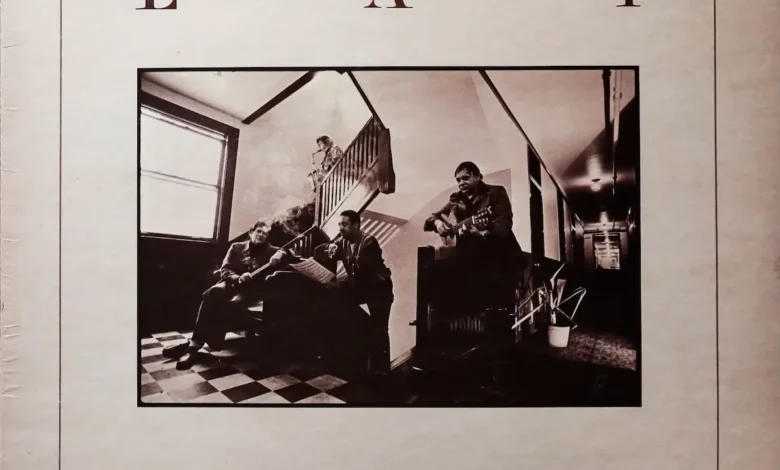
The L.A. Four, a quartet consisting of Bud Shank, Laurindo Almeida, Ray Brown, and Shelly Manne, represents a significant chapter in the evolution of 20th-century jazz. Their self-titled second album for Concord Jazz (CJ-18), recorded in early 1976, serves as a definitive case study in the intersection of jazz, classical, and Brazilian musical traditions. This ensemble did not merely perform jazz standards; they curated a sophisticated soundscape that challenged the boundaries of "chamber jazz," proving that technical virtuosity could coexist with fluid, cross-genre improvisation.
Historical Context and the Genesis of the Ensemble
To understand the artistic weight of The L.A. Four, one must trace the professional history of its core members, specifically the long-standing creative partnership between Bud Shank and Laurindo Almeida. Their collaborative roots extend back to 1950, when both musicians were members of the Stan Kenton Orchestra. This period was pivotal in the history of jazz, as it saw the early integration of Latin American rhythms into mainstream American jazz—a movement that would later be solidified by the bossa nova craze of the 1960s.
Historical records indicate that Shank and Almeida were exploring these rhythmic structures as early as 1953 and 1954, specifically on the World Pacific label (WP1412/Vogue LAE12019). While Stan Getz is frequently credited with popularizing bossa nova in the 1960s, the foundation for this synthesis of styles was laid a decade earlier by the experimentation of Shank and Almeida. The 1976 reunion of these two artists, bolstered by the rhythm section of Ray Brown and Shelly Manne, was not merely a nostalgic project but a continuation of their original musical inquiry.
Analytical Breakdown of the 1976 Concord Session
The 1976 release, recorded in Los Angeles, features a tracklist that defies standard genre categorization. The repertoire includes:
- Dindi
- Rainbows
- Rondo Espressivo (J.S. Bach)
- Manteca (Dizzy Gillespie)
- St. Thomas (Sonny Rollins)
- Concierto De Aranjuez (Joaquín Rodrigo)
The inclusion of Bach’s Rondo Espressivo alongside Gillespie’s Manteca highlights the ensemble’s breadth. As Ray Brown noted regarding the group’s philosophy, the members operated without the pressure of commercial catering, allowing for a fusion of classical rigor and bebop spontaneity. The technical execution on Manteca is particularly notable, featuring a sophisticated bass-and-drums dialogue between Brown and Manne that serves as a masterclass in percussive interplay.
The Contributions of the Rhythm Section
The effectiveness of The L.A. Four is largely attributed to the synergy between bassist Ray Brown and drummer Shelly Manne. Ray Brown, long recognized as a foundational figure in jazz bass, brought a level of precision and harmonic depth that elevated every track on the album. His ability to anchor the group while maintaining melodic independence is a defining characteristic of this recording.
Shelly Manne, conversely, provided a rhythmic foundation that was both constructive and highly musical. In an era when percussionists were often relegated to time-keeping roles, Manne utilized his solos to create cohesive narrative arcs within the music. His work on this album is widely cited by critics as a prime example of "musician-centric" drumming, where the focus remains on the structural integrity of the piece rather than mere technical display.
Biographical Significance and Artistic Recognition
The career of Bud Shank provides a compelling narrative of high-level musicianship. His influence was not limited to the quartet; he was highly respected among his peers, including Duke Ellington. An illustrative anecdote from this era involves the soundtrack for the film Assault on a Queen. Following their collaboration, Ellington reportedly offered Shank a permanent position in his orchestra. Johnny Hodges, Ellington’s longtime lead alto player, was allegedly moved by Shank’s performance, an occurrence that spoke volumes given the high standard maintained within the Ellington ranks. Shank eventually declined the offer due to his established commitments to film studio work, yet the offer remains a testament to his standing in the jazz hierarchy.
Laurindo Almeida’s role as the group’s arranger and classical authority cannot be overlooked. His transcription of Joaquín Rodrigo’s Concierto De Aranjuez for this ensemble remains a hallmark of his career. By adapting complex orchestral works for a small jazz quartet, Almeida and the group effectively bridged the gap between the concert hall and the jazz club, a feat that reinforced the "chamber jazz" label often applied to the group.
Broader Impact and Industry Implications
The emergence of The L.A. Four in the mid-1970s coincided with a period of introspection within the jazz industry. As jazz-fusion and rock-influenced jazz began to dominate the commercial airwaves, ensembles like The L.A. Four offered an alternative: a return to acoustic excellence and refined arrangements.
The economic implications for independent labels like Concord Jazz were significant. By focusing on high-fidelity, intellectually demanding recordings, Concord Jazz was able to carve out a niche market that valued musical longevity over short-term pop-chart success. The release of The L.A. Four (CJ-18) was a benchmark for the label, setting a standard for production quality and artistic cohesion that would define their catalog for the remainder of the decade.
Technical and Chronological Summary
The session, held in Los Angeles in early 1976, lasted approximately 45.5 minutes of total playtime, split between two primary segments: 25 minutes for the first side and 20.5 minutes for the second. This timing was optimal for the vinyl format of the era, ensuring high audio fidelity without sacrificing the integrity of the long-form compositions like the Concierto De Aranjuez.
The ensemble’s ability to maintain a consistent output of high-caliber music, regardless of the source material, established a blueprint for the "super-group" model in jazz. Rather than relying on individual stardom, the quartet relied on collective discipline. The synthesis of Shank’s fluid alto saxophone and flute, Almeida’s intricate classical-jazz guitar, Brown’s authoritative bass, and Manne’s inventive percussion remains a pinnacle of 1970s jazz production.
Conclusion: The Legacy of The L.A. Four
The legacy of this quartet persists in the way it is taught and studied by contemporary musicians. By refusing to "cater to anything," as Ray Brown famously stated, the group ensured that their recordings would remain relevant to students of music theory and jazz history alike. The 1976 album is not merely a collection of tracks; it is an artifact of a time when the boundaries between classical and jazz were being actively and successfully eroded. For the listener, the album offers a rare opportunity to hear four masters of their craft operating in a setting that demands both absolute technical control and absolute creative freedom. As the discography demonstrates, the group remained a testament to the idea that true musical innovation often lies in the refined, disciplined application of existing traditions.