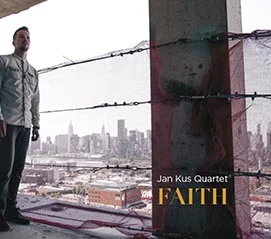
The contemporary jazz landscape is continuously reshaped by artists who draw upon diverse cultural backgrounds, classical training, and cross-continental experiences. Among the most promising modern voices to emerge in recent years is Slovenian-born saxophonist, composer, and bandleader Jan Kus. With the 2016 release of his debut full-length album as a leader, Faith, Kus established himself as a formidable presence in the international jazz community. Self-produced and ambitious in scope, the album serves as a definitive showcase for Kus’s fully realized artistic vision, blending modern mainstream jazz idioms with global rhythmic influences, sophisticated harmonic structures, and an elite ensemble of contemporary improvisers.
The release of Faith marked a major milestone in a career that has spanned multiple continents, rigorous academic study, and prestigious mentorships. By examining the musical architecture of Faith, the trajectory of its creator, and the broader implications of its cross-cultural sound, music critics and industry observers have gained a clearer understanding of how contemporary jazz continues to evolve through the contributions of a new generation of global artists.
Formative Years and Early Accolades
Jan Kus’s journey to the forefront of modern jazz began in his native Slovenia, where his early promise on the saxophone caught the attention of cultural authorities. Recognizing his exceptional aptitude, the Slovenian Ministry of Culture awarded Kus a prestigious scholarship enabling him to relocate to the Netherlands and study at the Royal Conservatory of The Hague.
During his tenure at the conservatory, Kus immersed himself in the rich European jazz ecosystem. His studies extended beyond the classroom as he participated in extensive concert tours across Belgium, Cyprus, Greece, Hungary, Italy, Slovenia, Slovakia, and the Netherlands, collaborating with a network of Europe’s finest young jazz talents. These formative international experiences deeply influenced his compositional palette, instilling an appreciation for diverse musical traditions that would later define his solo work.
Seeking to expand his artistic boundaries further, Kus crossed the Atlantic in 2012 to pursue his Master of Music degree in the United States. He enrolled at the Aaron Copland School of Music at Queens College in New York City, a historic institution renowned for nurturing generations of jazz greats. At Queens College, Kus studied under the legendary saxophonist and educator Antonio Hart. Under Hart’s rigorous tutelage, Kus refined his tone, technical dexterity, and harmonic vocabulary, ultimately earning the coveted Jimmy Heath Award, given annually to the school’s most promising wind players. This recognition by faculty and peers cemented his status as a rising star within the fiercely competitive New York jazz scene.
The Anatomy of Faith: A Global Soundscape Rooted in Modern Jazz
Released in 2016, Faith represents the culmination of Kus’s transatlantic experiences. As a self-produced project, the album offers an unfiltered look at the saxophonist’s creative ethos. Rather than adhering strictly to traditional post-bop formulas, Kus constructs a globally transcendent sound that embraces complex Latin rhythms, contemporary harmonic textures, and vocal integration.
To bring this expansive vision to life, Kus assembled a core quartet comprising pianist and Fender Rhodes player Sean Fitzpatrick, double bassist Dan Martinez, and drummer Joel Mateo. This rhythm section acts as the gravitational pull of the album, providing the elasticity and structural integrity required for Kus’s complex compositions. In addition to the core quartet, Kus invited a stellar roster of guest artists to expand the sonic palette of the record, including his mentor Antonio Hart on alto saxophone, trumpeter Alex Sipiagin, electric guitarist Rafal Sarnecki, vocalist Mélanie JB Charles, percussionist Carlos Maldonado, and electronic artist Ziga Murko.
The resulting recording is remarkably cohesive despite its stylistic breadth. From high-octane reinterpretations of jazz standards to deeply personal original compositions, Faith moves fluidly across musical landscapes, demonstrating a maturity and compositional sophistication rarely heard on a debut release.
Deep Dives and Standout Performances
The interplay between generations is one of the defining characteristics of Faith. On the original composition "Emptiness," Kus shares the frontline with his mentor, Antonio Hart. The track serves as a masterclass in dynamic contrast and conversational phrasing. Hart’s focused, incisive alto saxophone lines intertwine seamlessly with Kus’s brash, full-bodied tenor. Rather than competing for sonic space, the two saxophonists function as eloquent foils for one another, gradually building the melody’s emotional intensity through elongated lines and a rising tide of improvisational fervor.
The album also pays homage to the bebop tradition through a striking reimagining of Thelonious Monk’s classic composition "Rhythm-a-Ning." Transformed here into a quartet treatment featuring trumpeter Alex Sipiagin, the track showcases Kus’s exceptional rhythmic command. Rather than merely executing rapid-fire passages, Kus and Sipiagin treat Monk’s angular melody with rhythmic elasticity. Driven by Fitzpatrick’s piano tension and Mateo’s propulsive drumming, Martinez’s bass anchors a subtle shift into a driving Latin rhythm, proving that the ensemble possesses both deep reverence for jazz history and the technical audacity to reinvent it.
Vocal integration plays a critical role in the texture of Faith, largely due to the contributions of vocalist Mélanie JB Charles. Charles, who has become an increasingly ubiquitous presence on emerging millennial jazz recordings, possesses a languid, seasoned vocal timbre that resists easy categorization. On the track "Strength," Charles utilizes her voice as a true instrument, vocalizing in unison and counterpoint with Kus’s saxophone. The result is a seamless blend of human voice and brass that blurs the line between wordless scatting and instrumental phrasing.
Conversely, the ballad "I’m Just a Little Person"—which appears in two distinct versions on the album—highlights the subtler nuances of the ensemble. In its primary vocal setting, the arrangement relies on gentle spacing and breath control. Charles delivers a performance that emphasizes the breathy beauty of her lower register, while Kus matches her intimacy with extraordinary sustain and control on the tenor saxophone. A second, alternate take reimagines the tune as a trio version, with Kus shifting to soprano saxophone. Supported by sparse, loping contributions from the rhythm section, the soprano-led trio creates a poignant atmosphere of longing, proving that Kus is equally adept at navigating the emotional demands of a spacious ballad as he is at tackling high-tempo bebop.
Among the album’s many highlights, the muscular and complex composition "Neófito" stands out as a critical focal point. Driven by heavy Latin grooves and intricate harmonic textures, the track encapsulates the modern, globally influenced ethos of the entire project. It demands immense technical precision from the ensemble while maintaining an infectious forward momentum that lingers long after the final note.
Track Listing and Comprehensive Personnel
To fully understand the structural ambition of Faith, one must examine its extensive track listing, which weaves recurring thematic interludes—such as "One for the Band" told from the perspectives of Jan, Sean, and Dan—throughout the program:
- Disconnect
- Emptiness
- One for the Band
- Aqui
- One for the Band — Jan’s Story
- I’m Just a Little Person
- One for the Band — Sean’s Story
- Rhythm A Ning
- Strength
- One for the Band — Dan’s Story
- Neófito
- Faith
- I’m Just a Little Person (Trio Version)
The realization of this comprehensive musical vision was made possible by a carefully curated roster of international musicians:
- Jan Kus: Tenor saxophone, soprano saxophone
- Sean Fitzpatrick: Piano, Fender Rhodes
- Dan Martinez: Double bass
- Joel Mateo: Drums
- Mélanie JB Charles: Vocals
- Antonio Hart: Alto saxophone
- Alex Sipiagin: Trumpet
- Carlos Maldonado: Percussion
- Rafal Sarnecki: Electric guitar
- Žiga Murko: Electronics
Critical Reception and Industry Impact
Upon its release, Faith received widespread acclaim from jazz critics, educators, and industry professionals. Reviewers frequently highlighted Kus’s advanced technical dexterity, his mastery over breath control, and a warm, round tone that belied his relative youth. By successfully integrating European conservatory training, American jazz tradition, and Latin rhythmic sensibilities, Kus positioned himself as part of a vanguard of contemporary artists who view jazz as a truly borderless global art form.
Industry analysts note that self-produced debut albums of this scale carry significant financial and logistical challenges. However, the critical success of Faith vindicated Kus’s independent approach, proving that artists equipped with strong digital distribution networks and high-level artistic collaborations can bypass traditional gatekeepers to make a profound impact on the global jazz consciousness.
Broader Implications and Future Outlook
The trajectory of Jan Kus offers valuable insights into the current state of jazz education and international cultural exchange. Programs like the Aaron Copland School of Music and European conservatory networks continue to serve as crucibles for talent, fostering cross-pollination between American innovators and international students. As artists like Kus bring their unique cultural heritages to the epicenters of jazz—such as New York City—the vocabulary of the genre expands, incorporating microtonal elements, folk rhythms from Eastern Europe, and contemporary electronic textures.
Furthermore, the collaborative spirit demonstrated on Faith underscores the collaborative nature of the millennial jazz movement. Musicians of Kus’s generation operate within porous networks where genre boundaries are treated as fluid suggestions rather than rigid constraints.
As Jan Kus continues to perform, compose, and record, industry observers will undoubtedly monitor his career with keen interest. Faith stands not merely as an impressive debut, but as a bold artistic declaration. If the maturity, technical brilliance, and global perspective displayed on this recording are any indication of what is to come, Jan Kus is poised to remain a vital and transformative voice in modern jazz for decades to come.