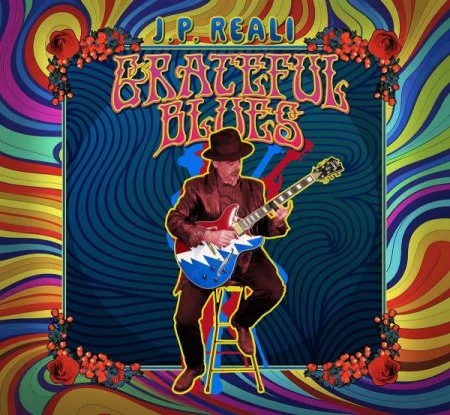
The intersection of traditional blues and the sprawling, improvisational legacy of the Grateful Dead has long offered fertile ground for musical exploration. For decades, music historians and purists alike have occasionally overlooked the foundational truth that the Grateful Dead—despite their reputation as psychedelic pioneers and jam-band royalty—were fundamentally a blues band at heart. Before embarking on a consciousness-expanding, multi-decade sonic journey that captivated millions, the core members of the iconic San Francisco ensemble cut their teeth on the standard American blues canon. Now, veteran blues artist J.P. Reali is paying homage to that foundational lineage with the release of his latest studio project, Grateful Blues, via Reali Records. Spanning six tracks and a concise 25 minutes, this new EP serves as a heartfelt love letter to the Dead’s extensive catalog, successfully bridging the gap between traditional blues instrumentation and the exploratory spirit of the jam-band landscape.
Main Facts of the Release
Grateful Blues is a meticulously crafted six-track EP that reinterprets classic material from the Grateful Dead songbook through a distinct blues lens. Recorded in Philadelphia and released under the Reali Records banner, the project features a tight-knit ensemble of seasoned musicians. The record is driven by J.P. Reali on guitars and vocals, supported by the rich textures of keyboardist Rich Budesa, the steady rhythmic foundation of drummer and producer Jim Larson, and the deep, anchoring basslines of Monty Cullum.
Rather than delivering carbon-copy covers, Reali has intentionally reimagined the source material to highlight the underlying blues, country, and roots influences that informed the Dead’s original compositions. The EP includes fresh takes on well-known cuts such as "Easy Wind," "Loose Lucy," "West L.A. Fadeaway," "I Need A Miracle," "Mr. Charlie," and "Tennessee Jed." Clocking in at just 25 minutes, the release strikes a careful balance between extended, expressive soloing and structured songwriting, deliberately avoiding the sprawling, interminable 16-minute jams sometimes associated with the genre while retaining the improvisational essence of live performance.
Chronology and Musical Evolution
J.P. Reali’s deep-seated connection to the music of the Grateful Dead is rooted in a lifelong fandom that began in his youth. Growing up, Reali’s musical education was profoundly shaped by devouring the compilation album Skeletons from the Closet at the impressionable age of 14. This early exposure sparked a decades-long devotion that saw him attend dozens of live performances as the band toured across the country.
Parallel to his love for the Dead, Reali cultivated a formidable career as a blues artist. A native of New York who spent decades performing extensively throughout the Washington, D.C. metropolitan area, Reali eventually relocated to Newark, Delaware. Over the years, he has navigated numerous musical pathways, culminating in his critically acclaimed 2024 straight-ahead blues album, Blues Since Birth.

The transition to Grateful Blues represents a calculated artistic pivot. Reflecting on the creative direction of the new EP, Reali noted that the project was designed as a deliberate step to integrate his artistry into the broader jam-band scene. By taking the classic compositions he has loved for decades and filtering them through his distinct blues sensibilities, Reali has charted a new chronological milestone in his recording career, proving that his artistic range extends far beyond conventional blues structures.
Track-by-Track Musical Analysis
The EP opens with a dynamic reworking of "Easy Wind," originally featured on the Grateful Dead’s critically acclaimed 1970 studio album, Workingman’s Dead. In Reali’s hands, the folky, roots-oriented original is updated with echoes of a countrified 1970s Eric Clapton guitar vibe. Rich Budesa’s organ work introduces a warm, enveloping texture that anchors the arrangement.
Budesa continues to shine on "Loose Lucy," leaning into the piano in a style reminiscent of legendary blues pianist Johnnie Johnson. This performance injects a retro, bayou-rock feel into the track. Originally a staple of the band’s live sets during the 1973–1974 era before being unexpectedly revived in 1990, "Loose Lucy" serves as a welcome deeper cut on the EP. Throughout this track and others, attentive listeners can easily discern the structural and stylistic echoes of pioneering architects like Chuck Berry, Johnny Cash, Dr. John, and the Delta blues tradition.
The mid-tempo track "West L.A. Fadeaway" provides a humorous nod to the Grateful Dead’s commercial peak and cultural ubiquity in the late 1980s. This composition offers Reali ample space to showcase his technical proficiency on the guitar, highlighted by a soaring, extended solo. Following closely is "I Need A Miracle," originally released on the 1978 album Shakedown Street. Operating as an upbeat driving song, the track is propelled forward by witty, self-deprecating lyrical narratives about a down-on-his-luck protagonist seeking a towering companion. Drummer and producer Jim Larson delivers a standout performance on this cut, anchoring the rhythm section with precision and power.
As the EP draws to a close, Reali incorporates clever nods to the live performance traditions of the jam-band circuit. A charming outro quotes the beloved track "Bertha," channeling the spontaneous, medley-driven spirit of a Grateful Dead concert. Bassist Monty Cullum then leads the ensemble directly into "Mr. Charlie." This track serves as a direct tip of the cap to blues icon Robert Johnson, driven by Reali’s expressive slide-guitar work.
The record concludes with "Tennessee Jed," transformed here into a slow, acoustic country stomp. Offering insight into the unique arrangement, Reali remarked that there is simply no other recorded version quite like it in existence, setting his interpretation apart from standard covers.

Production and Supporting Personnel
The creation of Grateful Blues was a collaborative effort executed by a tight-knit core of professional musicians in a Philadelphia recording studio. Production duties were handled by drummer Jim Larson, whose steady timekeeping and creative direction ensure that the EP maintains a cohesive sonic identity from start to finish. Larson’s production philosophy centers on honoring the improvisational nature of the source material while maintaining the crisp fidelity expected of a modern studio release.
Keyboardist Rich Budesa plays a vital role in defining the album’s acoustic atmosphere. Across multiple tracks, Budesa’s mastery of the organ and piano supplies the necessary harmonic cushion and textural depth, effectively bridging the gap between classic rock and traditional blues aesthetics. Meanwhile, bassist Monty Cullum provides a rock-solid low-end foundation, frequently stepping forward to guide smooth transitions between tracks, as demonstrated in the seamless segue into "Mr. Charlie." Together, this ensemble creates a polished, live-in-the-studio sound that feels both spontaneous and meticulously rehearsed.
Broader Impact and Industry Implications
The release of Grateful Blues arrives at a time of renewed interest in genre-blending American roots music, where the boundaries between traditional blues, country, and jam-band culture continue to dissolve. By explicitly targeting the jam-band scene with this release, Reali is positioning himself at a unique stylistic crossroads.
For blues purists, the album offers a masterclass in how foundational 12-bar structures and Delta slide techniques can be successfully applied to counter-culture rock anthems without losing their authentic edge. For the legions of dedicated Deadheads, the EP provides a fresh, respectful perspective on familiar compositions, proving that the underlying songwriting of Jerry Garcia, Robert Hunter, and their collaborators shares a deep, inextricable DNA with classic American blues.
Furthermore, the EP’s measured 25-minute runtime challenges the conventional wisdom that jam-band tributes must feature endless, meandering instrumentals to be authentic. By distilling the improvisational energy of the Grateful Dead into concise, punchy arrangements, Reali demonstrates that economy of style can coexist with exploratory musicianship. As Grateful Blues makes its way to streaming platforms and physical distribution via Reali Records, it stands as a testament to the enduring power of the blues and its capacity to continually reinvent itself through the visions of dedicated artists.