IT’S BRISTOL BABY: CHAOS ERUPTS AS RYAN BLANEY AND CARSON HOCEVAR CLASH AT THE LAST GREAT COLISEUM

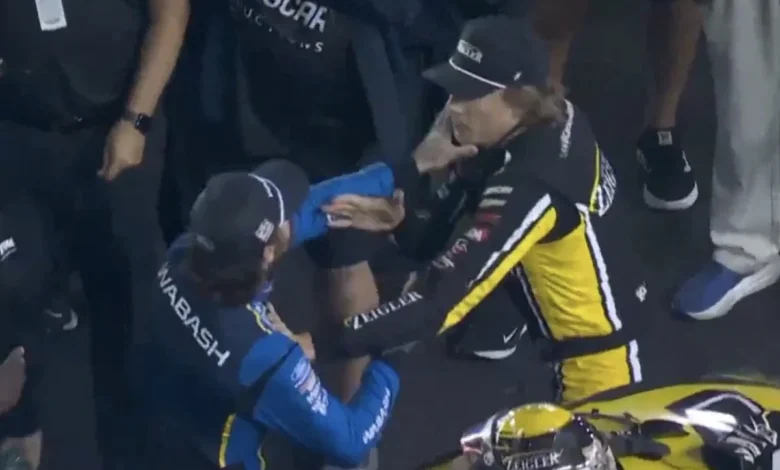
The NASCAR Cup Series returned to the high-banked, half-mile concrete expanse of Bristol Motor Speedway for the third race of the postseason, but the intensity of the Chase for the Cup was overshadowed by a volatile physical confrontation on pit road. What began as a high-stakes battle for position between Ryan Blaney and Carson Hocevar culminated in a post-race altercation, highlighting the deepening friction between the sport’s established veterans and its most polarizing young talent.
A High-Stakes Duel at the Bullring
The narrative for the evening was set long before the green flag dropped. Due to inclement weather that forced the cancellation of qualifying sessions, Ryan Blaney was relegated to a 29th-place starting position. Despite the disadvantage, the Team Penske driver mounted a masterful charge through the field, pacing the pack for 202 laps and positioning himself as a primary contender for the win.
However, the trajectory of the #12 car was abruptly altered on lap 457. As Blaney navigated a pass on Carson Hocevar to secure second place, the two drivers engaged in a close-quarters maneuver. Hocevar, known for his aggressive defensive driving, attempted to regain the inside line. Blaney appeared to attempt a block to maintain his momentum, but Hocevar refused to lift. The resulting contact sent the #12 Ford Mustang sliding into the outside retaining wall, effectively ending Blaney’s evening and his pursuit of a victory.
Timeline of the Confrontation
The events at Bristol were the latest in a series of escalating on-track incidents involving Hocevar. The chronology of the night unfolded as follows:
- Pre-Race: Ryan Blaney faces a steep uphill battle, starting 29th due to weather-canceled qualifying.
- The Mid-Race Surge: Blaney dominates the middle stages, leading over 200 laps and asserting himself as the driver to beat.
- Lap 457: The pivotal contact occurs. Blaney’s attempt to block Hocevar leads to a collision that destroys the #12 car’s race-winning chances.
- Post-Race: Blaney immediately approaches the #77 pit stall. A physical altercation ensues, with Hocevar claiming he struck first in self-defense after being grabbed.
- Post-Race Media: Both drivers provide conflicting accounts of the contact, with the garage area buzzing about the physical nature of the dispute.
The Polarization of Carson Hocevar
Carson Hocevar, the 23-year-old pilot of the #77 entry, has become the most discussed figure in the NASCAR garage this season. While his aggressive driving style has drawn ire from competitors, his marketability has skyrocketed. Recent data from the NASCAR Shop indicates that Hocevar currently leads the series in online merchandise sales and sits within the top five for trackside revenue—a meteoric rise from his 32nd-place ranking in the same period last year.
This paradox—where a driver is simultaneously the most criticized and the most popular—is a rare phenomenon in professional motorsports. Supporters point to his maiden victory at Talladega earlier this season as evidence of his "electric" personality, while detractors focus on a statistical trend that is becoming impossible to ignore. Through the first half of the current season, Hocevar has been involved in 30 distinct on-track incidents involving 21 different drivers, a frequency that has placed him at the center of multiple feuds.
A Pattern of Aggression: The Darlington Precedent
The friction at Bristol was not an isolated event. Earlier in the season at the Southern 500 at Darlington Raceway, Hocevar was involved in a similar incident with veteran Brad Keselowski. During the final laps of Stage 1, contact from Hocevar sent the #6 car into the wall, followed by a second, secondary tap that sent Keselowski into a spin.
The aftermath at Darlington was telling. The television broadcast team openly criticized the move, noting that the garage area’s patience was wearing thin. Keselowski, usually a measured veteran, offered a stern warning post-race, stating, "His day’s coming, and it’s coming hard." When asked about the prospect of retaliation, Hocevar offered a cryptic, "I’ll tighten my belts," signaling that he is aware of his reputation but remains unmoved by the threat of retribution.
Official Reactions and Peer Perspective
The sentiment within the driver lounge remains sharply divided. Christopher Bell, appearing to reference the broader tension, remarked, "I don’t know what really happened, but about time," following the altercation on pit road. This suggests a growing consensus among veterans that Hocevar’s driving style necessitates a corrective response from his peers.
Hocevar’s own perspective on his driving philosophy remains pragmatic. In recent interviews, he has dismissed the notion that he should alter his approach to avoid making enemies. "You’re not really thinking about it out there," Hocevar noted. "It doesn’t really affect me… everybody’s out there for himself anyway." This stance, while perhaps necessary for a driver competing in a cutthroat environment, does little to de-escalate the tension with veterans who prioritize "the code" of professional racing.
Implications for the Chase and Beyond
The physical confrontation at Bristol carries significant implications for the remainder of the Cup Series playoffs. NASCAR officiating faces the difficult task of managing "the code"—the unwritten rules of conduct—while maintaining a standard of competition that keeps fans engaged.
- Safety and Conduct: NASCAR has historically penalized drivers who engage in intentional wrecking or physical altercations. If the intensity continues to escalate, the sanctioning body may be forced to issue heavier fines or points penalties to curb the retaliatory nature of these incidents.
- Competitive Integrity: With the playoffs in full swing, every point is vital. The loss of a car like Blaney’s at Bristol could be the difference between advancing to the next round or being eliminated. When these losses are perceived to be the result of reckless driving rather than racing incidents, it creates a toxic environment that can destabilize the championship field.
- Broadcasting and Ratings: From a commercial standpoint, the rivalry is a boon for viewership. The "villain" archetype is a proven driver of interest in professional sports. However, there is a fine line between a compelling rivalry and a safety hazard that threatens the legitimacy of the competition.
Analysis: The Cost of the "Hurricane"
The term "Hurricane" has become an apt descriptor for Hocevar’s impact on the series. He is a disruptor who thrives on the chaos he creates. However, the sustainability of this approach is questionable. Historically, drivers who adopt an "every man for himself" mentality eventually find themselves racing against the entire field rather than with them.
When a driver reaches a threshold where they have alienated a significant portion of the garage—as evidenced by the frustration of champions like Keselowski and Blaney—the track becomes a significantly more difficult place to work. Retaliation in NASCAR is rarely swift; it is often patient, calculated, and executed when it hurts the most.
As the Cup Series heads to the next race, all eyes will be on the #77 car. Whether Hocevar continues his aggressive trajectory or faces the consequences warned by his peers remains to be seen. What is clear is that the 2026 season has been defined by a clash of generations, and the "Bristol incident" will be remembered as the moment the tension reached a boiling point. The sport now faces a critical juncture: determine how to channel the excitement generated by this rivalry while ensuring that the "code" of professional racing remains intact. The challenge for NASCAR is to balance the entertainment value of these conflicts with the necessity of maintaining order on the track.
Related posts: