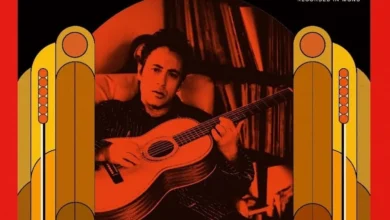
Jake Xerses Fussell Returns to Acoustic Minimalism with His Sixth Studio Album The Old Beloved Path


The contemporary folk landscape has long relied on innovators who look backward to move forward, and few practitioners of this craft have approached traditional American music with as much reverence and stylistic independence as Jake Xerses Fussell. In his sixth full-length studio release, The Old Beloved Path, Fussell once again demonstrates his unique ability to unearth forgotten musical artifacts—obscure traditional songs, century-old instrumental motifs, and peripheral fragments of folk history—and breathe contemporary life into them. While the North Carolina-raised, Georgia-based artist occasionally weaves original compositions into his recorded output, his primary medium remains the careful excavation and adaptation of archival folk material.
What distinguishes The Old Beloved Path from his immediate predecessors is not a sudden departure in thematic material, but rather a deliberate and striking pivot in production aesthetics. Following a multi-year period marked by lush instrumentation, cinematic string arrangements, subtle synthesizers, and atmospheric soundscaping on albums such as 2022’s critically acclaimed Good and Green Again and its 2024 follow-up When I’m Called, Fussell has chosen to strip away the sonic layers. The new record marks a decisive return to a stark, intimate, and stripped-down approach, placing his intricate, melodic guitar work and deeply introspective vocal delivery front and center.
Main Facts and Production Aesthetics
At its core, The Old Beloved Path functions as a masterclass in restraint. Rather than relying on commercial hooks, manufactured radio-ready structures, or standard pop formulae, Fussell constructs his songs to achieve a cumulatively hypnotic effect. His arrangements are designed to lull the listener into a contemplative, almost dreamy state, allowing the narrative weight of centuries-old verses to resonate without modern distraction.
This philosophy is immediately evident on the album’s opening track, "No 1." The song is constructed around spacious atmospherics and hypnotic repetitions, showcasing Fussell’s signature technique of blending chorus-washed arpeggios with fluid, tuneful melodic runs. There is no urgency in the performance; instead, the track breathes, inviting the listener into a meditative sonic space that establishes the tonal architecture for the entire record.
In stepping away from the broader orchestrations of his previous two records, Fussell has re-established the core identity that defined his early career while incorporating the refined technical precision he has developed over a decade of touring and recording. The production choices reflect a growing industry-wide movement among roots and Americana artists who are rejecting over-production in favor of acoustic authenticity, capturing the warm, organic imperfections of live performance in the studio.
Chronological Context and the Evolution of Fussell’s Discography
To understand the artistic significance of The Old Beloved Path, one must examine the chronological trajectory of Fussell’s recording career. Emerging from the vibrant Southern music scenes of Oxford, Mississippi, and later Durham, North Carolina, Fussell absorbed musical traditions firsthand from legendary vernacular artists, folklorists, and historians. His father, renowned folklorist Fred C. Fussell, instilled in him a deep appreciation for the social history behind regional music, an influence that has guided Jake’s career from its inception.
Fussell’s self-titled debut album, released in 2015, established his template: patient, jazz-inflected guitar interpretations of ancient Southern blues and folk tunes. This was followed by 2017’s What in the World and 2019’s Out of Sight, each record steadily expanding his audience and earning critical acclaim from publications such as Pitchfork, Rolling Stone, and The Wire. During this foundational period, his sound was predominantly acoustic, anchored by his guitar, a small rhythm section, and occasional pedal steel or horns.
The inflection point in his career arrived with the release of Good and Green Again in 2022, produced by James Wallace. For the first time, Fussell embraced a broader palette, integrating sweeping string arrangements, ambient textures, and a more cinematic scope. This trajectory continued with 2024’s When I’m Called, which pushed further into atmospheric territory, earning praise for its lush arrangements and emotional depth.
However, the completion of the When I’m Called touring cycle signaled a desire for re-examination. Rather than doubling down on the orchestral folk direction, Fussell and his collaborators opted to deconstruct their methodology. The result is The Old Beloved Path, a record that bridges the gap between the spacious minimalism of his early work and the compositional maturity gained during his tenure with major independent roots label Paradise of Bachelors.
Historical Roots: Deconstructing Early, Early in the Spring
Central to the narrative of The Old Beloved Path is Fussell’s meticulous song selection process, best exemplified by his treatment of the traditional standard "Early, Early in the Spring." The song carries a vast and heavily documented history within the transatlantic folk canon. Musicologists and folklorists have traced documented recordings and field collections of the tune back to at least the early 1900s, with textual and melodic iterations appearing in broadsides and oral traditions stretching as far back as the 1770s.
The song tells a timeless tale of maritime separation, heartbreak, and romantic longing—themes that have anchored Anglo-American folk music for centuries. In Fussell’s hands, the song undergoes a subtle modernization without losing its ancient resonance. His performance utilizes a soothing sonic texture, pairing his clear yet inherently mysterious vocal delivery with understated guitar phrasing.
Critics and music historians have frequently drawn stylistic comparisons between Fussell and other visionary singer-songwriters operating on the fringes of Americana. Most notably, comparisons to Bill Callahan are frequently invoked. Both artists share a penchant for unhurried phrasing, a literary approach to lyricism, and a distinctive, baritone-adjacent vocal clarity that commands attention through understatement rather than volume.
However, a closer examination reveals notable artistic divergences between the two. While Callahan’s work leans decisively toward the surreal, the metaphysical, and occasionally posthumanistic narratives, Fussell remains firmly grounded in pastoral imagery, traditional folklore, and romantic motifs. Fussell does not invent surrealist landscapes; instead, he acts as a conduit for the real, lived experiences embedded within the archival texts he interprets.
Industry Perspectives and Supporting Data
While comprehensive commercial sales figures for niche independent folk releases take months to compile, preliminary streaming metrics and physical pre-order data indicate strong early enthusiasm for The Old Beloved Path. Independent record stores report robust demand for vinyl variants, reflecting a broader market trend where vinyl collectors heavily favor acoustic, singer-songwriter, and roots releases that emphasize warm, dynamic mastering.
Industry analysts note that Fussell’s decision to scale back production aligns with a shifting economic and artistic landscape for independent musicians. Producing lush, multi-instrumental arrangements with string sections and ambient production requires significant financial investment in studio time and session players. Conversely, a stripped-down, core-band configuration allows for greater creative agility, streamlined touring operations, and a more direct connection between the artist’s recorded output and live performances.
Booking agents and festival organizers have observed a growing appetite among live music audiences for unadorned, virtuoso musicianship. As headlining festival slots increasingly feature heavily produced electronic and pop acts, intimate listening rooms and folk festivals are experiencing a resurgence in demand for artists who can captivate a room with a single acoustic guitar and a compelling vocal performance. In this context, The Old Beloved Path positions Fussell perfectly for an extensive, highly intimate tour routing across North America and Europe.
Critical Analysis and Broader Implications
The release of The Old Beloved Path carries several implications for the contemporary folk and Americana genres. For years, the commercial center of Americana has drifted toward a slick, radio-friendly hybrid of country, rock, and pop—often referred to pejoratively as "bro-country" or commercial alt-country. In contrast, artists operating in the lane carved out by Fussell, along with peers like Michael Hurley, Shirley Collins, and Hiss Golden Messenger, represent a vital counter-movement that prioritizes historical preservation, avant-garde patience, and musical archaeology.
By stripping away the sonic embellishments of his previous two records, Fussell proves that an artist does not need to rely on perpetual stylistic escalation to remain relevant. Growth, in Fussell’s artistic universe, is achieved through refinement, subtraction, and a deeper intimacy with the source material.
Furthermore, the album highlights the ongoing viability of the traditional folk canon in the twenty-first century. As younger generations become increasingly detached from regional folk histories, interpreters like Fussell serve as crucial cultural archivists. They ensure that centuries-old melodies and stories do not gather dust in university libraries or Smithsonian vaults, but instead continue to circulate in clubs, living rooms, and modern recording spaces.
Ultimately, The Old Beloved Path stands as a defining artistic statement for Jake Xerses Fussell. By returning to his acoustic roots while applying the wisdom of a decade-long recording career, he has crafted an album that is simultaneously ancient and entirely modern. As listeners immerse themselves in its hypnotic repetitions and pastoral imagery, they are reminded of the enduring power of a well-told story, delivered with patience, respect, and unmatched artistic integrity.
Related posts: