The Evolution of the Hull Suite: A Journey of Heritage and Sound
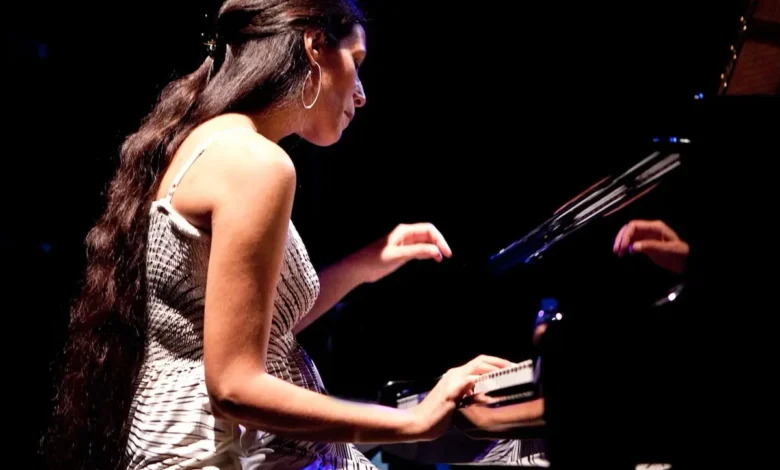
Commissioned originally by the Hull Jazz Festival to commemorate World Piano Day 2024, Zoe Rahman’s Hull Suite has evolved from a concentrated solo piano exploration into a vibrant trio dialogue. Following its debut, Rahman expanded the composition to incorporate the rhythmic and harmonic foundations of bass and drums. For its recorded performance at London’s historic Vortex Jazz Club on June 21, 2025, Rahman was joined by long-term collaborators Alec Dankworth on bass and Gene Calderazzo on drums.
The project is deeply rooted in Rahman’s multifaceted cultural background, drawing from Bengali, Irish, and classical traditions. The conceptual framework for the suite is autobiographical, detailing the migration narratives of her parents: her father’s journey from Bengal to Australia and her mother’s migration from England to New Zealand. One poignant historical episode included in the suite’s narrative is the forced sale of her mother’s piano, a financial sacrifice made to satisfy Australian immigration authorities regarding the family’s self-sufficiency.
Beyond personal history, the suite functions as a tribute to the city of Hull. Rahman drew direct inspiration from two specific public monuments: one memorializing the 2.2 million people who emigrated from the port of Hull to the United States between 1836 and 1914, and another honoring the maritime history shared between Britain and Iceland.
The performance structure at the Vortex was framed by three of Rahman’s earlier compositions: Synergy, Fresh Start, and Red Squirrel. The latter serves as an idiosyncratic, spirited commentary on the plight of the endangered red squirrel. The performance, released via Manushi Records, spans approximately 47 minutes and balances technical pianistic panache with emotional resonance.
Critics note that while the music is programmatic in its inspiration, it avoids heavy-handed narrative tropes. Tracks such as Piano Story, Voyage, and Waves are cited for their atmospheric depth, while the concluding track, East Coast, provides a triumphant resolution to the suite’s thematic arc. The support provided by Dankworth and Calderazzo is characterized by a sensitivity that allows Rahman’s compositions to breathe, confirming her status as a significant figure in modern British jazz.
Bach Reimagined: The Arbenz Approach to Baroque Improvisation
Simultaneously, the release of Bach Suite III: A Living Organism by Michael Arbenz marks a significant development in the "classical-jazz crossover" subgenre. Unlike traditional jazz interpretations of classical works, which often prioritize melody-based improvisation, Arbenz utilizes the structural DNA of Johann Sebastian Bach’s Orchestral Suite No. 3 in D Major as a springboard for original composition.
The recording, captured at Hammerstudios in Basel on March 27, 2026, features the Arbenz brothers—Michael on piano and Florian on drums—alongside the acclaimed Atom String Quartet. The ensemble includes violinists Dawid Lubowicz and Mateusz Smoczynski, violist Michal Zaborski, and cellist Krzysztof Lenczowski.
The album operates on the premise that Bach himself was a serial arranger of his own work. By re-scoring his music for varying ensembles throughout his career, Bach established a precedent for the flexibility of his compositions. Arbenz posits that his own "re-scoring" would likely be viewed by the composer not as an act of desecration, but as a continuation of the baroque tradition of adaptive reuse.
The structural breakdown of the suite includes:
- Sonic Prelude (based on the Overture)
- Upbeat Bounce (based on the Gavotte)
- Inner Engine (based on the Bourrée)
- Respire (based on the Air)
- Final Spin (based on the Gigue)
A notable highlight is Respire, which features a distinct nod to the "Air on the G String"—the most famous movement of the original suite—played by Lubowicz. The Atom String Quartet is treated not as a secondary or accompanying unit but as a central rhythmic and melodic force. In Upbeat Bounce, the quartet demonstrates a capacity for swing that rivals traditional jazz rhythm sections, proving that the rigid constraints of a classical string ensemble can effectively communicate the improvisational requirements of contemporary jazz.
Comparative Analysis: Structure and Improvisation
The two projects share a commonality in their attempt to bridge historical narratives with modern improvisation, yet they diverge significantly in their methodologies. Rahman’s work is inherently narrative, utilizing personal family history and the sociopolitical history of migration as a catalyst for composition. Her approach is rooted in the "jazz trio" format, where the focus remains on the interplay between piano, bass, and drums.
Conversely, the Arbenz project is structural and architectural. By deconstructing the Orchestral Suite No. 3, Arbenz engages with the formal rigor of baroque music. The inclusion of a string quartet allows for a denser harmonic palette and a broader dynamic range than the standard piano trio, facilitating a more complex sonic environment that borders on chamber jazz.
Broader Implications for the Jazz Industry
These two releases highlight a growing trend in contemporary jazz toward "informed adaptation." By anchoring new works in either deep personal history or historical classical frameworks, artists like Rahman and Arbenz are expanding the audience base for jazz while maintaining artistic integrity.
The success of these albums suggests a shift in the role of the jazz artist: from an individual improviser to a curator of cultural memory. Rahman’s ability to evoke the experience of 19th-century migration through sound mirrors the broader cultural discourse on identity and movement. Similarly, Arbenz’s work demonstrates that the "canon" is not a static repository of genius but a malleable source of inspiration that can be continually re-energized by the language of modern jazz.
Chronology of Production and Release
- June 2024: Zoe Rahman receives the commission for the Hull Suite for World Piano Day.
- June 21, 2025: Live recording of the Hull Suite at the Vortex Jazz Club, London, featuring Alec Dankworth and Gene Calderazzo.
- March 27, 2026: Studio recording of Bach Suite III: A Living Organism at Hammerstudios, Basel.
- June 2026: Concurrent critical reception of Bach Suite III alongside other Bach-inspired jazz projects, such as the Neil Cowley Trio’s Built On Bach.
- Late 2026: Both albums are positioned as significant contributions to the year’s jazz catalogue, emphasizing the interplay between legacy and improvisation.
Conclusion
Both Hull Suite Live and Bach Suite III exemplify a sophisticated approach to musical storytelling. Whether through the lens of individual lineage or the re-interpretation of historical masters, these artists demonstrate that jazz remains an expansive, inclusive, and highly adaptable art form. As the industry continues to evolve, these recordings serve as essential case studies for how artists can navigate the tension between historical reverence and contemporary innovation. The critical reception of these works underscores the audience’s appetite for music that is as intellectually stimulating as it is emotionally resonant, cementing the reputations of these musicians within the global jazz community.