RiverFlux Audio Launches Bit Layer: A Sophisticated New Free Multiband Bitcrusher Plugin

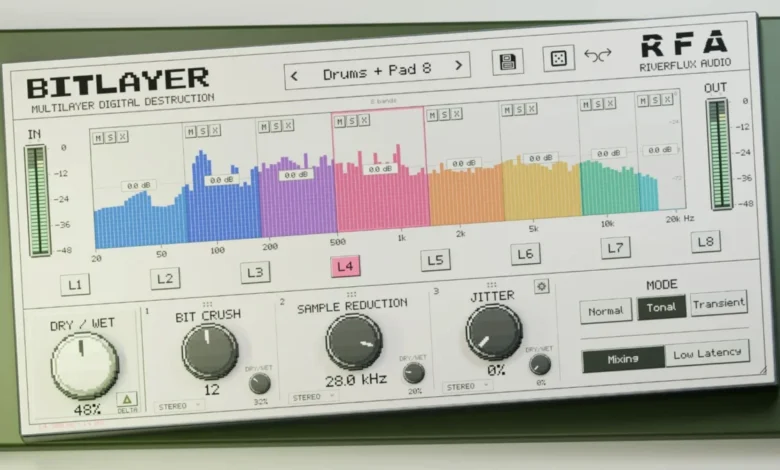
The digital audio landscape has long favored the bitcrusher as a fundamental tool for sound design, valued for its ability to introduce harmonic distortion, alias, and bit-depth degradation to otherwise sterile digital signals. While stock plugins bundled with Digital Audio Workstations (DAWs) such as Ableton Live’s Redux or Logic Pro’s Bitcrusher provide basic functionality, they often lack the surgical precision required for modern, complex production environments. Addressing this gap, boutique developer RiverFlux Audio has released Bit Layer, a sophisticated, free plugin that introduces multiband architecture, mid/side routing, and transient/tonal splitting to the bitcrushing workflow, challenging the market dominance of paid premium alternatives.
The Evolution of Digital Degradation
The bitcrushing effect finds its roots in the limitations of early digital audio technology. In the 1980s and 1990s, hardware samplers and digital synths were often restricted by lower bit depths (typically 8-bit or 12-bit) and lower sample rates. These technical constraints introduced audible quantization errors and aliasing, artifacts that were once considered undesirable flaws. However, as digital technology matured and audio fidelity reached high-resolution standards, producers began to embrace these "imperfections" for their sonic character.
By the late 2000s, the "lo-fi" aesthetic became a cornerstone of genres ranging from electronic dance music (EDM) to hip-hop and experimental pop. The bitcrusher was transformed from a byproduct of hardware necessity into a deliberate creative effect. Today, the market features a variety of tools, from simple "crunch" knobs to complex processors like Cableguys CrushShaper or MeldaProduction’s MBitFunMB, which allow for granular control over the signal path. RiverFlux Audio’s entry into this space represents a shift toward making high-end, surgical sound design tools accessible to a broader demographic of producers without the typical price barrier.
Technical Architecture of Bit Layer
Bit Layer differentiates itself through its multi-layered approach to signal corruption. Unlike traditional crushers that apply a global effect to an entire track, Bit Layer utilizes an eight-band architecture. This enables the user to isolate specific frequency ranges—such as the high-end air of a vocal or the transient snap of a snare drum—and apply degradation only where it is needed.
Each of the eight independent layers is equipped with dedicated controls for bit depth, sample rate, and jitter. Notably, the signal path within each layer is reconfigurable, allowing the user to decide the order of these processing modules. This is a significant inclusion for sound designers, as the order of operations in digital processing—such as whether the sample rate reduction occurs before or after bit-depth reduction—radically alters the harmonic content of the output. Additional features include per-layer mute, solo, gain staging, and dry/wet mixing, providing a level of control typically reserved for premium signal processors.
Advanced Signal Targeting: Mid/Side and Transient Processing
Perhaps the most significant advancement in Bit Layer is its inclusion of mid/side (M/S) routing and tonal/transient splitting. In standard stereo processing, the left and right channels are treated equally. M/S processing allows the user to manipulate the "Mid" signal (the sum of the left and right channels, typically where the kick drum, bass, and lead vocals reside) independently of the "Side" signal (the difference between the channels, often containing ambient textures, reverb, and stereo width). By applying bitcrushing solely to the sides, a producer can add gritty texture to a sound’s stereo width without compromising the punch and clarity of the center-panned elements.
Furthermore, the plugin’s ability to split signals based on transients—the initial attack portion of a sound—versus its tonal content (the sustain) introduces a new dimension of sonic control. By applying heavier bit-crushing to the transient, a user can emphasize the sharpness of a percussion hit while leaving the body of the sound clean. Conversely, one might choose to degrade the sustain for a "melting" or "degrading" effect while preserving the initial transient for rhythmic accuracy.
Market Context and Industry Implications
The release of Bit Layer arrives at a time when the "freemium" model in audio software is under significant pressure. High-quality free plugins are no longer rare, but they are frequently limited in scope. RiverFlux Audio’s decision to release a tool with such high-end routing capabilities for free suggests a strategic move to capture market share within the competitive "producer tools" ecosystem.
For the independent producer, this means that professional-grade sound design is no longer locked behind paywalls. Analysis of the current market indicates that bitcrushing plugins are among the most frequently used "creative" effects in modern production. As DAW stock plugins often remain stagnant in their feature sets, developers like RiverFlux Audio are effectively providing the "missing" features that professionals require for advanced sound design. This creates a ripple effect: as free tools become more capable, the barrier to entry for high-quality production is lowered, potentially driving further innovation among commercial plugin developers who must now differentiate their products through user interface design, AI-assisted features, or deep-sampled hardware emulation.
Technical Specifications and Availability
RiverFlux Audio has prioritized compatibility in the development of Bit Layer. The plugin is available for Windows and Linux in both VST3 and CLAP (CLever Audio Plugin) formats. For macOS users, AU (Audio Unit) support is included. The inclusion of the CLAP format is noteworthy, as it is an open-source standard developed by Bitwig and u-he, designed to offer higher performance, better multi-threading, and improved plugin-host communication compared to traditional formats.
The distribution model via Gumroad is a common route for boutique developers, allowing for direct-to-consumer engagement and efficient updates. The plugin requires no registration or invasive licensing software, which is a significant selling point for users who prioritize privacy and low-overhead computing environments.
Fact-Based Implications for Producers
From a production standpoint, the implications of using a multiband, M/S-capable bitcrusher are vast. Historically, "crushing" a full mix would result in a muddy, incoherent mess due to intermodulation distortion in the low frequencies. By allowing for multiband application, Bit Layer enables:
- Surgical Frequency Management: Keeping the low-frequency "weight" of a track clean while introducing grit to the mid-range.
- Stereo Field Preservation: Avoiding the collapse of the stereo image by applying effects selectively to the mid or side channels.
- Transient Integrity: Maintaining the "punch" of a track while simultaneously adding the sonic "flavor" of digital degradation.
- Signal Reordering: Testing various combinations of jitter, bit depth, and sample rate to achieve custom textures that are not possible with fixed-chain plugins.
As digital audio continues to favor clean, high-fidelity signals, the deliberate introduction of artifacts remains a key method for adding character and human touch to electronic music. Tools like Bit Layer facilitate this process with precision, reflecting a broader trend in software development where complex signal routing is becoming more intuitive and accessible.
Conclusion
Bit Layer serves as a robust case study for the current state of audio plugin development. By combining high-end functionality with a free distribution model, RiverFlux Audio has provided a significant utility for both novice producers and seasoned sound designers. While the market remains saturated with bitcrushing options, the combination of eight-band multiband architecture, M/S routing, and transient/tonal splitting places this plugin in a unique position.
For those currently relying on the basic bitcrusher effects bundled with their DAW, Bit Layer represents a substantial upgrade in terms of creative potential. As the industry moves toward more complex, individualized soundscapes, the demand for such precise, modular, and accessible tools is expected to continue growing. Producers seeking to expand their sonic palette without increasing their overhead costs will likely find Bit Layer to be an essential addition to their digital audio workstation.
The software is currently available for download, and its arrival marks a noteworthy moment for the open-source and boutique plugin community, demonstrating that professional-grade creative control can be achieved through thoughtful, efficient, and accessible software engineering.