MID Unveils Free Ableton Live Extension: Move Loop Slicer Automates Track Segmentation for Seamless Mobile and Studio Integration

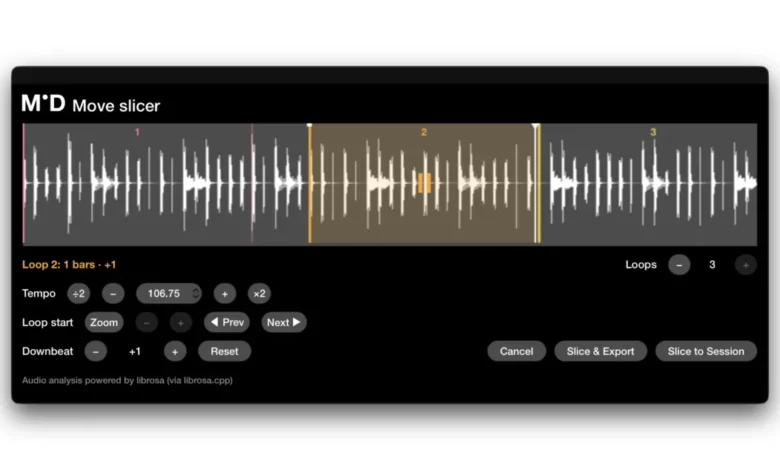
MID, a developer known for its innovative tools tailored for Ableton Live, has released a significant new Ableton Extension, the Move Loop Slicer. This free utility aims to streamline the process of dissecting longer audio material into bar-aligned loops, specifically designed for effortless triggering within Ableton’s mobile performance application, Ableton Move, and also for integration into Live’s Session View. The introduction of Move Loop Slicer marks another stride in MID’s commitment to empowering musicians by automating time-consuming tasks, allowing them to focus on creative performance and production.
The core functionality of Move Loop Slicer addresses a common workflow challenge for electronic musicians. Often, producers and performers need to extract short, rhythmic segments from longer tracks or audio files for live sets, hybrid performances, or as backing materials. Traditionally, this process within Ableton Live involves meticulous manual warping, setting tempo and beat grids, manually slicing the audio, preparing individual loop files, and then arranging them within the Session or Arrangement View. This can be a laborious and repetitive task, detracting from the immediate creative flow. Move Loop Slicer aims to drastically reduce this friction by automating key analytical and slicing processes.
Automated Analysis for Enhanced Workflow Efficiency
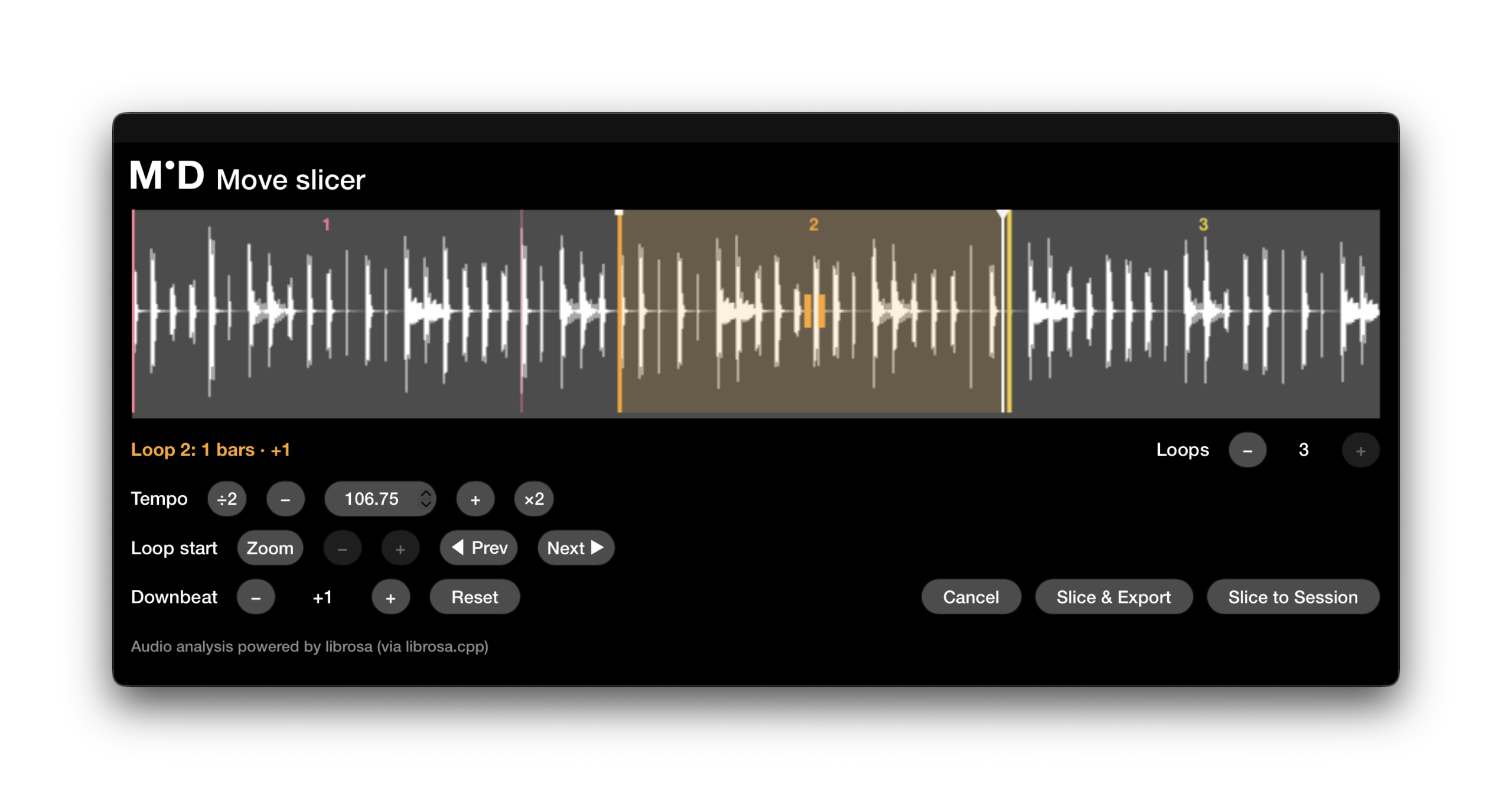
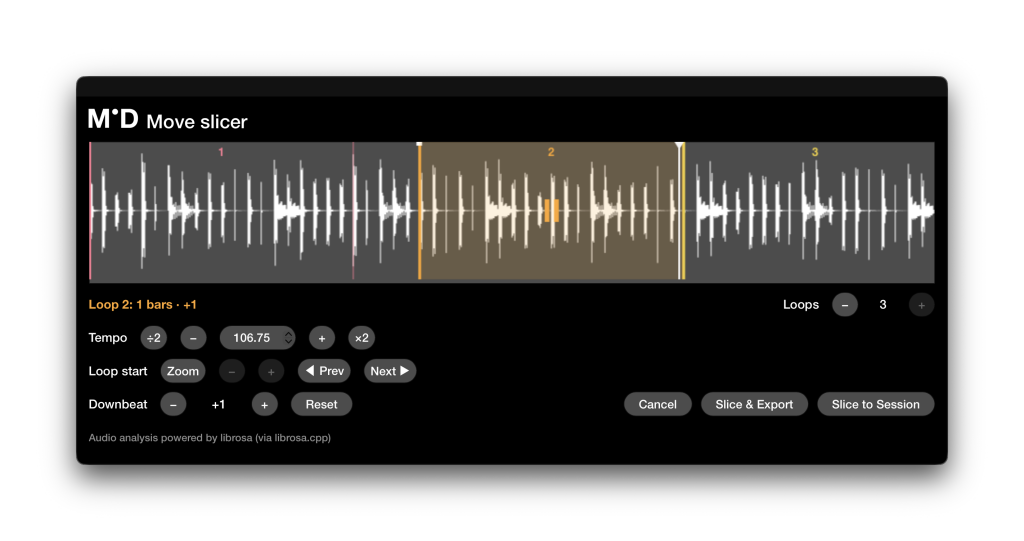
At the heart of Move Loop Slicer’s innovation lies its ability to intelligently analyze audio. Leveraging sophisticated open-source libraries, the extension can automatically detect the tempo and beat grid of an incoming audio file. Furthermore, it goes beyond simple beat detection by identifying structural elements such as sections and breaks within the audio. This advanced analysis culminates in the precise placement of loop grids directly on the first transient of each detected segment, ensuring that generated loops are musically aligned and ready for immediate use.
This automated approach offers substantial benefits for users, particularly those working with Ableton Move. The mobile nature of Move often necessitates quick setup and immediate playback capabilities. The ability to import a longer audio file and have it automatically segmented into perfectly aligned, bar-length loops—ready to be dropped into Move’s timestamped folders—transforms the workflow from one of tedious preparation to one of rapid iteration and performance readiness. For users who prefer to work within Ableton Live, the extension can slice audio directly into Session View clips, complete with color-coding on a designated track, making them instantly playable and navigable. This feature is particularly valuable for live performers who need to quickly access and trigger various sections of their material.
The Evolution of Ableton Extensions and MID’s Contribution
The release of Move Loop Slicer comes at a time when Ableton is actively fostering an ecosystem of user-created tools through its Extensions framework. Launched in beta, Ableton Extensions represent a significant step towards a more modular and customizable Ableton Live experience. These extensions, which can be developed by third parties, integrate directly into Live’s interface, offering new functionalities and workflows that were previously unattainable or required complex workarounds.
MID, under the direction of Benjamin Weiss (also known as Nerk), has been a consistent contributor to the Ableton ecosystem. Weiss, a seasoned producer and former engineer at Native Instruments and Ableton, has a history of developing unique tools and sound packs that cater to electronic music production. His work often exhibits a distinctive character, particularly evident in his other beta experiments like KIK (a kick synth with sub-bass capabilities) and DLY (a delay effect with modulation and feedback). These tools, alongside Move Loop Slicer, underscore MID’s focus on providing practical, creative, and often free solutions for Ableton users.
The "Ableton Extensions" program itself has been building momentum since its announcement. Initially released as a public beta, it invited developers to explore new possibilities for Live. The framework allows for deeper integration than traditional Max for Live devices, enabling extensions to appear as first-class citizens within Live’s UI. Early adopters and developers have been actively contributing, with a growing list of extensions appearing regularly. The requirement for Move Loop Slicer to run on Live’s latest public beta (version 12.4.5 and later) highlights its cutting-edge nature and its integration with the newest advancements in Ableton’s flagship DAW.
Technical Underpinnings: A Glimpse into the Engineering
The sophisticated audio analysis capabilities of Move Loop Slicer are powered by a robust combination of open-source libraries, meticulously compiled and adapted for WebAssembly. This technological foundation is crucial for enabling real-time, in-browser or in-application processing without requiring extensive local computational resources for the analysis itself.
Specifically, the extension utilizes:
- librosa: This Python library, renowned for its comprehensive audio analysis functionalities, serves as the bedrock for tempo, beat, and structural analysis. Its algorithms are adept at identifying musical features within audio signals.
- librosa.cpp: To bridge the gap between the Python-based librosa and the WebAssembly environment, librosa.cpp is employed. This C++ port allows the powerful analytical features of librosa to be compiled into WebAssembly, making them accessible within Ableton Live’s Extension framework.
- pffft (Pretty Fast Fourier Transform): For the Fast Fourier Transform (FFT) backend, pffft is utilized. FFT is a fundamental algorithm in digital signal processing, essential for analyzing the frequency content of audio signals, which in turn aids in beat detection and tempo analysis.
- Eigen: For matrix mathematics operations, the Eigen library is integrated. Eigen is a high-performance C++ template library for linear algebra, crucial for the complex calculations involved in audio signal processing and analysis.
The licensing of these components, including librosa (ISC), pffft, and Eigen (MPL-2.0), indicates a commitment to open-source principles and a desire to leverage well-established, community-driven technologies. The compilation of these libraries into WebAssembly signifies a forward-thinking approach to software development, enabling cross-platform compatibility and efficient execution within the Ableton Live environment.
Beyond Slicing: MID’s Broader Creative Vision
Move Loop Slicer is not an isolated release but part of a larger vision from MID. The developer’s existing offerings include unique sound packs for Ableton Move and other hardware, often featuring collaborations with notable artists. A particularly interesting collaboration mentioned is with Dr. Walker, a reunion of two underground techno legends who are also recognized for their legendary modifications of the Jomox XBase 09. This historical context, referencing highly sought-after hardware modifications like the "Toktok" and "Dr. Walker" editions of the XBase 09, hints at a deep understanding of and appreciation for the nuanced sounds and creative potential sought by discerning electronic musicians.
The shop hosted on Gumroad showcases this broader portfolio, including the aforementioned KIK and DLY extensions. KIK offers a straightforward yet effective approach to crafting kick drums with integrated sub-bass, a common need for producers across various electronic genres. DLY, a delay effect, is noted for its character, capable of producing "NERK-y" sounds at its extremes, a testament to the distinctive sonic signature that Benjamin Weiss often imbues in his creations. This "NERK-y" character, as described, aligns with the experimental and often raw aesthetic found in underground electronic music, suggesting that MID’s tools are designed not just for utility but also for sonic exploration and inspiration.
The fact that Move Loop Slicer is available for free, despite its sophisticated functionality, is a significant boon for the Ableton user community. It lowers the barrier to entry for accessing powerful workflow enhancements, encouraging experimentation and wider adoption of Ableton’s newer features like Extensions. While it is a beta release and requires the latest public beta of Live, its availability as a free download makes it an attractive proposition for anyone looking to optimize their audio slicing and loop creation processes, especially those who utilize or are interested in Ableton Move.
Implications and the Future of Live Workflow
The implications of tools like Move Loop Slicer extend beyond mere convenience. By automating complex audio analysis and segmentation, it democratizes advanced production techniques. Musicians who may not possess deep technical knowledge of audio engineering or signal processing can now leverage these capabilities to achieve professional-sounding results. This aligns with Ableton’s philosophy of making music creation accessible and intuitive.
The seamless integration with Ableton Move is particularly noteworthy. As mobile music-making tools become more sophisticated, the ability to efficiently prepare and import material is paramount. Move Loop Slicer addresses this directly, potentially enhancing the live performance capabilities of Move users and bridging the gap between studio production and on-the-go creativity.
Furthermore, the success and adoption of such free, community-developed Extensions could influence the future development of Ableton Live itself. It demonstrates the value of a robust extension framework and encourages further innovation from both independent developers and Ableton. The underlying technology, utilizing WebAssembly and powerful open-source libraries, also hints at the future direction of software development for digital audio workstations, prioritizing efficiency, cross-platform compatibility, and modularity.
The continued availability of MID’s tools, both free and commercial, alongside the growing landscape of Ableton Extensions, signifies a vibrant and collaborative ecosystem. For producers and performers seeking to refine their workflows, experiment with new sounds, and push the boundaries of their creativity within Ableton Live, tools like Move Loop Slicer represent a valuable and accessible resource. The ongoing development and release of such utilities by creators like Benjamin Weiss are crucial for the evolution of digital music production and performance. The move towards automating tedious tasks frees up valuable creative energy, allowing artists to focus on what truly matters: the music itself.