Simon Green’s Eighth Studio Album Distance in Static Marks Twenty-Five Years of Bonobo

The electronic music landscape has undergone profound shifts since the turn of the millennium, yet few artists have managed to maintain the consistent creative evolution demonstrated by Simon Green, better known to the global audience as Bonobo. With the arrival of his eighth studio album, Distance in Static, Green marks a significant milestone: twenty-five years of professional recording. This latest project, released independently, serves as both a retrospective of his quarter-century career and a bold step into a new sonic territory, reflecting a maturation of his signature downtempo, organic-electronic synthesis.
A Global Sonic Tapestry: Production and Collaboration
The genesis of Distance in Static represents an expansive approach to contemporary production, with recording sessions spanning multiple continents. Green utilized the distinct atmospheric qualities of studios in Los Angeles, Tokyo, and London to craft the album’s dense, layered textures. Furthermore, the inclusion of sessions at Neil Young’s legendary Broken Arrow Ranch added a layer of analog warmth and acoustic depth that characterizes much of the project’s sonic profile.
The album is defined by its ambitious multilingual vocal collaborations. By integrating the voices of Arooj Aftab, Joy Crookes, Nilüfer Yanya, Ichiko Aoba, Kanako Yamamoto, Nicole Miglis, and Aanya Martin, Green has created a tapestry of human expression that transcends linguistic borders. The compositions oscillate between English, Urdu, and Japanese, creating a global dialogue that complements the instrumentation.
Technically, the album stands as a masterclass in hybrid sound design. Green has integrated traditional Iranian musical elements and the delicate, percussive nature of guzheng recordings with heavily processed electronic synthesis. This juxtaposition of the ancient and the digital is a recurring theme in Green’s work, but it is rendered with a new level of precision on this record. The result is a soundscape that balances the high-energy requirements of club-oriented rhythms with the introspective, ambient structures of his earlier downtempo work.
Twenty-Five Years of Evolution
To understand the significance of Distance in Static, one must contextualize the trajectory of the Bonobo project. When Green emerged in the early 2000s, he was at the forefront of the "chillout" movement, a genre that provided a sophisticated alternative to the aggressive dance music of the era. Over the last two and a half decades, he has successfully transitioned from a bedroom producer to the leader of a full-scale live band, a transformation that has redefined how electronic music is perceived in a live setting.
The duality of the performer—the electronic selector behind the decks and the band leader commanding a stage—is the central tension that Distance in Static seeks to resolve. Green has frequently spoken about the difficulty of maintaining authenticity while navigating the transition from intimate studio production to massive arena performances. This album is a reconciliation of those two roles, proving that the intimacy of a recording can be translated into a grander, more cinematic experience without losing its emotional resonance.

Visual Identity and Aesthetic Direction
The presentation of the album is as carefully curated as the music itself. For the visual direction of the project, Green collaborated with renowned designer Trevor Jackson. Together, they developed a visual language based on microscopic photography, presenting the natural world through an abstract, high-definition lens. This choice mirrors the music: intricate, detailed, and often unrecognizable until viewed from a specific, close-up perspective. This aesthetic decision emphasizes the album’s title, suggesting that even in the static of a chaotic, noise-filled world, there is a clear, beautiful signal if one knows where to look.
The Artist’s Perspective
Reflecting on his career longevity, Green recently shared his thoughts on the changing landscape of electronic music. "I think the front end of what I’ve done has now become something that’s referential to younger people," he noted. This acknowledgment highlights his status as a progenitor of modern electronic textures.
His creative process for this album was driven by a specific philosophical inquiry: the search for clarity within disorder. "I liked the idea of listening for a distant signal—trying to find something in the noise," he explained. This sentiment serves as a mission statement for the album, which consistently strips away unnecessary layers to reveal the core emotional frequency of each track. It is a work that acknowledges the passage of time, yet refuses to be trapped by nostalgia.
Supporting Data and Industry Impact
The release of Distance in Static arrives at a time when the independent music model is increasingly viable for established artists. By choosing an independent path for his eighth album, Green retains creative control over both the distribution and the artistic narrative. Given that his previous works have garnered multiple Grammy nominations and topped electronic charts internationally, this independent venture is expected to be a benchmark for how legacy artists can maintain relevance without the infrastructure of a major label.
Market analysis of the electronic music sector indicates that audiences are increasingly seeking "hybridized" content—music that combines traditional instrumentation with synthetic production. Distance in Static aligns perfectly with this trend, positioning itself to capture both the dedicated long-term fan base and a new generation of listeners drawn to the global, collaborative nature of the project.
Global Tour Logistics
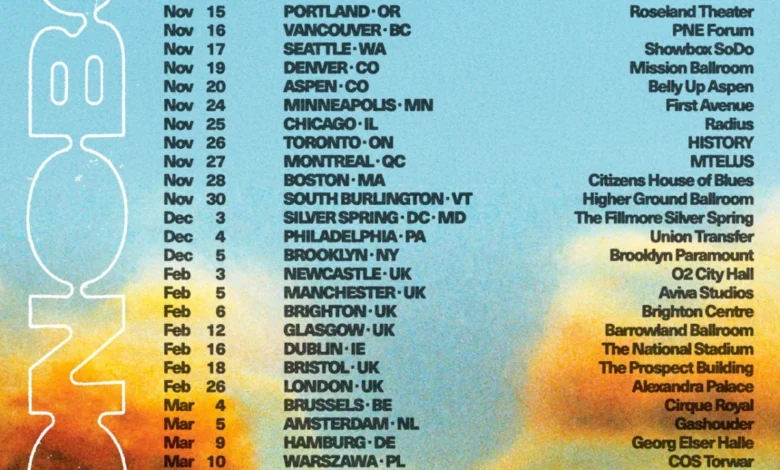
To facilitate the launch of the album, Green has announced a comprehensive touring schedule that spans two years. The North American leg is set to commence in late 2026, targeting major metropolitan hubs and secondary markets. This will be followed by an extensive run through the United Kingdom and Europe in early 2027.
The centerpiece of the tour will be a headline performance at London’s Alexandra Palace, a venue that holds historical significance for artists reaching the pinnacle of their craft. The decision to perform in arenas rather than smaller clubs signifies the scale of the production, which will rely on high-fidelity audio engineering to capture the nuances of the guzheng and Iranian samples recorded in the studio. These dates represent one of the most ambitious live undertakings of Green’s career, underscoring the confidence he has in the new material.

Analysis of the Broader Implications
The release of Distance in Static serves as a case study in the longevity of electronic artists. In an industry notorious for rapid cycles of relevance, Bonobo has managed to survive by refusing to remain static. By moving between genres—from trip-hop and jazz-fusion to house and ambient—Green has ensured that his work remains a moving target for critics and a source of constant discovery for listeners.
The implications for the wider industry are clear: the barrier between "live band" performances and "electronic production" has effectively collapsed. As more artists look to incorporate organic, multi-instrumental elements into their electronic compositions, the blueprint provided by Distance in Static will likely be studied for its technical proficiency and its ability to blend disparate cultural sounds into a cohesive whole.
Furthermore, the focus on multilingual collaboration speaks to the increasing globalization of music consumption. As digital streaming platforms break down geographical barriers, artists who can bridge the gap between Western electronic structures and non-Western melodic or rhythmic traditions are finding broader, more diverse audiences. Green’s work with artists like Ichiko Aoba and Arooj Aftab is not merely a stylistic choice; it is a strategic alignment with the future of the global musical zeitgeist.
Final Reflections
As Distance in Static makes its way into the world, it does so with the weight of twenty-five years of experience behind it. Simon Green has succeeded in creating a record that feels simultaneously like an ending and a beginning. It closes the chapter on his initial rise and early development while opening a new one defined by sophisticated collaboration and deep, analytical sound design.
For the listener, the album provides a sonic space that is both expansive and intensely personal. It invites the audience to participate in the act of listening, to filter through the "static" of modern life, and to find the signal buried within the noise. With this release, Bonobo has not only secured his place in the history of electronic music but has also ensured that his contribution to the genre remains vibrant, vital, and forward-looking. Whether experienced through high-fidelity headphones or in the echoing space of a major arena, Distance in Static confirms that after a quarter-century, the signal is clearer than ever.