Sonya Yoncheva Triumphs in Met Opera Revival of Cherubini’s Rarely Performed Masterpiece Medea

Luigi Cherubini’s 1797 operatic masterpiece Medea occupies a uniquely complex position in the history of Western classical music. Once praised by Ludwig van Beethoven as one of the supreme dramatic accomplishments of its era, the work gradually slipped from the standard international repertoire for nearly a century. Its modern resurgence was propelled largely by the legendary Greek-American soprano Maria Callas, whose definitive mid-twentieth-century interpretations cemented the title role as an iconic vehicle for dramatic sopranos. However, this association proved to be a mixed blessing. For decades, any subsequent artist courageous enough to tackle the score faced insurmountable comparisons to Callas. Combined with the opera’s staggering vocal and theatrical demands, Medea has frequently struggled to secure its rightful place as a repertory mainstay alongside works by Verdi, Puccini, or Mozart.
Adding to its historical evolution is the ongoing question of musical editions. Cherubini originally composed the work in French with spoken dialogue. Following the composer’s death, German composer Franz Lachner introduced German recitatives in 1855, which were subsequently translated into Italian by Carlo Zangarini. It is this latter Italian-language adaptation—featuring the added recitatives—that Maria Callas famously performed and that contemporary institutions, including the Metropolitan Opera, routinely present. This musicological shift mirrors the performance history of other major operatic works, such as Georges Bizet’s Carmen, which relies heavily on posthumously added recitatives by Ernest Giraud. Despite these textual variations and historical hurdles, the opera remains a visceral theatrical experience, adapted directly from Euripides’ classic tragedy. The narrative traces the devastating vengeance of Medea against her unfaithful husband, Giasone, who abandons her to marry Glauce, the daughter of Creonte, King of Corinth, in a cynical bid for political survival. Betrayal, dark scheming, and ultimate infanticide drive the unfolding tragedy.
Production Design and Revival Dynamics
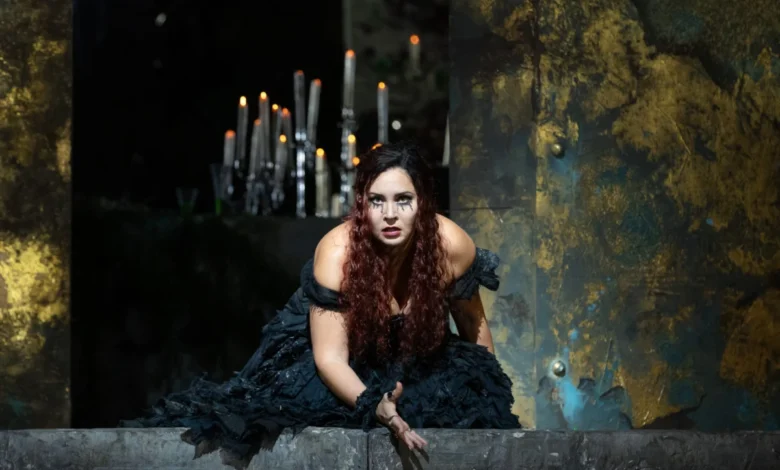
The Metropolitan Opera’s current staging marks a direct revival of the acclaimed 2022-23 production directed by David McVicar, which initially opened the company’s season to considerable critical fanfare. McVicar’s conceptual framework remains one of his more striking contributions to the modern Met repertoire. The stage design utilizes two imposing golden gates to physically segment the performance space, symbolizing the profound psychological and emotional isolation of the titular character. Upstage, a massive mirror reflects the action from an inverted perspective, creating an eerie, liminal atmosphere that suggests a fractured reality.
During key sequences, such as the Corinthian wedding celebrations, this mirror effectively superimposes dual realities for the audience, though its potential is occasionally underutilized during transitional moments. By the opening of Act III, however, as Medea meditates on her impending vengeance, the reflective surface transforms dynamically into a projection screen framed by roaring digital flames. While the visual architecture remains largely intact from its premiere run, this revival occasionally lacks the cohesive dramatic drive and lighting precision of the initial performances. Shifts in ensemble pacing and minor staging inertness highlighted the challenges of recapturing initial theatrical momentum, demonstrating how evolving audience expectations and shifting casts can alter the reception of a major revival.
Musical Direction and Orchestral Interpretation
On the podium, veteran conductor Carlo Rizzi navigated the complex score with seasoned authority, steering the Metropolitan Opera Orchestra through a demanding evening. The performance experienced a somewhat tentative start during the overture. An intricate exchange between the string and wind sections during the second theme revealed momentary hesitations, resulting in a somewhat homogeneous orchestral texture that occasionally blurred dynamic contrasts. Similar ensemble discrepancies surfaced during the opening choral sequences and Glauce’s early vocal showcase, where coordination between the pit and stage required visible adjustments from the conductor.
Once Sonya Yoncheva made her commanding entrance as Medea, however, the musical landscape shifted dramatically. Rizzi and his leading lady established an instantaneous rapport, guiding the orchestra from robust structural support into active, visceral dialogue with the vocalists. The orchestral prelude to Act III proved particularly striking, building an atmosphere of palpable dread before erupting into volcanic fury. The evening reached its musical zenith during Medea’s final aria, Del fiero duo, where the synergy between soprano and orchestra achieved a harrowing intensity, vividly painting the psychological horror of the drama. Rizzi’s steering of the final two acts exemplified masterclass operatic pacing, proving that his collaborative approach extends far beyond mere accompaniment.
Sonya Yoncheva’s Definitive Portrayal
At the center of the production stands Bulgarian soprano Sonya Yoncheva, whose portrayal of Medea anchors the entire evening. Yoncheva has evolved into one of the most compelling dramatic sopranos on the international stage, blending formidable vocal security with a fearless theatricality. The role of Medea demands immense flexibility across an expansive vocal register, requiring the soprano to cut through thick orchestration, execute rapid coloratura passages during moments of acute emotional turmoil, and instantly transition from hushed pianissimo introspection to searing, declamatory fury.
Beyond the vocal hurdles, the physical demands of the role are punishing. Medea dominates the stage for the vast majority of the opera, often performing entirely solo for extended stretches. The performer must elicit empathy and psychological understanding for a character bent on horrific destruction, culminating in the infanticide of her own children. Yoncheva approached these challenges with absolute conviction, building upon her prior experience with the French-language version of the opera in Berlin to conquer the Italian edition for the first time.
From her initial calculated, predatory strides to slouched, serpentine movements that visually suggested a descent into bestial fury, Yoncheva utilized her physicality to externalize Medea’s deep psychological fracturing. Her facial expressions shifted fluidly from icy hostility to profound, desolate mourning. This physical commitment found its dramatic peak in the harrowing final scene, where she raised a dagger against her children, only to hesitate, violently shove away one child, and finally freeze as another grasped her arm. Her vocal execution matched this theatrical brilliance note for note. Projecting effortlessly over the Met orchestra, Yoncheva exhibited a remarkably balanced register, highlighted by a potent, resonant chest voice and pristine, weeping legatos during her pleas to Giasone and Creonte. Her concluding coloratura was razor-sharp, maintaining absolute technical control while operating at the dramatic edge.
Supporting Cast and Generational Talent
The supporting ensemble delivered consistently strong performances, led by mezzo-soprano Victoria Karkacheva in her highly anticipated Metropolitan Opera debut as Neris. Karkacheva’s rich, luminous tone provided an ideal foil for Yoncheva’s voluminous voice, particularly during their intense collaborative scenes, while her fluid phrasing in Solo un pianto con te versare earned immediate audience approval. Tenor Michael Spyres brought a robust, darker vocal timbre to the role of Giasone, offering a striking contrast of delicate phrasing in his opening scenes against punchy, dramatic exchanges during his confrontations with Medea.
Soprano Elena Villalón portrayed Glauce with sparkling tone throughout her aria O Amore, vieni a me!, though the upper extremes of the score occasionally stretched her vocal limits against full orchestral volume. Bass Alexandros Stavrakakis lent a honeyed, authoritative gravity to the role of Creonte, balancing stern leadership with elegant legato lines. Special recognition was also earned by young actors Anton Ratz and Jasper Thurston-Vargo as Medea’s children, whose silent, highly vulnerable physical performances—particularly a tense, split-second interaction involving a raised dagger—elicited collective gasps from the audience and highlighted the strength of youth casting in contemporary operatic staging.
Broader Cultural Implications and Repertory Impact
The Metropolitan Opera’s revival of Medea underscores the ongoing institutional effort to reintroduce marginalized or underperformed masterpieces to contemporary audiences. By pairing a demanding score with top-tier international talent, the production successfully mitigates the historical hesitation surrounding Cherubini’s work. While revivals inherently face challenges in replicating the pristine magic of a premiere season, Yoncheva’s commanding performance has reignited critical conversations regarding the opera’s rightful place in the global operatic canon. As major houses increasingly look to balance traditional masterworks with ambitious theatrical risks, productions of this caliber demonstrate both the enduring relevance of classical Greek tragedy and the vital importance of artistic courage on the modern operatic stage.