Boston University Musicology Releases ‘The Finales of Turandot: Puccini’s Last Act’

The enduring mystery and musical puzzle of Giacomo Puccini’s final opera have occupied scholars, composers, and audiences for nearly a century. Now, Boston University musicologist and theorist Deborah Burton has offered the most comprehensive examination to date of the myriad efforts to finish the composer’s swan song. Published by Routledge, Burton’s new 304-page volume, The Finales of Turandot: Puccini’s Last Act, arrives on September 21, 2026, serving as a landmark contribution to operatic scholarship. The book provides a meticulous, historically grounded survey of the cultural, political, and musical forces that have driven successive generations of composers to attempt what Puccini left unfinished at his untimely death in 1924.
Puccini was battling throat cancer when he passed away in Brussels during the composition of Turandot’s final scenes. He left behind extensive sketches and orchestrations for the opera up to the death of the slave girl Liù, effectively halting the score at the very emotional climax of the work. The monumental task of bringing the opera to the stage fell first to Franco Alfano, whose 1925 completion has remained the standard repertoire version despite enduring decades of cuts, criticism, and alternative attempts.
Burton’s study casts a wide net across the twentieth and twenty-first centuries, exploring not only Alfano’s initial realization under the political pressures of Fascist Italy, but also subsequent attempts by high-profile modern and contemporary composers. These include Luciano Berio’s 2001 postmodern finale, which integrated modern harmonic languages with Puccini’s extant sketches; Hao Weiya’s 2008 completion, commissioned by the Chinese government to offer an alternate cultural perspective on the narrative; and Christopher Tin’s 2024 finale, which directly engaged with and sought to redress criticisms regarding negative female and racial stereotypes perpetuated in earlier versions.
In addition to narrative analysis, Burton’s book incorporates valuable primary source documentation. Readers will find incipits from Puccini’s original musical sketches, Berio’s working materials, newly translated correspondence shedding light on the composition and commissioning processes, and other rare historical artifacts. This documentary evidence underpins Burton’s broader academic thesis: that every attempt to complete Turandot reveals as much about the era in which the completion was written as it does about Puccini’s original compositional intentions.
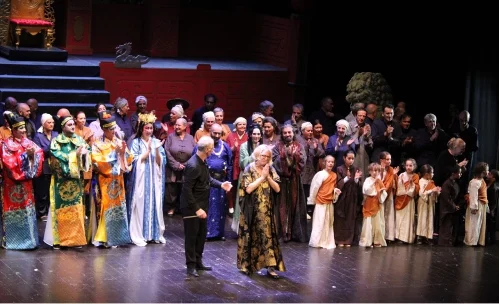
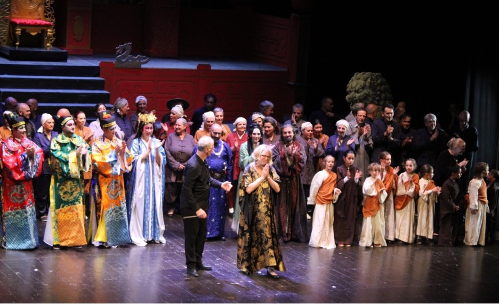
The publication of the book follows closely on the heels of another major milestone in Burton’s engagement with the opera. This past summer, a reconstructed epilogue developed by Burton received its world premiere at the historic Teatro della Pergola in Florence, earning critical praise and demonstrating the ongoing vitality of her scholarly insights when brought from the page to the stage.
A Century of Composing Turandot: A Chronological Overview
To understand the scope of Burton’s new book, one must trace the century-long lineage of completions that have sought to solve the dramaturgical and musical riddle left behind by Puccini.
When Puccini died on November 29, 1924, leaves of manuscript paper containing approximately thirty-six pages of sketches for the final duet and grand finale were left on his piano. Arturo Toscanini, who would conduct the posthumous world premiere at Teatro alla Scala on April 25, 1926, ultimately selected Franco Alfano to complete the score based on Puccini’s notes.
Alfano’s task was fraught with difficulty. Toscanini famously rejected Alfano’s first draft for being insufficiently deferential to Puccini’s style while simultaneously failing to soar to the dramatic heights required by the libretto by Giuseppe Adami and Renato Simoni. A heavily edited, truncated version of Alfano’s work—further slashed by Toscanini during rehearsals—became the standard version performed globally for decades.
Decades later, dissatisfaction with Alfano’s resolution prompted new approaches. In 2001, Italian composer Luciano Berio was commissioned to write a new finale. Utilizing the composer’s sketches more liberally and introducing contemporary harmonic idioms, Berio’s version offered a more ambiguous, unresolved psychological landscape that reflected postmodern sensibilities regarding narrative closure.
As the geopolitical and cultural landscape shifted in the twenty-first century, creators from outside the Western European tradition began offering their own interpretations. In 2008, Chinese composer Hao Weiya unveiled a completion commissioned by the Beijing-based authorities. Hao’s version sought to recalibrate the tonal and structural balance of the final scene, engaging more deeply with the Chinese source material—Carlo Gozzi’s original play and the traditional Beijing folk tune "Mo Li Hua" (Jasmine Flower) that permeates Puccini’s score—thereby offering a counter-narrative to European Orientalist tropes.
Most recently, Grammy-winning composer Christopher Tin unveiled a 2024 finale designed to confront the problematic racial and gender dynamics embedded in the original libretto. Tin’s version aimed to rescue the character of Turandot from the reductive tropes of the cruel, frigid ice-princess subdued entirely by patriarchal force, offering instead a more egalitarian resolution to the narrative arc.
Critical Acclaim and Expert Commentary
In anticipation of its September release, The Finales of Turandot has already drawn praise from prominent figures in the contemporary classical and operatic spheres.
Composer Christopher Tin, whose own engagement with the opera’s legacy positions him uniquely within Burton’s study, lauded the publication through an official press release.
"The authoritative survey of a century of attempts to pen an ending to Turandot," Tin stated. "Each composer reveals their challenges in completing the work, taking approaches that vary as greatly as the composers themselves. Yet despite all the different results, a common thread runs throughout: a love, and tremendous respect, for the grandeur, compositional prowess, and musical eloquence of Puccini’s final masterpiece."
Tin’s remarks highlight the central paradox explored in Burton’s book: while the history of Turandot completions is defined by editorial friction, ideological shifts, and aesthetic disagreements, it is fundamentally unified by an enduring reverence for Puccini’s harmonic genius and theatrical instincts.
Academic Background and Research Context
Deborah Burton brings deep institutional expertise and specialized research focus to her latest monograph. As an associate professor of composition and music theory at Boston University, her scholarly output has long centered on Italian operatic traditions, counterpoint, historical music theory, and formal analysis.
Her previous major monograph, Recondite Harmony: Essays on Puccini’s Operas, published by Pendragon Press in 2012, established her as one of the preeminent international authorities on Puccini’s structural methodologies. In that work, Burton explored the hidden symmetries, leitmotif networks, and structural architectures underpinning works such as Tosca, La Bohème, Madama Butterfly, and Turandot.
Beyond her monograph publications and teaching commitments, Burton has played an active leadership role within the academic community, serving as president of the New England Conference for Music Theory from 2006 to 2008. Her ongoing work bridges the gap between rigorous music-theoretical analysis and practical performance history, making her uniquely suited to synthesize a century of complex compositional interventions into a coherent narrative.
Implications for Modern Opera Production and Scholarship
The release of The Finales of Turandot arrives at a critical juncture for international opera houses. In recent years, cultural institutions have increasingly grappled with how to stage canonical works that contain dated racial, ethnic, and gender stereotypes. By examining how composers from Alfano to Tin have attempted to solve the structural and ideological problems of the third act, Burton’s book provides artistic directors, stage directors, and musicologists with a vital historical framework.
Furthermore, the publication encourages a re-evaluation of how unfinished masterworks are integrated into the contemporary repertoire. Rather than treating Puccini’s score as a closed book with a single, obligatory appendix, Burton’s research validates the multiplicity of endings as legitimate cultural artifacts. Each completion functions as a historical mirror, reflecting the artistic anxieties, political regimes, and aesthetic values of the moment in which it was created.
As opera companies increasingly experiment with alternative endings—ranging from Berio’s introspective modernism to recent efforts at decolonizing the narrative—Burton’s study offers an indispensable guide for navigating the complex web of copyright, historical reception, and musical style.
The Finales of Turandot: Puccini’s Last Act is set for release on September 21, 2026, and is expected to become an essential text for music libraries, scholars, conductors, and opera enthusiasts worldwide.
Related posts: