The Definitive Guide to Mozart Clarinet Concerto Recordings: Editorial Recommendations from The Classic Review


Wolfgang Amadeus Mozart completed his Clarinet Concerto in A major, K. 622, in October 1791, marking a poignant milestone as the final instrumental concerto he would ever write. Composed less than two months before his untimely death on December 5, 1791, the work was dedicated to his close friend and fellow Freemason, the virtuoso clarinetist Anton Stadler. Mozart reported to his wife, Constanze, from Prague in October 1791 that he had nearly finished scoring the finale. Stadler most likely gave the premiere performance in Prague shortly thereafter, although no contemporary concert program has survived to confirm the exact date.
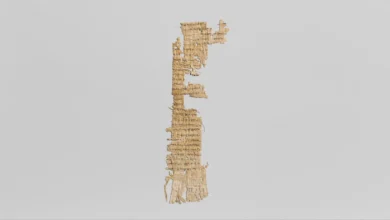
The history of the manuscript itself is famously fraught with loss. The original autograph score has vanished entirely, leaving musicologists and performers to rely on a partial earlier sketch of the first movement—originally written for the basset horn in G—which Mozart transposed and adapted. Because the original manuscript is lost, performers and editors must continually navigate textual discrepancies between the reconstructed basset clarinet versions and the heavily standardized 1801 edition that dominated concert halls for a century and a half.
Chronological Evolution and Textual Traditions
The instrumental mechanics of K. 622 are inextricably linked to Anton Stadler’s experimental instrument of choice: the basset clarinet. This specialized woodwind featured an extended lower joint that reached four semitones below the standard A clarinet, plumbing depths down to written C. Mozart heavily exploited this extra chromatic depth, weaving the dark, subterranean timbres of the instrument into the thematic fabric of the outer movements and the central Adagio.

However, when Breitkopf & Härtel published the concerto posthumously in 1801, the solo part was transposed and rewritten to fit the ordinary, non-extended clarinet in A. This adaptation excised or altered Mozart’s lowest basset notes, a compromise that held the stage undisputed for nearly 150 years. The orchestral scoring remains exceptionally transparent: strings, two flutes, two bassoons, and two horns, deliberately omitting oboes to ensure that the delicate wind colors sit high, bright, and weightless around the soloist. The three movements—a spacious, expansive Allegro, a long-breathed Adagio of profound emotional gravity, and a buoyant Rondo finale—create a structural architecture that tests both the technical endurance and expressive capacity of any instrumentalist.
In the modern era, recordings are largely divided between adherents of the familiar 1801 published text and scholars championing reconstructions of the original basset clarinet version. This fundamental editorial choice profoundly dictates the overall tone, register, and harmonic reach of the solo line, forcing contemporary interpreters to make definitive aesthetic choices before a single note is played. To assist listeners in navigating this vast recorded legacy, the editorial team at The Classic Review has compiled a definitive survey of the finest recordings of Mozart’s masterwork.
Thea King, English Chamber Orchestra, Jeffrey Tate (1985)
Thea King’s 1985 recording stands as a watershed moment in the modern performance history of K. 622, doing more than any prior release to firmly establish the reconstructed basset clarinet as a viable, expressive standard for the concerto. Her performance remains the critical yardstick against which subsequent basset clarinet accounts are measured.
The defining characteristic of King’s interpretation is her meticulous phrasing. Long musical paragraphs are intelligently broken down into smaller, searching units, each granted its own distinct contour and rhetorical weight without ever sounding fussy or mannered. Playing a modern-system instrument, she utilizes a reconstructed solo part enriched by subtle, tasteful adjustments of her own devising. Her dynamic palette successfully balances luminous lyrical breadth with darker, more shadowed dramatic moments, while granting full, uninhibited weight to the aggressive orchestral-tutti passages when the score demands it.
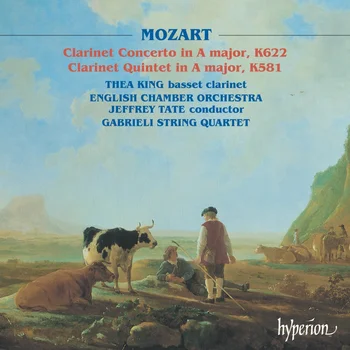
In the central Adagio, King draws upon the cool, crystalline upper register of the instrument to profoundly touching effect, seamlessly leading back to the primary theme via a short, entirely unforced cadenza. The Rondo finale concludes with a characteristic touch of wit—a sudden, effortless plunge to the absolute bottom of the instrument’s extended range followed by a crisp trill. Supported by Jeffrey Tate and the English Chamber Orchestra, who provide exemplary clarity and poise, the release is usefully rounded out with a compelling reading of the Clarinet Quintet, K. 581. Compared to the leaner, more radically historical performances that eventually followed, King’s vision remains broad, traditional, and deeply reassuring.
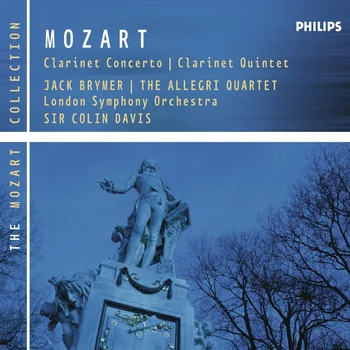
Jack Brymer, London Symphony Orchestra, Colin Davis (1964)
While artists like King construct the musical line through incremental details, Jack Brymer treats the melodic architecture as a continuous, unbroken song. Recorded in 1964 alongside conductor Sir Colin Davis and the London Symphony Orchestra, this landmark recording utilizes the standard ordinary clarinet text, representing the traditional version that generations of music lovers grew up with.
Davis maintains an exceptionally alert orchestral accompaniment, driven by a palpable rhythmic lift and forward momentum, yet invariably held in elegant classical check. Brymer’s tone is consistently warm, gentle, and sustained, casting a rich glow around every note. His interpretive manner possesses an unhurried, patrician grace characteristic of mid-century British woodwind playing, ensuring that the integrity of the long phrase is never compromised.
Tempos throughout are generally swifter than those found in more expansive, ruminative interpretations, rendering the outer movements brisk and exciting, albeit slightly less inward or consoling. Joined by the Allegri Quartet for a companion performance of the Clarinet Quintet, Brymer’s account remains the mandatory starting point for listeners seeking the concerto in its familiar, unadulterated concert-hall form, entirely free of the modern preoccupation with low-register reconstructions.
Martin Fröst, Amsterdam Sinfonietta, Peter Oundjian (2002)
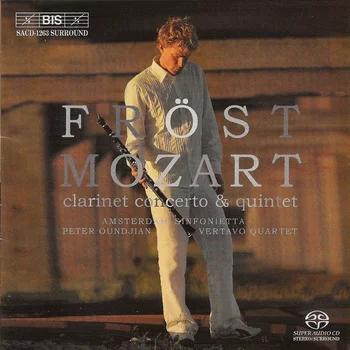
For sheer dynamic daring and micro-nuance, the 2002 recording by Swedish virtuoso Martin Fröst, backed by the Amsterdam Sinfonietta under Peter Oundjian, occupies a category of its own. Fröst exercises a degree of dynamic control that scales down to absolute whispers, creating pianissimos that linger long in the listener’s memory.
The heart of the performance lies in its haunting Adagio. Fröst treats the movement as an inward, deeply personal meditation—serious yet entirely devoid of solemnity—sculpted as a single, continuous melodic arc. He exploits the extreme tonal contrasts inherent in his instrument, utilizing a bottom register that sounds exceptionally dark, smoky, and resonant. The outer movements, by contrast, are buoyant, remarkably nimble, and propelled by a springy articulation.
The orchestral accompaniment is refined, transparent, and impeccably balanced, complemented by the Vertavo Quartet in the mandatory Clarinet Quintet pairing. Because Fröst’s aesthetic is so immaculate and precise, the reading can occasionally strike some listeners as emotionally cool, with one or two of the ultra-whispered passages bordering on over-refinement. Nevertheless, for those who prioritize the slow movement as the spiritual core of the concerto, this version is essential listening.
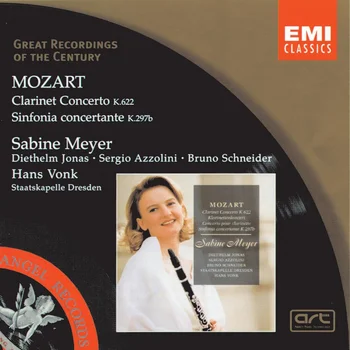
Sabine Meyer, Staatskapelle Dresden, Hans Vonk (1990)
Sabine Meyer and conductor Hans Vonk approach the concerto not as a traditional vehicle for a soloist accompanied by an ensemble, but as a genuine chamber partnership. Their 1990 recording with the venerable Staatskapelle Dresden pairs vibrant instrumental exuberance with intense emotional poignancy, driven by a confident, direct theatricality.
Where Martin Fröst turns inward toward quiet introspection, Meyer is resolutely outgoing. Vonk meets this extroverted energy with an orchestral sound that pulses with vitality from the initial downbeat to the final bar. Meyer navigates the expansive descending runs of the first movement with ironclad technical control, executing seamless transitions between detached and slurred articulations. Her tonal profile is noticeably deeper and rounder than that of the standard A clarinet, maintaining an even, homogenous texture from top to bottom.
The release is rounded out by a sparkling performance of the Sinfonia Concertante for Winds, K. 297b. Listeners who favor the slower, more majestic pacing of mid-century recordings may find themselves desiring a greater degree of repose, but Meyer’s pacing closely mirrors the classical vitality of Brymer and Davis, securing its place among the elite interpretations on disc.
Antony Pay, Academy of Ancient Music, Christopher Hogwood (1984)
For the historically informed performance enthusiast, Antony Pay’s 1984 recording with Christopher Hogwood and the Academy of Ancient Music offers an invaluable window into late 18th-century performance practice. Pay performs on a modern copy of a period-accurate basset clarinet, while Hogwood’s ensemble utilizes authentic period instruments tuned to historical pitch standards.
The result is a performance defined by high energy, bold rhetoric, and an inherently dance-like momentum. Pay articulates every phrase with distinct vocal personality, interpolating tasteful, historically appropriate ornamentation that culminates in a thrillingly effortless Rondo finale. The period clarinet yields a reedy, liquid timbre that instantly distinguishes it from modern instruments, colored softly and naturally without excessive vibrato.
Hogwood drives the orchestral tuttis with spirited authority while keeping the softer passages open, transparent, and uncluttered. While subsequent period-instrument recordings have introduced greater layers of nuance and textural warmth, Pay’s account remains refreshingly direct and unpretentious. Coupled with an illuminating reading of the Oboe Concerto featuring soloist Michel Piguet, this recording is the definitive choice for listeners seeking to experience Mozart’s masterpiece exactly as its first audiences might have heard it.
Broader Impact and Artistic Implications
The enduring fascination with Mozart’s Clarinet Concerto, more than two centuries after its composition, underscores its unique status as the swan song of classical wind literature. The ongoing debate between advocates of the traditional 1801 text and champions of the basset clarinet reconstructions highlights a broader philosophical shift in classical music performance: a growing desire to strip away centuries of editorial sedimentation in search of the composer’s original sonic intent. Whether listeners gravitate toward the historical authenticity of Antony Pay, the refined warmth of Thea King, or the classic poise of Jack Brymer, K. 622 remains an inexhaustible canvas for artistic expression, continually redefining our understanding of Mozart’s final creative months.