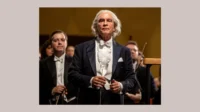
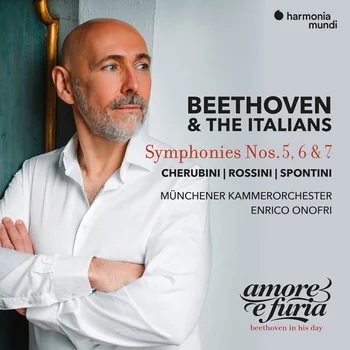
The intersection of Austro-German symphonic mastery and the influential operatic traditions of early 19th-century Italy forms the conceptual core of a notable new release from Harmonia Mundi. Titled Beethoven & the Italians: Symphonies Nos. 5, 6 & 7 – Cherubini, Rossini, Spontini, the recording pairs Ludwig van Beethoven’s iconic mid-period symphonies with contemporaneous works by Luigi Cherubini, Gaspare Spontini, and Gioachino Rossini. Led by conductor Enrico Onofri at the helm of the Münchener Kammerorchester (Munich Chamber Orchestra), the release attempts to illuminate the cross-channel currents and reciprocal stylistic influences passing between Vienna and the major European theatrical centers. While the conceptual framework offers a compelling musicological premise, the execution yields a mixture of brilliant historical realizations and frustrating interpretive idiosyncrasies.
Chronology and Repertoire: Uncovering the Italian-German Nexus
The multi-disc package, cataloged under Harmonia Mundi HMM 902443.45, adopts an ambitious chronological and stylistic scope. Rather than presenting Beethoven in isolation, the program weaves his symphonic outputs with overtures and instrumental compositions by his Italian contemporaries working in Paris and beyond. This curatorial strategy reflects a broader contemporary shift in classical music programming, wherein standard-repertoire masterworks are contextualized against the broader European landscape that shaped them.
Historically, Beethoven held immense admiration for Luigi Cherubini, famously declaring the Florentine composer to be the greatest dramatic composer of his era. The stylistic footprints of Cherubini’s revolutionary rescue operas—most notably Médée—can be clearly traced in the driving tension, dramatic Sturm und Drang elements, and instrumental colors of Beethoven’s Fifth Symphony. Onofri’s release underscores these connections by sequencing the works side-by-side, allowing listeners to audit the shared musical DNA of the era.
Orchestral Performance and Historical-Informed Execution
The Münchener Kammerorchester operates on modern instruments, yet under Onofri’s direction, they execute a performance practice closely aligned with historically informed performance (HIP) standards. Throughout the opening tracks, the ensemble employs specialized bowing techniques, stark articulation, strategic use of open strings, and a marked reduction in string vibrato. These technical choices successfully bridge the gap between modern orchestral capability and early 19th-century performance aesthetics.
Particularly striking is the opening reading of Cherubini’s Médée Overture. The instrumental balance favors prominent woodwinds and hard-mallet timpani, paired with what appear to be period brass instruments. This configuration establishes a heterogeneous, highly dramatic palette of color that easily surpasses standard, middle-of-the-road interpretations, such as Sir Neville Marriner’s recordings with the Academy of St Martin in the Fields. The Munich ensemble’s incisive execution provides an electrifying introduction to the album’s thematic explorations.

Interpretive Controversies in Beethoven’s Fifth and Sixth Symphonies
Despite the strong opening, the performances of Beethoven’s symphonies encounter significant hurdles regarding tempo, structure, and pacing. In Beethoven’s Symphony No. 5 in C minor, Op. 67, Onofri takes liberties that challenge the fundamental momentum of the score. Most notably, the conductor bypasses the dramatic fermatas in the opening bars, as well as the crucial fermata assigned to the first violins shortly thereafter.
Musicologists and critics have long noted that Beethoven’s Fifth relies on an incessant, unrelenting momentum to achieve its profound psychological impact. By working against this rhythmic drive, the performance undercuts the structural tension required to make the famous oboe cadenza in the recapitulation function effectively. Ideally, the oboe solo serves as a sudden, breathtaking oasis of calm before the rest of the orchestra abruptly dismisses the tranquility. In Onofri’s reading, the oboe dwells excessively on the passage, followed by an unwarranted long pause that distorts Beethoven’s architectural intent.
The inner movements fare better due to fewer disruptive interventions, though Onofri incorporates unmarked swells on long notes—a stylistic affectation previously championed in early Beethoven cycles by conductors like Sir Roger Norrington and Sir Charles Mackerras before they abandoned the practice in subsequent recordings. Conversely, the Trio of the Scherzo is delivered with brilliance, and the opening three chords of the finale are granted additional weight and duration, allowing listeners to fully appreciate the novel sonority of the newly added trombones and piccolo.
A similar dichotomy marks the reading of Symphony No. 6 in F major ("Pastoral"). Clocking the first movement at 10 minutes and 50 seconds, Onofri matches the brisk timings of contemporary period-conscious recordings, such as those by Jos van Immerseel with Anima Eterna (10’37"), François-Xavier Krivine with La Chambre Philharmonique (10’53"), and Manfred Honeck with the Pittsburgh Symphony Orchestra (11’01"). However, unlike those benchmarks, which maintain a supple flexibility of pulse, Onofri’s approach leans toward a relentless, mechanical efficiency.
Furthermore, balance issues persistently plague the orchestral texture. The Munich string section is notably lean, utilizing a distribution listed in the album booklet as 6/5/4/5/2. This forces the ensemble below the string complements deployed by other historically informed interpreters, such as Jordi Savall (10/8/6/5/3) and Sir John Eliot Gardiner (12/10/8/6/4). Consequently, during the Scene by the Brook, the violins occasionally struggle to project their melodic lines over the broader orchestral fabric. While the Scherzo captures a delightfully folksy energy, the ensuing Storm movement feels curiously restrained, lacking the vivid pictorialism and driving momentum typical of top-tier HIP recordings.
The Italian Repertoire: Discoveries and Redemption
Where the Beethoven symphonies provoke critical debate, the surrounding Italian repertoire emerges as the recording’s strongest asset. Beethoven’s Seventh Symphony receives a relatively straightforward reading, benefiting from a restrained approach to interpretive interventions, though the aforementioned string deficit remains a persistent distraction.
The inclusion of "the other Italians" validates the album’s conceptual premise. Gaspare Spontini’s Olimpie Overture, strategically positioned immediately following Beethoven’s Fifth, establishes a direct acoustic bridge through its striking three-chord opening. Played with arresting vitality and technical brilliance, it highlights the stylistic cross-pollination of the period.
Similarly, Onofri resists treating Gioachino Rossini’s Guillaume Tell Overture as mere "pops" concert fare, instead foregrounding its structural sophistication and symphonic dimensions. The opening sections are delivered with genuine tenderness, and the brass sections execute the storm sequences with authority.
The program concludes with Cherubini’s Symphony in D major, a work delivered with far greater conviction and interpretive depth than rival recordings by Piero Bellugi with the Sanremo Symphony Orchestra or Riccardo Chailly with the La Scala Orchestra. Onofri adopts a noticeably broader tempo, granting the score the necessary breathing room to expose its considerable lyrical charm.
Broader Implications and Market Reception
Distributed globally by Harmonia Mundi under catalog number HMM 902443.45, Beethoven & the Italians is currently accessible to listeners via physical compact disc, standard digital download platforms, and streaming services, including Apple Music Classical and Presto Music.
The release contributes to an ongoing musicological reassessment of the early 19th-century canon, challenging the traditional narrative that places Austro-German instrumental music in complete isolation from Mediterranean operatic culture. While Onofri’s unorthodox handling of Beethoven’s structural architecture may alienate purists, the project succeeds as a thought-provoking programming experiment. Ultimately, the recording’s primary value lies not in its contentious Beethoven interpretations, but in its spirited advocacy for the undervalued symphonic and theatrical works of Cherubini, Spontini, and Rossini.