Trump Demands Midterm Referendum on Washington Overhaul with Lincoln Memorial Address Focused on Vanity Projects and Architectural Revamps

WASHINGTON — In the final stretch before a pivotal midterm election cycle that threatens to reshape the balance of power in Congress, President Donald Trump delivered his closing national address on Monday from a symbolic backdrop that critics argue encapsulates his administration’s tenure: the Lincoln Memorial Reflecting Pool. Eschewing critical electoral battlegrounds in competitive swing states or vulnerable Republican strongholds, the president chose the nation’s capital to demand a mandate for his sweeping federal renovations and governance style, framing the upcoming vote as a direct referendum on his first two years back in office.
Standing before the recently repaired landmark, the president delivered a nearly thirty-minute address that heavily emphasized architectural projects, federal redesigns, and personal grievances, overshadowing traditional campaign messaging as Republican candidates nationwide brace for potential legislative losses. While top concerns for American voters center on cost-of-living strains, economic headwinds, and international trade policies, the administration’s closing argument doubled down on federal infrastructure overhauls, self-enrichment controversies, and grievances over Washington aesthetics.
The Setting and the Speech: A Focus on Federal Infrastructure
The choice of the Lincoln Memorial Reflecting Pool carried profound political symbolism. Rather than visiting districts where Republican lawmakers are fighting to retain House and Senate majorities, the president used the national mall to highlight what his administration terms an overhaul of Washington, D.C.
"This is a massive piece of pool," Trump remarked during his address, dedicating a significant portion of his closing remarks to the history of the monument. "It was treated with a lot of love. And then it was treated with a lot of hate, and we’ve got to stop the hate. I mean, they’ve had years here where you couldn’t see any water. It was just algae. And it had a bad aroma, to put it mildly. A lot of bad things happened."
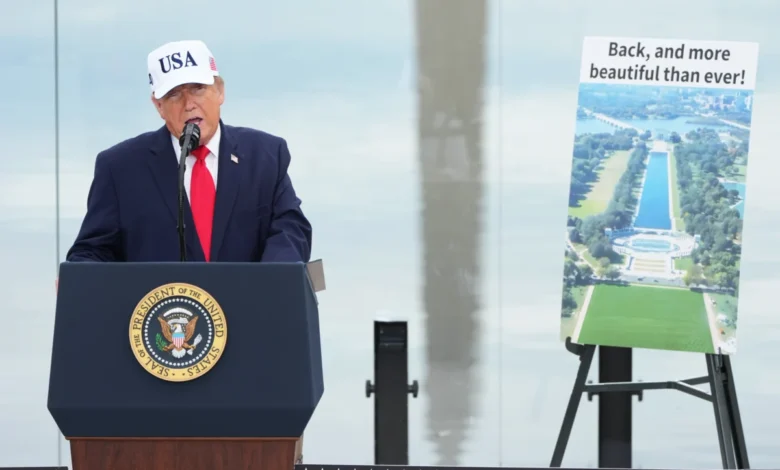
Utilizing large poster boards on easels as visual props, the president displayed aerial photographs of the pool bearing the caption "Back, and more beautiful than ever!" At one point, he requested a printed comparison of how the landmark appeared prior to recent modifications.
The speech also included a preview of future architectural ambitions for the capital. Trump outlined plans for additional monumental projects intended to commemorate his administration, including an Arc de Triomphe-inspired arch adjacent to the Lincoln Memorial, a new golf course facility on East Potomac Park, and a statuary display titled the "Garden of American Heroes." At one point during the remarks regarding the pool’s official reopening, the president joked about renaming the landmark the "Trump Reflecting Pool," though he subsequently clarified he was jesting.
Controversy Surrounding the Reflecting Pool Renovations
The focal point of the president’s address—the restoration of the Lincoln Memorial Reflecting Pool—has been a subject of intense federal scrutiny and controversy. The project involved the installation of a $16.4 million polymer liner designed to prevent water leakage and seepage. However, the contract was awarded without the competitive bidding processes typically mandated by Congress, drawing sharp criticism from government accountability watchdogs.
Shortly after installation, the polymer liner reportedly peeled, transforming sections of the prominent national landmark into an algae-infested basin. The administration initially attributed the structural failures to vandalism, prompting federal investigations. However, a subsequent federal review concluded that the damage was not the result of malicious destruction, but rather stemmed from installation deficiencies by the chosen contractor.
Despite these findings, the president maintained during his Monday remarks that the pool had been vandalized, defending the execution of the project as a necessary correction to years of institutional neglect.
Political Climate and Midterm Electoral Pressures
The president’s decision to anchor his closing argument in Washington rather than campaigning in competitive electoral districts underscores a widening strategic divide between the White House and GOP candidates facing difficult reelection battles. Across the country, Republican lawmakers and candidates are bracing for potential electoral setbacks that could strip the party of its majority in the House of Representatives and jeopardize its control of the Senate.
Political analysts note that voter sentiment has been heavily influenced by ongoing economic pressures, including high cost-of-living metrics, persistent inflation, and fuel price volatility linked to international disruptions stemming from the administration’s foreign policy stances, particularly regarding Iran. Furthermore, economic downswings in border communities and industrial sectors, attributed by economists to ongoing tariff regimes, have complicated the GOP’s legislative defense.
Concurrently, high-profile immigration enforcement actions led by Immigration and Customs Enforcement (ICE) have generated intense debate, while ethics controversies involving federal spending and executive branch projects have dominated news cycles. The physical transformation of Washington, D.C.—including the construction of a new White House ballroom, extensive use of gold leaf ornamentation, and modifications to cultural institutions such as the Kennedy Center—has increasingly become a focal point of political debate regarding federal priorities amid broader economic challenges.
Reframing the Midterm Choice: Accusations and Economic Claims
When the president finally pivoted to the midterm elections during his address, he characterized the opposition party’s candidate slate in stark terms, issuing stern warnings about the legislative direction of the country should control of Congress shift.
"The Democratic Party has nominated the most extreme and dangerous slate of candidates in American history," Trump stated, asserting that the opposition platform centered on open-ended immigration policies, tax increases, energy sector restrictions, and regulatory rollbacks. He warned that a shift in congressional control would reverse the economic gains achieved during his administration.
Insisting that the United States is currently experiencing a "golden age" of prosperity, the president maintained that his executive branch had fulfilled its legislative and policy objectives at an unprecedented pace. "We’ve achieved more in less than two years than any administration in American history, and I’ve kept every single promise I made except far more," Trump said. "We’ve done much more than I promised."
He urged his political base to turn out in high numbers, arguing that voter mobilization remains essential to preserving the administration’s legislative agenda. "If the people that voted for me and voted in the last election—where we had such a great victory—if they go out and vote, just a good portion of them, we will win in a landslide."
Broader Implications for Governance and the Capital Landscape
The closing address highlights a central tension in contemporary American politics: the divergence between executive priorities centered on institutional legacy, infrastructure branding, and national symbolism, and the immediate economic anxieties expressed by the electorate ahead of a crucial congressional election.
As ballots are cast across the nation, the administration’s decision to frame the midterms as an explicit endorsement of its Washington overhauls ensures that the architectural and administrative footprint of the executive branch will remain a central theme of political discourse. Whether voters choose to reward the administration’s restructuring of the capital or penalize the party in power for broader economic strains will be answered as election results unfold across the country.