The Melbourne International Jazz Festival: A Quarter-Century Legacy of Global Rhythms and Local Innovation

The Melbourne International Jazz Festival (MIJF) has, over the course of 29 years, solidified its status as the primary gateway for international jazz talent into the Asia-Pacific region. Serving as a vital hub for artists touring from the United States, the United Kingdom, and Europe, the festival facilitates a circuit that includes smaller-scale jazz events in Auckland, Sydney, Adelaide, and Perth. By providing a platform for cross-cultural exchange, the MIJF has become an essential pillar of the international jazz calendar, fostering audience development while simultaneously acting as a catalyst for local musical innovation.
A Decade of Evolution and Scale
The 2026 iteration of the festival spanned ten days and showcased an ambitious breadth of programming, featuring 550 artists from 18 countries across more than 30 venues. While the sheer diversity of the lineup served to engage a wide spectrum of musical preferences—supported by an expanded free concert series—the festival’s expansive footprint also presented logistical challenges. Observers noted that while the festival succeeded in accessibility, many attendees engaged with only a fraction of the total events, highlighting the MIJF’s ongoing struggle to achieve the same ubiquitous cultural saturation as Melbourne’s other major international events, such as the Melbourne International Comedy Festival.
The Opening Weekend: Tradition Meets Contemporary Soul
The festival’s major outdoor concert, strategically moved to the opening weekend, featured the Teskey Brothers. As a jazz-adjacent act capable of drawing crowds exceeding 6,000, the brothers’ performance underscored the festival’s strategy of balancing genre-purity with commercial viability. Their set, which served as both a debut of forthcoming material and a tenth-anniversary celebration of their breakthrough record Half Mile Harvest, resonated deeply with a loyal local audience.
Supporting this performance was funk legend Fred Wesley and the New JBs. Wesley’s presence provided a critical historical bridge to the origins of the genre. Backed by an ensemble featuring drummer Bryan Morris, whose technical precision and youthful intensity mirrored the performances of other emerging talents throughout the festival, Wesley demonstrated the enduring relevance of his James Brown-era horn arrangements. His performance served as a stark reminder of the festival’s commitment to honoring the architects of modern jazz and funk.
Curating the Modern Jazz Experience: The JazzLab Template
A central figure in the festival’s structural evolution is artistic director Michael Tortoni. A long-standing fixture in Melbourne’s jazz scene since 1992, Tortoni has refined the art of venue management. The 2017 relocation of the iconic Bennetts Lane Club to the Brunswick district, rebranded as JazzLab, has provided the MIJF with a permanent, world-class home. By incorporating tiered viewing, optimized acoustics, and specialized lighting, Tortoni has created a replicable model for late-night jazz venues, ensuring that the environment supports, rather than distracts from, the performance.
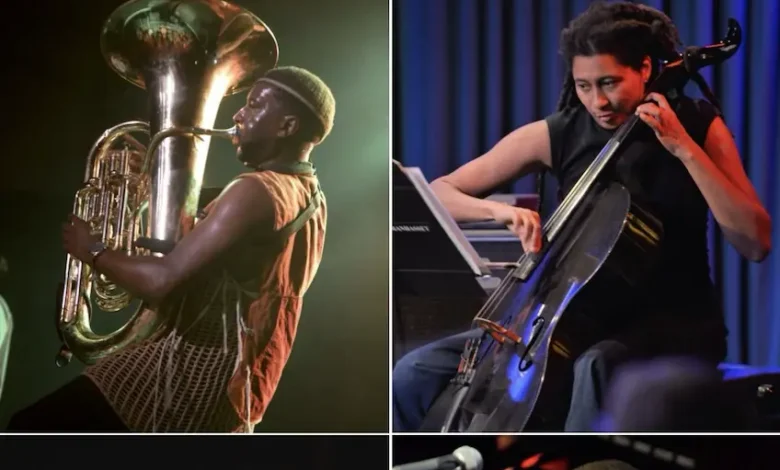
The 2026 program highlighted this focus, with particular emphasis on the contemporary scenes of New York and Chicago. The Kris Davis Trio, noted for their inventive, angular approach, set a standard for technical proficiency, while the Tomeka Reid Quartet delivered what many critics deemed the standout performance of the festival. Reid, a cellist with deep roots in the Association for the Advancement of Creative Musicians (AACM), presented a masterclass in collective improvisation. The precision of the quartet’s performance—particularly the interplay between Reid and guitarist Mary Halvorson—offered a model of mature, collaborative jazz that prioritizes mutual respect and sonic space.
Cross-Genre Narratives and Global Perspectives
The festival’s mid-size venue programming explored the intersection of poetry, narrative, and music, with a notable focus on the London jazz scene. Benedict Clementine’s Melbourne debut provided a study in theatricality and vocal dexterity. While Clementine’s performance drew inevitable comparisons to Nina Simone, his set also demonstrated the complexities of managing international hype, proving that even highly talented performers face the challenge of meeting the high expectations of a seasoned jazz audience.
Parallel to this, Aja Monet’s collaboration with the Australian Art Orchestra underscored the festival’s commitment to social and political discourse. Monet, a prominent voice in contemporary poetry, utilized the platform to champion causes such as the #Say Her Name movement. The inclusion of local drummer Ebs Daramola, who stepped in on short notice, underscored the resilience and talent of the Melbourne music community.
Complex Orchestration: The Case of Saltwater, Sugar
The festival also ventured into the realm of “scored fictional narrative” with the Australian Art Orchestra’s production of Saltwater, Sugar. Staged in Melbourne’s growing south-eastern arts corridor, the piece utilized a 16-piece orchestra to explore the history of Pacific Islander workers in 1880s Queensland. Composer Aaron Choulai’s Ellington-inspired score served as a bridge between diverse histories of struggle and resilience. While the production was noted as a work-in-progress, it highlighted the festival’s willingness to support large-scale, experimental storytelling that pushes the boundaries of traditional jazz composition.
Technical Boundaries and Global Lineups
The Melbourne Recital Centre hosted Tigran Hamasyan, whose exploration of Armenian folklore blended with heavy metal and progressive rock textures drew a capacity crowd. While the departure from traditional jazz vernacular proved divisive for some, it signaled the MIJF’s dedication to showcasing artists who are actively pushing the limits of the genre.
This spirit of boundary-pushing continued with London’s Jazz re:freshed partnership, which brought artists like Pearl Summer and Theon Cross to the city. Cross’s performance on the tuba stood out for its physicality and refusal to adhere to traditional brass-band limitations. By treating the tuba as a lead instrument, Cross provided a necessary bridge to the festival’s grand finale.
Closing the Circle: Aziza and the Future of Jazz
The festival concluded at Hamer Hall with a performance by the supergroup Aziza, featuring Lionel Loueke, Chris Potter, Dave Holland, and Eric Harland. The performance served as an institutional statement on the current state of modern jazz. By demonstrating that professional mastery and collective cohesion are not mutually exclusive with individual virtuosity, Aziza provided a definitive closure to the 2026 event.
Analysis: Economic and Cultural Implications
The MIJF 2026 serves as a microcosm for the broader challenges and opportunities facing the jazz industry. The festival’s reliance on international touring acts remains a double-edged sword: it ensures high-quality programming but necessitates significant financial investment. However, the integration of local educators and emerging artists into these international lineups creates a self-sustaining ecosystem.
Data from the 2026 festival indicates that the emphasis on multi-venue programming and the development of the Brunswick site has successfully decentralized the festival’s impact, preventing the congestion common in city-center-only events. Yet, the festival’s persistent "niche" perception suggests a need for continued outreach. While the MIJF has successfully established itself as a professional incubator, its next phase of growth likely lies in narrowing the gap between its high-brow artistic offerings and the broader public consciousness.
As the Melbourne International Jazz Festival approaches its third decade, it remains a critical nexus for the global jazz community. Its success in balancing legacy acts like Fred Wesley with contemporary innovators like the Tomeka Reid Quartet confirms that the genre, while ever-evolving, remains firmly rooted in the principles of artistic integrity and community collaboration. The festival does more than just bring international jazz to Australia; it actively constructs the future of the art form by providing the space for the next generation of musicians to test their boundaries.