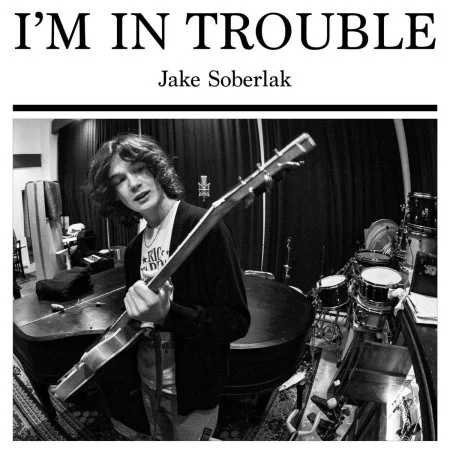
At just 17 years old, singer, guitarist, and harmonica player Jake Soberlak has firmly established himself as one of the most promising young talents in contemporary roots music with the release of his debut album, I’m In Trouble. Hailing from Kamloops, British Columbia, Soberlak has bypassed the common pitfalls of young musicians—such as overplaying and a reliance on digital overproduction—to deliver a remarkably mature, stripped-down blues record. Recorded live off the floor at Vancouver’s Afterlife Studios, the nine-song, 34-minute independent release captures a raw, organic energy that harks back to the golden era of mid-20th-century electric blues, drawing explicit comparisons to early Fleetwood Mac, B.B. King, and Peter Green.
The Genesis and Production of I’m In Trouble
The journey toward I’m In Trouble began long before the studio doors opened in Vancouver. Immersed in traditional blues from a young age, Soberlak spent his formative years in British Columbia honing his craft on the guitar and harmonica, absorbing the intricate phrasing of delta and Chicago blues masters. Recognizing the need for an authentic, unadulterated sound, Soberlak enlisted an elite lineup of seasoned Canadian session musicians to bring his vision to life.
The recording sessions took place over an intensive two-day period at Afterlife Studios, a facility renowned for its warm acoustics and vintage gear. To capture the spontaneity of a live performance, producer and drummer Leon Power—who also anchored the rhythm section—opted to record every track live off the floor. This method eliminates the clinical perfection of modern multi-tracking, leaving room for real-time musical dialogue between the performers.
The ensemble backing Soberlak features a masterclass of Canadian blues and jazz talent. Alongside Leon Power’s dynamic and nuanced percussion, the lineup includes Darren Parris, whose dexterity on both electric and acoustic bass provides a rich, thumping foundation, and Darryl Havers, whose piano work injects vibrant texture and melodic counterpoint into the arrangements. The entire project was recorded by engineer John Raham, whose meticulous microphone placement preserved the room’s natural ambiance. Finally, the master was handed over to Harris Newman at Grey Market Mastering in Montreal, ensuring that the dynamic range of the live-off-the-floor recordings remained intact across digital and physical formats.
A Masterclass in Repertoire Selection

One of the most striking aspects of I’m In Trouble is its tracklist. Rather than relying on the most overplayed standards of the blues canon, Soberlak and his backing band curated a sophisticated selection of covers drawn from the deep catalogs of genre pioneers. The album features thoughtful interpretations of songs originally penned and performed by Elmore James, Freddie King, Otis Spann, and St. Louis Jimmy Oden.
Among the standout cover choices is St. Louis Jimmy Oden’s composition, best known in its slow, mournful iteration as "Goin’ Down Slow." On this record, the song is retitled "I’ve Had My Fun" and reimagined as a jaunty, funky rumba that showcases the rhythm section’s versatility. Similarly, dipping into Freddie King’s repertoire for the track "Manhole" and Otis Spann’s "Temperature Is Rising" demonstrates a level of curatorial taste rarely found in a teenager.
Furthermore, the record pays direct homage to the slide guitar traditions popularized by Elmore James. Tracks such as "I’m Worried" and "Can’t Stop Lovin’" feature searing slide work that channels the frantic, emotional intensity of Jeremy Spencer during his tenure with early Fleetwood Mac. Havers complements these guitar-driven moments with a delightful, rolling piano solo on the latter track, proving that the collaboration within the studio was built on mutual respect and high-level musicianship.
Original Compositions and Artistic Identity
While the covers demonstrate where Soberlak’s musical education lies, his three original compositions prove that he possesses a distinct artistic voice capable of standing shoulder-to-shoulder with his historical influences.
"I Can’t Find," one of the album’s emotional peaks, utilizes a gentle, rolling shuffle punctuated by Soberlak’s evocative harmonica stylings. The track immediately recalls the mid-century recordings of Sonny Boy Williamson II, yet it feels entirely contemporary thanks to Parris’s gorgeous acoustic bass lines. The song highlights Soberlak’s restraint; rather than overwhelming the mix with rapid-fire notes, he leaves ample space for the rhythm section to breathe, demonstrating a profound understanding of dynamic tension.
Another original, "Cement Shoes," is an instrumental tour de force. Driven primarily by searing guitar lines, the track serves as an explicit nod to the Freddie King school of instrumental blues-funk, emphasizing sharp attack, heavy vibrato, and impeccable timing.

The album concludes with its title track, "I’m In Trouble," which serves as the emotional and stylistic centerpiece of the entire release. Performed strictly as a trio featuring only Soberlak on vocals and guitar, alongside Havers on piano, the song strips away all artifice. The sparse arrangement evokes the timeless, late-night atmosphere captured by Otis Spann and Robert Lockwood Jr. on their landmark recordings, most notably Otis Spann Is The Blues. Soberlak delivers the vocal lines with an open, unaffected vulnerability that belies his seventeen years, proving that emotional authenticity matters far more than technical flash.
Industry Implications and the Future of the Blues
The release of I’m In Trouble arrives at a critical juncture for the contemporary blues genre. As older generations of founding blues artists pass away, the burden of carrying the tradition forward falls heavily on young practitioners. Industry observers have long debated whether digital natives can authentically connect with an art form born out of the mid-20th-century American South.
Soberlak’s debut serves as an emphatic affirmative response to that question. By avoiding the common trap of modern blues-rock—which often relies on overdriven distortion and shredding to mask a lack of emotional depth—Soberlak has aligned himself with the British blues explosion of the 1960s. Much like Peter Green and early Eric Clapton, Soberlak approaches the genre with reverence, studying the spaces between the notes rather than trying to fill every second of audio.
Cultural analysts and musicologists note that regional scenes in Canada, particularly in British Columbia, have quietly fostered vibrant roots and blues communities. Artists like Soberlak benefit immensely from local infrastructure, including independent studios like Afterlife and a network of seasoned professional musicians willing to mentor the next generation. The cross-generational collaboration evident on I’m In Trouble—where veteran players back a teenage wunderkind without overshadowing him—provides a sustainable model for passing down oral and musical traditions.
Looking ahead, the critical acclaim surrounding I’m In Trouble places immediate expectations on the young Kamloops musician. With a self-released debut that punches well above its weight class, Soberlak has established a high benchmark for his future output. As he transitions from regional stages to broader national and international markets, the primary challenge will be maintaining this delicate balance between traditional reverence and personal artistic evolution.
For blues enthusiasts and casual listeners alike, I’m In Trouble is a mandatory listen. It proves that the future of traditional blues is in safe hands, anchored by a young man who understands that in this genre, less is almost always more.