When Viral Videos Meet Federal Aviation Law: The Ongoing Battle Between Musicians and Commercial Airlines

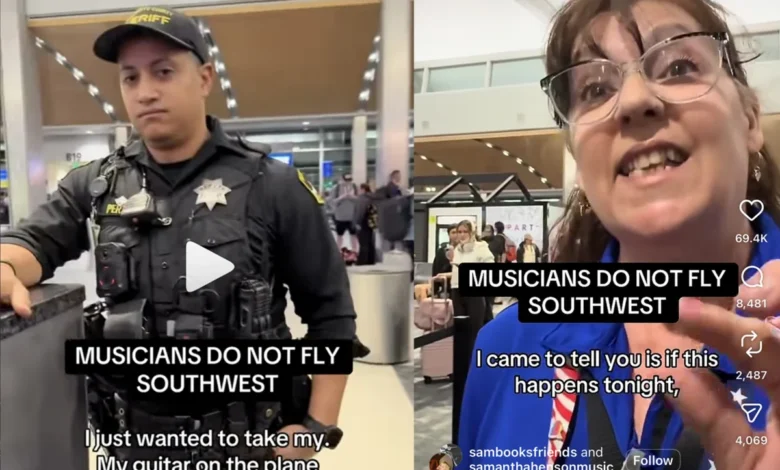
The intersection of commercial aviation policies and the rights of traveling musicians has once again sparked intense public debate following a widely circulated social media incident involving Southwest Airlines. Musician Samantha Henson was recently prevented from boarding a flight from Sacramento to Portland with her acoustic guitar, a confrontation that quickly amassed millions of views online and reignited longstanding discussions regarding the enforcement of federal regulations governing musical instruments in aircraft cabins.
This latest controversy highlights a persistent disconnect between federal law, airline gate operations, and the practical realities musicians face while touring. Despite federal mandates established more than a decade ago protecting the right of passengers to bring small instruments on board, incidents of gate agents denying instruments access to the cabin remain remarkably common.
The Incident: Sacramento to Portland
The confrontation occurred last week at Sacramento International Airport as Samantha Henson prepared to board a Southwest Airlines flight bound for Portland, Oregon. According to accounts of the incident and subsequent video documentation, a gate agent informed Henson that she would be required to check her guitar as baggage.
Henson noted that numerous passengers boarding after her were permitted to bring full-sized standard carry-on luggage into the cabin without facing similar restrictions. In an effort to resolve the dispute amicably, Henson offered several alternatives: she proposed waiting to board last to see if remaining overhead bin space was available, or alternatively, volunteering to take a later flight if space constraints proved insurmountable.
Rather than accommodating these reasonable solutions or assessing the actual cabin capacity, the gate agent escalated the situation by contacting the Sacramento County Sheriff’s Office. Responding law enforcement officers arrived at the gate, a scene captured on video that has since drawn widespread public amusement and criticism over the unnecessary deployment of police resources for a routine baggage dispute.
The viral footage underscores how rapidly customer service interactions can deteriorate when frontline personnel are either unfamiliar with applicable regulations or unwilling to exercise discretionary problem-solving.
Historical Context: A Familiar Conflict in Aviation
The friction between commercial airlines and musicians is by no means a recent development. For decades, fragile and valuable instruments subjected to traditional cargo holds have suffered catastrophic damage, leading to substantial financial losses for artists.
One of the most notable catalysts for public awareness on this issue occurred in 2008, when musician Dave Carroll watched baggage handlers toss his custom Taylor guitar onto the tarmac at Chicago O’Hare International Airport while flying with United Airlines. Upon arrival in Omaha, Carroll discovered the instrument was severely damaged. After months of unsuccessful attempts to secure compensation or an apology from customer service, Carroll produced a satirical protest music video titled "United Breaks Guitars." The video went viral globally, accumulating millions of views and resulting in a measurable, temporary decline in United Airlines’ stock value.
The incident served as a watershed moment for the music community, highlighting the urgent need for standardized protections for travelers carrying professional tools of their trade.
The Legislative Framework: The FAA Modernization and Reform Act of 2012
In response to sustained advocacy from musician coalitions and industry stakeholders, Congress enacted legislative protections under the FAA Modernization and Reform Act of 2012, which was signed into law by President Barack Obama.
Codified specifically under Section 403 of the act and further clarified by the Department of Transportation (DOT) in a final ruling issued in January 2015, the regulations explicitly govern the carriage of small musical instruments as carry-on baggage. Under Title 14 of the Code of Federal Regulations, Part 251:
- Mandatory Acceptance: Covered domestic and international air carriers must permit a passenger to carry a violin, guitar, or other small musical instrument in the aircraft cabin.
- No Additional Fees: Airlines cannot charge a fee for the instrument beyond standard carry-on baggage fees applicable to similar items.
- Storage Criteria: The instrument must be capable of being stowed safely in a suitable baggage compartment in the cabin (such as an overhead bin) or underneath a passenger seat, in accordance with Federal Aviation Administration (FAA) safety regulations.
- Availability of Space: Carriage is contingent upon the existence of actual storage space for the instrument at the time the passenger boards the aircraft.
Crucially, the Department of Transportation’s 2015 final rule established that airlines cannot force a passenger to remove a musical instrument that has already been safely stowed to accommodate the luggage of later-boarding passengers. However, because instruments are not granted absolute priority over standard carry-on bags, federal regulators strongly encourage musicians to secure early boarding positions whenever possible.
Operational Challenges and Gate Agent Disconnect
Despite clear federal guidelines, enforcement and awareness at the gate level remain inconsistent across the commercial aviation industry. Industry experts note that gate agents frequently undergo rigorous training regarding standard luggage dimensions and boarding efficiency metrics, yet training specific to specialty exemptions—such as musical instruments, medical devices, and diplomatic cargo—is often inadequate.
Furthermore, evolving aircraft interior designs present physical challenges. Many newer commercial aircraft feature modernized overhead bins designed to store roller bags vertically. While these bins maximize total capacity for standard luggage, their geometric contours and interior mechanisms occasionally feature structural dividers that prevent rigid hardshell guitar cases from fitting properly, even when sufficient volume exists.
When overhead storage is unavailable, flight crews often utilize forward coat closets to accommodate instruments. However, reliance on closet availability varies significantly based on aircraft model, route length, and the discretion of individual flight crews.
Industry Best Practices and Recommendations for Travelers
To mitigate the risk of gate conflicts, seasoned touring professionals and aviation advocates recommend several proactive strategies:
- Secure Early Boarding: Purchasing priority boarding upgrades, achieving elite frequent flyer status, or utilizing airline accommodations for passengers requiring extra time helps ensure access to overhead compartments before capacity is reached.
- Understand Aircraft Limitations: Familiarize oneself with the specific aircraft model scheduled for the flight. Smaller regional jets ("puddle jumpers") frequently lack adequate cabin storage for stringed instruments, making padded, reinforced gig bags or heavy-duty flight cases essential.
- Carry Documentation: Maintaining digital or physical copies of the DOT final rule on musical instruments provides travelers with a factual reference during disputes with uninformed personnel.
- Diplomatic Communication: Approaching gate agents with professional courtesy, rather than immediate confrontation, often yields cooperative solutions. Many musicians report success by accepting a standard gate-check tag for logistical processing down the jetway, only to store the instrument in the cabin if overhead space permits upon entry.
Broader Economic and Cultural Implications
The recurrence of high-profile incidents involving musical equipment reflects wider systemic challenges within customer service operations in the post-pandemic travel environment. With commercial flights frequently operating at or near maximum passenger capacity, gate agents face immense pressure to maintain strict departure schedules and enforce overhead bin compliance.
At the same time, for independent and mid-tier musicians who rely heavily on regional touring for their primary source of income, an instrument is not merely luggage; it is a vital professional livelihood. Damage or loss resulting from forced gate-checking can derail an entire tour, imposing severe financial and operational burdens on artists who already operate on narrow margins.
As public scrutiny intensifies through platforms like Instagram, TikTok, and YouTube, airlines face mounting reputational incentives to ensure comprehensive staff training regarding federal consumer protections. Until standardized compliance is achieved across all domestic carriers, traveling musicians will likely continue to rely on a combination of strategic planning, legal awareness, and digital documentation to protect their instruments from the cargo hold.