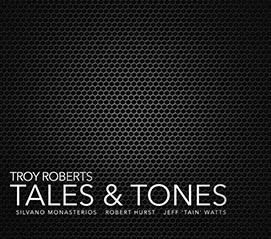
The contemporary jazz landscape is constantly evolving, driven by artists who bridge the gap between traditional bop foundations and modern, exploratory textures. Australian-born saxophonist Troy Roberts has firmly established himself as a formidable presence in this dynamic genre with his album Tales and Tones. Released to critical acclaim, the nine-track recording showcases a modern power-quartet operating at the absolute peak of its creative powers. Featuring an all-star rhythm section composed of pianist Silvano Monasterios, acoustic bassist Robert Hurst, and drummer Jeff "Tain" Watts, the album is a masterclass in dynamic contrast, polyrhythmic sophistication, and telepathic ensemble interplay.
Main Facts and Musical Architecture
At its core, Tales and Tones is an uncompromising exploration of narrative-driven jazz. The record balances high-octane, visceral workouts with moments of profound, elegiac stillness. Throughout the nine compositions—ranging from original modern standards to reimagined classics—Roberts commands both the soprano and tenor saxophones with astonishing technical fluency and emotional maturity.
The album’s opening track, "Decoration," sets an immediate, high-velocity tone, propelled by the muscular yet disciplined drumming of Jeff "Tain" Watts. Watts, a veteran of the legendary bands of Wynton and Branford Marsalis, locks in seamlessly with Robert Hurst, a foundational bassist known for his work with the Tonight Show Band and jazz greats like Stanley Turrentine. Together, Hurst and Watts form a rhythm section that provides both a sturdy anchor and a launching pad for the frontline soloists.
Pianist Silvano Monasterios completes the quartet. Monasterios navigates the sonic terrain with a chameleon-like ability, effortlessly shifting from breakneck, percussive bop lines to the delicate, impressionistic pastel hues required for the album’s more introspective ballads. The resulting synergy is a rare display of ensemble cohesion, where individual virtuosity never eclipses collective service to the composition.
Chronology and Evolution of the Project
The creation of Tales and Tones represents a significant milestone in Roberts’ rapidly ascending career. Hailed by critics as Australia’s gift to the art of jazz saxophone, Roberts has spent years cultivating his distinct voice across international stages, earning multiple DownBeat Student Music Awards and establishing residencies in the United States.
The trajectory leading up to this release involved meticulous planning and targeted collaboration. Recognizing the need for a rhythm section that could handle complex harmonic structures while pushing the boundaries of groove, Roberts assembled musicians whose combined pedigrees span decades of jazz history. The recording sessions were designed to capture the spontaneous energy of a live performance while maintaining the pristine sonic clarity expected of a modern studio release.
Chronologically, the album serves as a bridge between Roberts’ earlier, more academically inclined explorations and his current phase of mature, narrative-focused songwriting. Tracks like "Trams," "Cotu Chi Chi Chi," and "Mr. Pinononnk" illustrate a composer deeply versed in global rhythmic concepts, seamlessly weaving odd meters and complex subdivisions into accessible, swinging frameworks.
Supporting Data and Track Breakdown
The structural integrity of Tales and Tones relies heavily on its diverse tracklist, which alternates between explosive, high-tempo excursions and deeply felt, nuanced reflections.
The complete tracklisting for the album features:
- Decoration
- Trams
- Rivera Mountain
- Bernie’s Tune
- Cotu Chi Chi Chi
- Take The A Train
- Pickapoppy
- Mr. Pinononnk
- Boozy Bluesy
Among these, "Rivera Mountain" stands out as a pivotal moment of artistic revelation. Eschewing the aggressive, pummeling dynamics of the album’s heavier numbers, "Rivera Mountain" features a soft cascade of notes from Roberts’ soprano saxophone, underpinned by muted brushwork from Watts and the gentle, resonant gravitas of Hurst’s bass. Here, the musicians demonstrate restraint, replacing physical force with atmospheric resonance.
Conversely, the quartet’s treatment of Billy Strayhorn’s timeless standard, "Take The A Train," injects new life into a canonical work. By employing contemporary swing changes and elastic tempos, the ensemble pays homage to jazz history while firmly anchoring the arrangement in the twenty-first century.
Similarly, introvert-leaning pieces such as Bernie Miller’s "Bernie’s Tune" and the whimsical "Pickapoppy" allow Roberts to showcase his command of dynamic swells, romantic ritardandos, and elaborate cadential flourishes. These stylistic choices highlight a player who is as comfortable with theatrical, sweeping gestures as he is with intricate, linear bebop phrasing.
Official Responses and Critical Reception
Industry analysts, jazz educators, and contemporary critics have lauded Tales and Tones for its uncompromising artistic vision. Reviewers have repeatedly drawn attention to the rare balance Roberts strikes between intellectual complexity and visceral entertainment.
In statements regarding his approach to the saxophone, Roberts has frequently emphasized the importance of storytelling over mere technical display. "The horn is simply a vehicle to translate internal narratives into shared human experiences," Roberts noted during a recent discussion on his compositional process. This philosophy is evident in the way he responds to the rhythmic prodding of his rhythm section, maintaining a continuous, active dialogue with Watts, Hurst, and Monasterios rather than merely soloing over a static accompaniment.
Peers and collaborators have equally praised the collective work ethic of the quartet. Jeff "Tain" Watts, known for his discerning standards regarding ensemble chemistry, has highlighted the group’s unique ability to listen and react in real-time, creating a sonic environment where risks are encouraged and executed with precision. Robert Hurst’s contributions have been singled out for their harmonic depth and unwavering pulse, grounding the soaring melodic lines of the saxophone and piano.
Broader Impact and Industry Implications
The release of Tales and Tones arrives at a crucial juncture for the contemporary jazz genre. As commercial pressures often push artists toward crossover appeal or homogenized genre fusion, projects like Roberts’ quartet reaffirm the vitality of acoustic, straight-ahead jazz that embraces modern compositional sensibilities.
By uniting seasoned masters of the rhythm section with an inventive younger-generation saxophonist, the album serves as a successful model for intergenerational collaboration in jazz. This passing of the torch—not merely through mentorship, but via equal, peer-to-peer artistic partnership—ensures that the vocabulary of classic jazz is preserved while remaining receptive to contemporary innovation.
Furthermore, the album highlights the increasingly globalized nature of modern jazz. As an Australian artist making significant waves in the global jazz epicenter of the United States, Troy Roberts exemplifies the borderless exchange of talent that continues to revitalize the genre. The technical mastery and emotional depth displayed on Tales and Tones suggest that Roberts is not only a vital voice of his generation but a defining architect of jazz’s future.
As jazz continues to find new audiences through digital streaming and international festival circuits, records like Tales and Tones provide a vital anchor point. They remind listeners of the power of spontaneous human interaction, acoustic warmth, and uncompromising artistic integrity. For industry observers, the quartet’s success with this recording signals a promising trajectory, ensuring that Troy Roberts and his esteemed collaborators will remain at the forefront of the international jazz conversation for years to come.