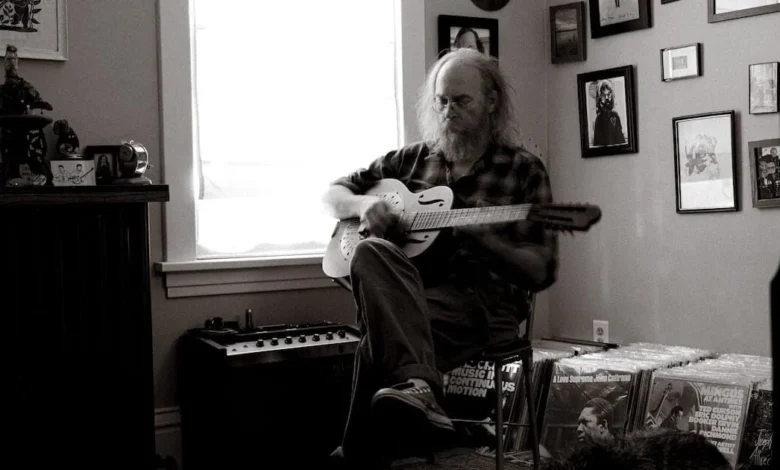
The veteran American roots and folk artist Charlie Parr has officially announced the upcoming release of his twentieth studio album, Rooming House, scheduled to debut on October 16, 2026, through the esteemed Smithsonian Folkways label. Widely recognized for his relentless touring schedule, intricate fingerpicking guitar style, and stark narrative songwriting, Parr’s latest project represents a distinct departure from standard album formats. Rather than a collection of disparate tracks, Rooming House functions as a cohesive, seven-song cinematic suite, plumbing the depths of working-class survival, generational trauma, systemic healthcare failures, and the quiet dignity found at the margins of American society.
Set against the rugged backdrop of Minnesota, the album unfolds like a meticulously framed independent film, utilizing spare instrumentation and novelistic lyricism to chronicle the lives of individuals struggling on the poverty line. Bolstered by the sophisticated, foundational drumming of Dave King—renowned for his work in the jazz avant-garde trio The Bad Plus—Parr delivers what critics and industry analysts are already projecting to be a career-defining pinnacle in a discography spanning two decades.
The Narrative Architecture of Rooming House
The structural backbone of Rooming House is rooted in a continuous, multi-decade narrative centered on a character named John. The album’s opening track, Duluth 1964, establishes an immediate and devastating dramatic premise by plunging the listener into a moment of acute childhood trauma. The song follows a twelve-year-old boy whose mother vanishes into the night without explanation, leaving him behind in a modest home.
As the narrative progresses, the boy’s upbringing is shaped by his landlady, who functions simultaneously as an employer and a surrogate mother figure. Following her passing decades later, John inherits the house and elects to rent out rooms to local community members experiencing housing instability. This domestic ecosystem serves as the physical and emotional stage for the vignettes that comprise the remainder of the suite.
Subsequent tracks utilize this setting to examine the granular realities of economic precarity. The title track employs a fly-on-the-wall perspective, capturing an evening meal preparation within the boarding house. Amidst the mundane details of daily life—such as requests to save a portion of cooked fish—the song introduces a heavy psychological and physical burden, as the narrator grapples with abnormal, sleep-depriving stomach pains.
Unlike traditional concept albums that rely on overt stylistic shifts, Rooming House maintains a unified sonic identity characterized by cyclical, hypnotic guitar patterns. Parr’s approach eschews conventional talking-blues structures in favor of Dylan-esque story songs. The repetitive, mantra-like musical phrasing allows the narrative weight of the lyrics to remain the focal point, creating an immersive auditory environment that mirrors the restricted, make-do circumstances of its subjects.
Humor, Fatalism, and Systemic Critique
While the overarching tone of the album is deeply reflective and occasionally melancholic, Parr incorporates moments of dark gallows humor reminiscent of singer-songwriter Loudon Wainwright III. This is most acutely demonstrated on the track (what’s so funny about) Universal Healthcare?.
The song juxtaposes an upbeat, bouncy musical arrangement against the grim reality of a narrator who suspects they are suffering from a life-threatening medical condition but cannot afford professional diagnosis or treatment. The track concludes with the narrator contemplating committing a minor robbery solely to ensure arrest and subsequent access to prison healthcare—a stark commentary on the fatalistic resignation induced by extreme economic marginalization.
Industry analysts note that Parr’s refusal to provide neat, artificial resolutions aligns the album with contemporary cinematic realism. The narrative does not offer facile answers to complex socioeconomic problems, mirroring the unresolved nature of poverty and aging in contemporary America.
Chronology and Conclusion
The arc of the album culminates in a closing double punch featuring Duluth 2026 and Lilliput Park. These tracks transition the narrative into the twilight years of its surviving characters, who navigate a landscape of fading memories, friendly ghosts, and an unspoken anxiety regarding the future. The largely instrumental closing piece, Lilliput Park, introduces a melancholic yet resonant fiddle melody that brings a sense of reflective closure to the suite.
With Rooming House, Smithsonian Folkways continues its tradition of championing foundational American folk expressions that document cultural and social histories. The album’s release will be accompanied by an extensive North American tour, commencing in late October 2025 and stretching through November, bringing Parr’s intricate storytelling and virtuosic accompaniment to audiences across the United States and Canada.
Charlie Parr Tour Dates (Fall 2026)
- October 30 – Minneapolis, MN – State Theatre
- November 4 – Milwaukee, WI – Vivarium
- November 5 – Green Bay, WI – Meyer Theatre
- November 6 – Berwyn, IL – FitzGerald’s
- November 7 – Chatfield, MN – Chatfield Center for the Arts
- November 10 – Nashville, TN – Exit/In
- November 11 – Asheville, NC – Eulogy
- November 12 – Carrboro, NC – Cat’s Cradle Back Room
- November 13 – Vienna, VA – Jammin Java
- November 14 – Philadelphia, PA – MilkBoy
- November 15 – Brooklyn, NY – Union Pool
- November 18 – Hamden, CT – Space Ballroom
- November 19 – South Burlington, VT – Higher Ground Ballroom
- November 20 – Toronto, ON – Horseshoe Tavern
- November 21 – Pittsburgh, PA – Club Cafe
- November 22 – Indianapolis, IN – HI-FI