Alaskan Moose Encounters Reveal the Hidden Reality of North America’s Largest Herbivores

Living in remote regions of the American North provides residents and travelers with unique opportunities to witness the raw, often chaotic behavior of wildlife in their natural habitats. Recent documented encounters in Alaska have brought renewed public attention to the sheer scale and unpredictable nature of the Alaskan moose, the largest subspecies of the moose family (Alces alces gigas). From violent, territorial clashes between massive bulls on public roadways to the surprising aquatic agility of cows crossing shallow river beds, these events underscore both the majesty and the inherent dangers posed by these animals.
The Territorial Dynamics of the Fall Rut
The Alaskan moose is a formidable presence in the state’s boreal forests, river valleys, and tundra regions. While they are primarily solitary creatures, the onset of the fall rut—occurring between late September and October—triggers a significant shift in behavior. During this period, bulls experience a surge in testosterone, transforming them into aggressive competitors.
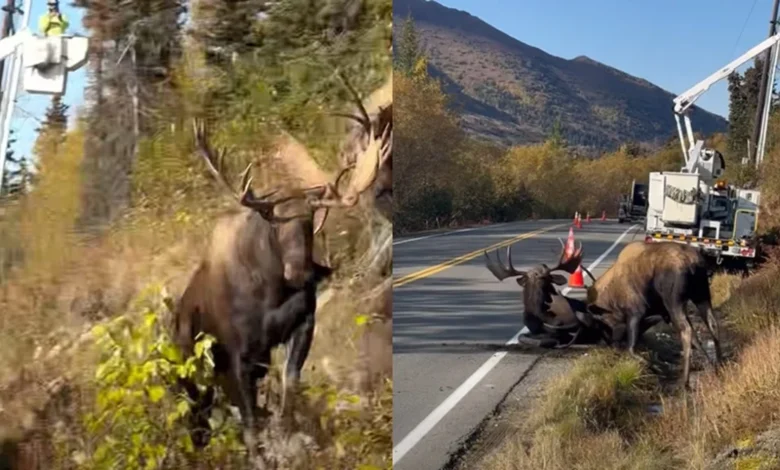
A recent incident captured on video near a roadway work site provided a visceral look at this behavior. Two mature bull moose, estimated to weigh well over 1,500 pounds, engaged in a violent physical confrontation. The brawl, which spilled onto a public road, saw the animals utilizing their massive, paddle-shaped antlers as both defensive shields and offensive weapons. Observers noted that the intensity of the struggle was reminiscent of medieval combat, with the animals pushing, pinning, and driving one another into the landscape.
Such conflicts are essential to the reproductive cycle of the species. Bulls establish dominance through these brawls, competing for access to cows. The physical toll on the participants is severe; despite their thick hides and dense musculature, these animals frequently sustain puncture wounds and blunt force trauma during these encounters. The resilience of the species is evident in how quickly they recover, often resuming their physical sparring moments after a heavy fall or a particularly aggressive charge.
Physical Specifications and Biological Adaptation
To understand why these animals appear so intimidating, one must look at their biological specifications. The Alaskan moose stands as the largest member of the deer family. On average, adult bulls stand roughly 6 to 7 feet tall at the shoulder. While average weights typically hover around 1,400 pounds, exceptional specimens can exceed 1,500 pounds.
Their anatomy is specialized for survival in harsh northern environments. Their long, powerful legs allow them to navigate chest-deep snow and traverse uneven, dense forest floors with relative ease. Furthermore, their diet, consisting of nutrient-dense willow, birch, and aquatic vegetation, provides the necessary fuel to maintain their massive frames.
Perhaps most surprising to the casual observer is their mobility in water. While moose are terrestrial, they are exceptional swimmers and have been documented moving at high speeds through shallow water. Recent footage of a cow moose traversing a water body has led to viral discussions regarding the animal’s ability to "run on water." In reality, this is a testament to the moose’s physical coordination in shallow, marshy terrain. When moving through depths of approximately one foot, the moose’s long limbs allow it to maintain high-velocity movement, creating the illusion of gliding across the surface.
Public Safety and Human-Wildlife Interaction
Despite their herbivorous diet, Alaskan moose are statistically more dangerous to humans than grizzly or black bears in the state. Their temperament is notoriously unpredictable, particularly when they feel threatened, cornered, or when a cow is protecting a calf.
The presence of these animals near infrastructure—such as highways and residential developments—poses significant risks. Because moose are large enough to total standard passenger vehicles upon impact, road safety officials consistently advise motorists to maintain significant distance. When a moose chooses to walk along a median or cross a road, it often causes traffic to grind to a halt. In several recorded instances, drivers have had to reverse their vehicles to avoid close-range encounters with bulls whose antlers alone can span up to six feet.
These interactions are not merely anecdotal. The Alaska Department of Fish and Game frequently issues warnings regarding wildlife safety, emphasizing that "wildlife is wild." When members of the public attempt to film or approach these animals, they often underestimate the speed at which a moose can accelerate, despite its size. A bull can cover significant distances in seconds, making the margin for error for a human on foot or in a car very slim.
Ecological Impact and Regional Significance
The presence of moose in Alaska is a cornerstone of the state’s ecosystem. As a primary herbivore, their grazing habits influence the growth patterns of local flora, such as willow and birch thickets. They are also a critical resource for local populations, serving as one of the most sought-after big game animals for subsistence hunting.
However, the management of these populations requires a delicate balance. As urban sprawl continues to push into the wilderness, human-moose interactions have become increasingly frequent. Infrastructure projects, such as the road work mentioned in recent viral reports, often bisect established moose migratory paths. This creates a scenario where the animals and human machinery are forced into the same space, leading to the types of dramatic confrontations that have recently surfaced on social media platforms.
Debunking Misconceptions and Linguistic Clarifications
Public fascination with these creatures often leads to misconceptions. One common error, frequently seen in the captions of viral videos, is the use of the word "meese" as the plural for moose. Linguists and biologists alike confirm that "moose" is the correct pluralization. This linguistic quirk is a small reflection of how deeply integrated the animal is into North American culture; people feel a need to categorize and describe them, even when the biological reality is simpler than the colloquialisms suggest.
Furthermore, there is a recurring sense of shock among the public regarding the sheer scale of these animals. When a moose stands next to a mid-sized SUV, the vehicle often appears toy-like. This is not a trick of the camera, but a reflection of the animal’s true height and mass. This visual discrepancy serves as a necessary reality check for those who are unaccustomed to seeing large ungulates in the wild.
Conclusion: Living Alongside Giants
The footage of moose brawling on highways or sprinting across rivers is more than just viral entertainment; it is a glimpse into the unfiltered life cycle of one of North America’s most iconic mammals. The Alaskan moose remains a symbol of the untamed North—a creature that is as graceful in the water as it is violent in the breeding season.
As human development continues to expand, the frequency of these encounters will likely rise. The responsibility falls on both the state to manage these populations and on the public to respect the boundaries of wildlife. Understanding the biological imperatives that drive a bull moose to fight or a cow to navigate water is key to fostering a safe coexistence. For now, the best advice remains the simplest: observe from a distance, remain cautious, and recognize that when a 1,500-pound animal is on the road, it always has the right of way.